Tag Archives: Yosemite

We kiss and name and praise.

I have a few hours to myself this afternoon and have been perusing a book of poetry that my husband gave me for Christmas, Dana Gioia’s Interrogations at Noon. I think I borrowed this collection from the library once, but long enough ago that even the poems I vaguely remembered are now fresh gifts — like this one on the first page.

WORDS

The world does not need words. It articulates itself
in sunlight, leaves, and shadows. The stones on the path
are no less real for lying uncatalogued and uncounted.
The fluent leaves speak only the dialect of pure being.
The kiss is still fully itself though no words were spoken.

And one word transforms it into something less or other –
illicit, chaste, perfunctory, conjugal, covert.
Even calling it a kiss betrays the fluster of hands
glancing the skin or gripping a shoulder, the slow
arching of neck or knee, the silent touching of tongues.

Yet the stones remain less real to those who cannot
name them, or read the mute syllables graven in silica.
To see a red stone is less than seeing it as jasper –
metamorphic quartz, cousin to the flint the Kiowa
carved as arrowheads. To name is to know and remember.

The sunlight needs no praise piercing the rainclouds,
painting the rocks and leaves with light, then dissolving
each lucent droplet back into the clouds that engendered it.
The daylight needs no praise, and so we praise it always –
greater than ourselves and all the airy words we summon.

— Dana Gioia

half dome 4 more sun yet
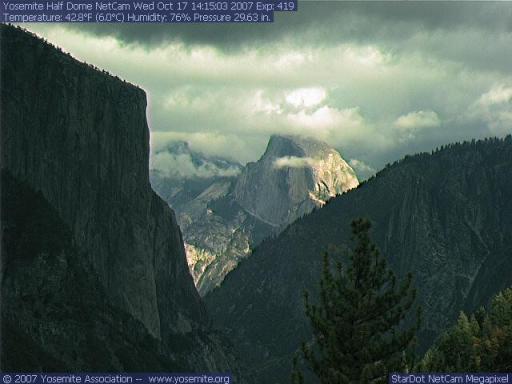
Webcam of Half Dome, Yosemite National Park

Mountain Air – smoke and writing


I returned this week from a solitary trip to the mountains, where I stayed in a cabin off the grid for four nights. I could easily write a book about my five days of journeying and lodging, probably a philosophical novel. Or would it be a how-to treatise with packing lists and suggested activities and prayers?

I’m always saying, “I could write a book about ____.” And it just occurred to me that I am always writing, as I endlessly analyze events as to their significance, and organize my thoughts, composing and reworking the lines in my mind. If I have a pencil or keyboard handy and hands free I might scribble down some of it, often in a notebook or in the margin of the book I’m reading. But the process has begun long before that.

It wouldn’t be a lie exactly, when people ask me what I do, to say, “I write.” Because I’m a process-oriented type, I can’t see a book ever resulting from my work, but no pressure — no one is clamoring for a discussion of the things in my pocket or the interrelatedness of the last ten books I read.

I thought I might do some sort of scribbling during my getaway, but I didn’t make much visible progress on my “books.” Many things that are fascinating to my self-centered self consumed my hours and my thoughts, and I do want to reflect on some of that here, hopefully without rambling on and on.


Today I just want to mention one sad thing about my experience: Smoke. The brown cinders from that horrid Rim Fire, the largest wildfire on record in the Sierra Nevada, had drifted south and made the air murky around Our Lake. One day was so bad that my eyes and throat and head hurt from the pollution. But I didn’t have to come home early, because it cleared up a little by the next morning.


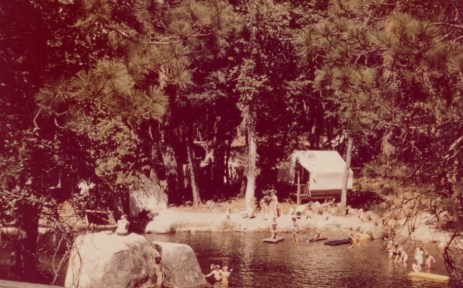
I can’t imagine what the landscape will look like, the next time we visit our beloved Yosemite and drive through the scorched forests. One thing I know: On August 25th the fire destroyed the Berkeley City Camp Tuolumne where my sisters and I as children vacationed with our grandparents.

It has been many decades since I did water ballet in that swimming hole in the Tuolumne River, or even visited the camp, and it won’t change my life that it is wiped out. But what a heartache for the people who spent dozens of formative summers in the context of that special place, and those for whom the rustic cabin life in an idyllic setting was a very recent tradition and expectation. I’m very thankful it was only smoke that invaded our family’s lake and village.

I communicate vintage style in small bits.

This week the discussion of Hidden Art of Homemaking is on chapter 9 – Writing Prose and Poetry. I haven’t kept up with the conversation at Ordo Amoris for a week or more, and for this chapter I’m just re-posting this from August 2009. Don’t be misled by the now-obsolete references to postage rates!

Old-Fashioned Correspondence


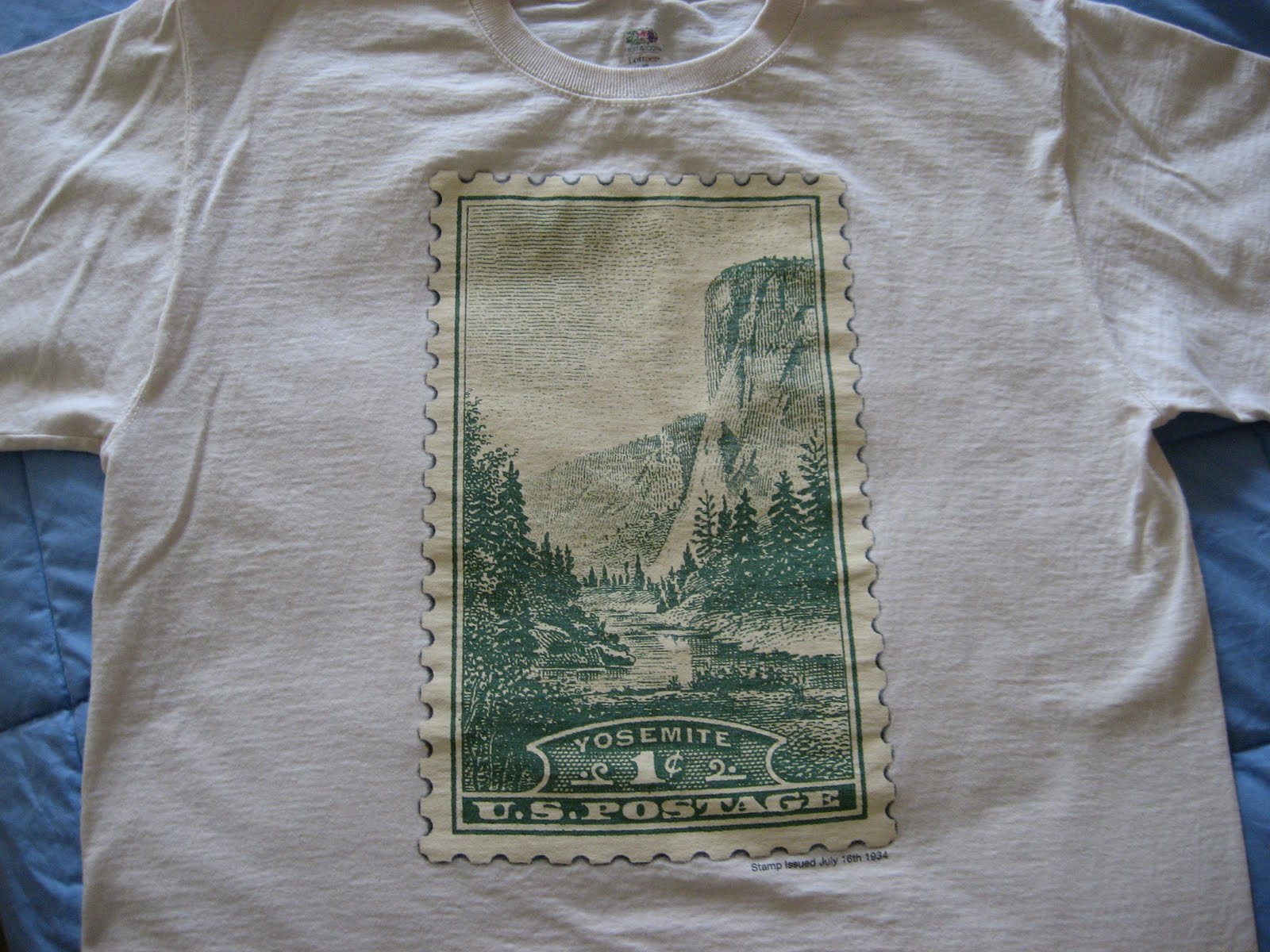
To introduce the postal theme– and for a few moments just forget about the concept of mail that can’t be carried in from the mail box in one’s real hands–I show you this T-shirt we bought in Yosemite last month, at the post office. It was the best clothing deal in the park, and an unusual and historic design: a reproduction of a stamp that was issued in 1936, showing–Yes! my beloved El Capitan! If you have ever beheld that rock I trust you won’t find its frequent appearance here tiresome.

I mostly wanted to tell about postcard-writing, and the shirt isn’t very pertinent to that…though it just occurred to me that one might buy the shirt at the Yosemite post office and then write a postcard sort of message on the fabric before mailing it in its more personalized form. I don’t think I’ll run right back there and pick up a few more, though.


When I was a child, my maternal grandmother would send postcards to me and my siblings from wherever she was traveling. I recall receiving word from Turkey, Norway, Mexico, and Hawaii. She also wrote very entertaining letters from home. As she has been a major role model for me, it’s no wonder that I feel it a natural activity as a human being to share my life in this way with those I love.

It’s easy when on a journey, away from the usual housekeeping duties, to remember friends and family and take the opportunity to let them know I do think of them. A trip just doesn’t satisfy if I haven’t dropped a dozen cards in the letter-box.

This picture was taken at the Grand Canyon. When others in our party were hiking down into the gorge one morning, I walked all over the place looking for a picnic table with a view, from which I might write my cards. That was not to be found, but in a sheltered courtyard I did find a good spot, away from wind and next to a big stone with rain water pooled in a depression on the top. I didn’t notice this rock until I was startled by a raven who swooped down to drink.

Postage “just” went up again. It now costs 28 cents to mail a postcard. On those first envelopes carrying my grandmother’s address in the corner, the stamps on the other corner said “4 cents.” I can’t imagine that a postcard was more than a penny.

One thing I inherited from my father recently was the stamps from his desk drawer. There are some pretty old ones, from when a letter was 25 cents. If they still have stickum on them I use that, and if not, I apply a little Elmer’s glue and save my pennies by using these old stamps.

I also “inherit” stamps from my father-in-law, who gets them (less and less, now that he responds infrequently) from charitable organizations that want him to send donations. They come to him already sticking to envelopes, but I cut them off and glue them on to our own bill payments. Some of my collection are in the photograph above. If you want to see the stamps up close, just click on the picture and you can see an enlarged version.

In California it seems that every town is a tourist town. At least, I find postcards in all the stores. But in some locales, the market has yet to be discovered, and I have to make my own postcards, which I learned to do from Martha Stewart, who gives us this handy template and instructions for using it. I’ve made these one-of-a-kind cards with photos of someone’s backyard, or a lake that is small and unknown, or a town that is seemingly too plain for the professional postcard people.

But why restrict this fun habit to traveling days? I started sending postcards to the grandchildren and friends any old time. A postcard is small enough that I can find time to write a few words while the iron or computer is warming up or perhaps even in the middle of the night when sleep won’t come. I don’t think old-fashioned correspondence of this sort will ever become obsolete or unwelcome.

California Mountains – Getting Over

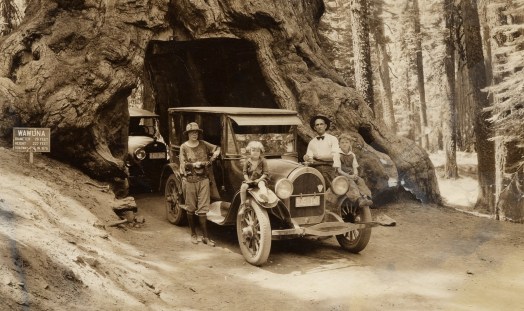
I posted this photo last summer, too!

My husband and I drove our car back and forth over the Sierra Nevada mountains this month. We had several highway options, but no matter which pass we choose to chug up I am always reminded of the forebears in covered wagons going cross-country, and the more recent grandparents driving cars like this on one-lane roads. That’s my mother in the middle of this photo taken in Yosemite.
On the Monitor Pass south of Lake Tahoe
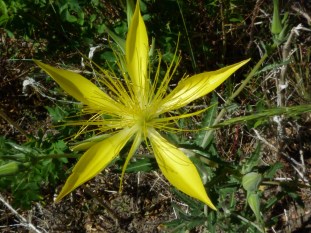
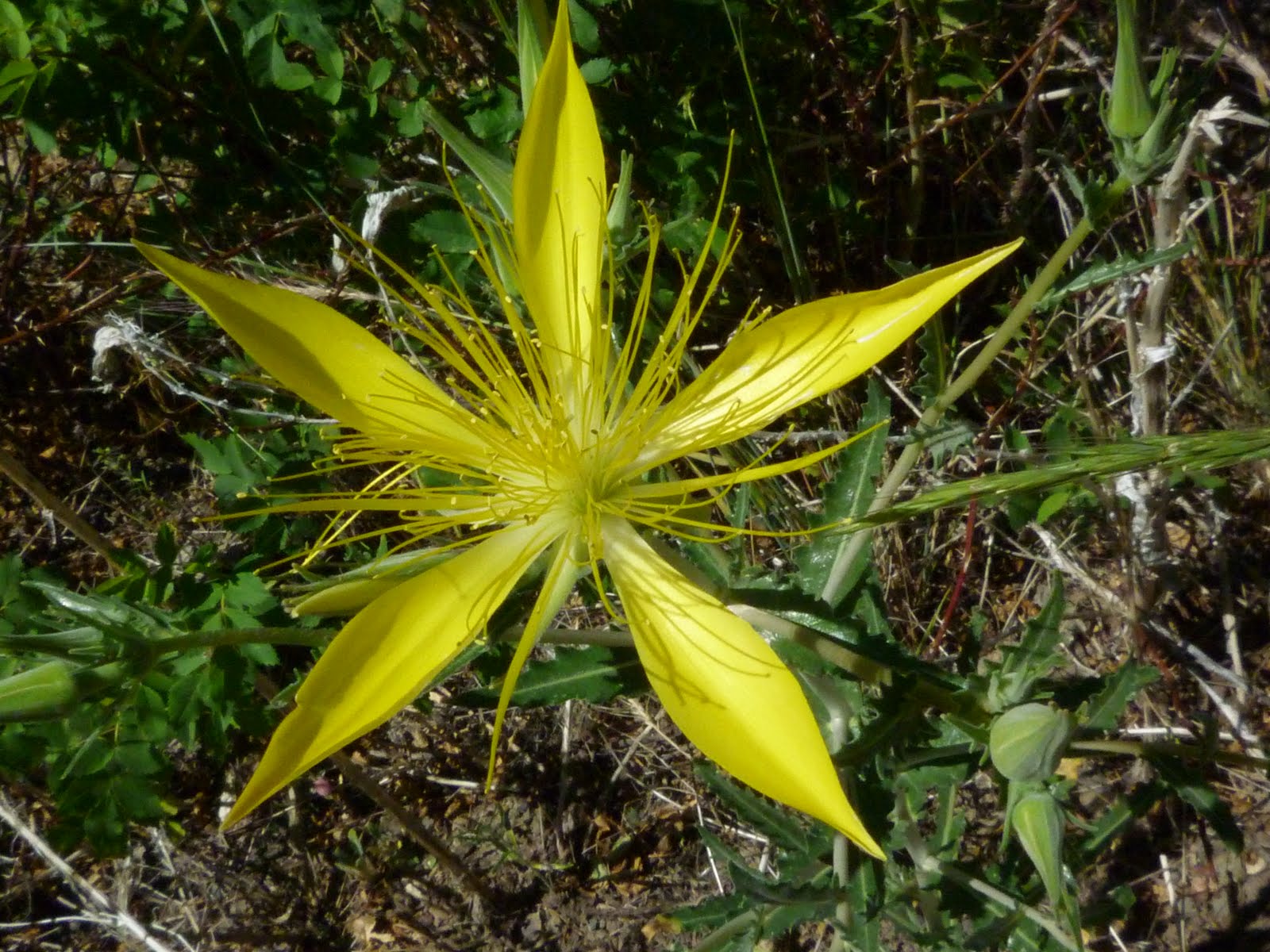
Giant Blazing Star on Monitor Pass

My little SUV has four cylinders to propel it forward, which sometimes ends up a bit slow on the steep grades, but at least we have no worries about our horses struggling through raging streams, or the possibility of our wagon tipping over or breaking a wheel on the rocks.

That is, if I can stay on the road — it’s so easy to get distracted by the wildflowers and swerve too wildly at the turnout for a photo op.

We passed over the Sierras by way of three different routes and summits this trip, and also drove over another pass that doesn’t cross those mountains.

We came at our first stop, Lake Tahoe, from the northwest, over Donner Pass. Ah, the Donner Party — what an uncomfortable story, one that raises severe ethical questions. My heart breaks for those pioneers who got bogged down and starved in the snow. Patty Reed’s Doll is a book that somehow manages to tell the tale for children. I recently gave it to granddaughter Annie for her birthday.

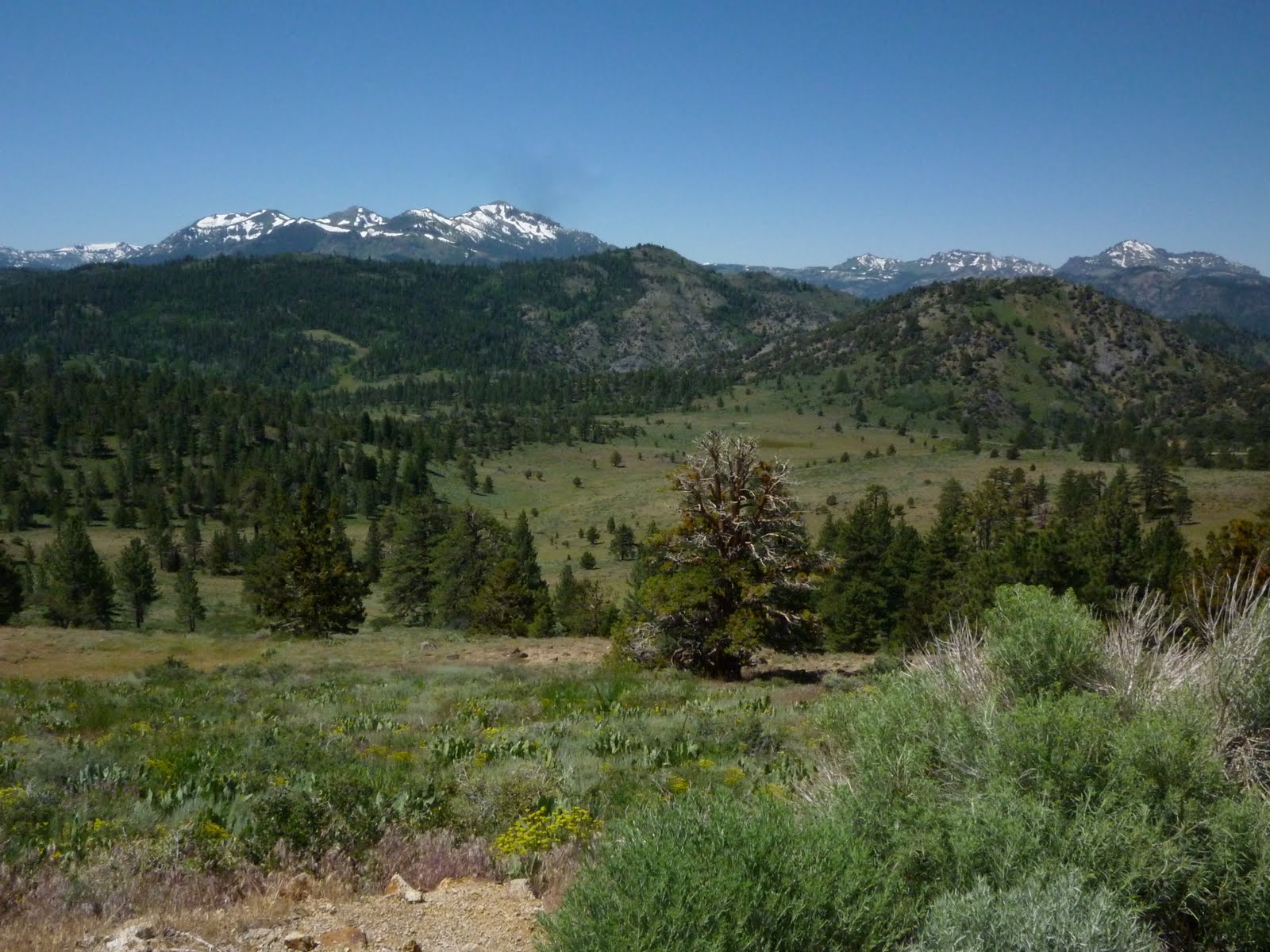
Leaving Tahoe after camping for two days, we took the Monitor Pass to the eastern side of the Sierras. Its summit is over 8,000 ft. At the top one drives through rolling “hills” as pictured above, with a mixture of meadows, conifers and sagebrush, and wildflowers galore.

Continuing south on Hwy 395 we rose above 8,000 feet again to get over the Conway Summit, a pass that doesn’t take you as the others do in a generally east-west direction, but gets you over a plateau just north of Mono Lake.

One might ask why we would want to go to all the trouble of climbing mountain passes on pavement, just to go on a hike…Why not ascend on the closer, western side? Well, if one likes to visit the highest altitudes, but doesn’t want to get sore feet walking for days, the smartest thing is to let your car do the work of getting part way up, by going over. The eastern approach is quite steep, and the Owens Valley floor itself is already aound 4,000 ft. elevation, so you’ve got a good head start if you come at the peaks from that side.

To get to our trailhead, we only had to steer upward and our four cylinders climbed over 5,000 ft. in less than half an hour. Yes, it does take us most of a day’s drive to get to the eastern side, but it would take me a week — or more likely I’d never go — to get to the same places by way of the more gradual western approach.

After our adventures on either side of the Owens Valley, we drove back up Hwy. 395 to the Sonora Pass to get home.  The sign at the top reads “9,624 feet.” It’s the second-highest pass in the Sierra Nevada, after Tioga Pass which runs through Yosemite National Park and which we won’t be traversing this year.
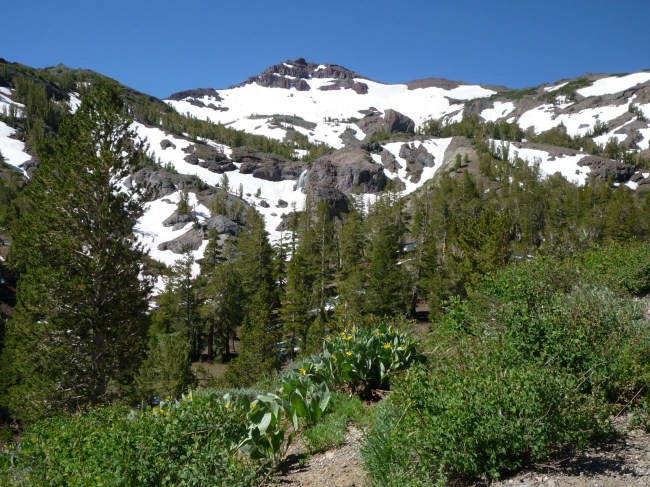
On the Sonora Pass, July 2011

It was quite beautiful up there. For the first hour or so on the highway we hardly met a car. By lunchtime we’d descended to hot lands again, and felt the mountains slipping behind us.

But I am so far ahead of myself, talking about the end of the trip when I’ve only begun to tell about the beginning. More to come soon, about our summer mountain adventures.

(next in the series: Tahoe, Rivers and a Song, Directions and Points )