Monthly Archives: November 2014

Compliance at the front door.

When my doorbell rang the other morning I whipped off my apron and dutifully went to open the door, hoping to find a neighbor with a plate of cookies or even a request for help, and not a salesman or proselytizer. Alas, it was a complete stranger, a man, holding some flyers.

He extended his hand for me to shake, and told me his name. I did not take his hand, because I don’t know a thing about him yet and we are not entering into an agreement or a social relationship. I am often this non-compliant at the front door, because I’m defensive about protecting my home territory. The threshold of our house is one place it seems important to resist those who want to be what seems to me over-familiar. I can be friendly without touching, can’t I?

Most people, on seeing that you do not want to shake their hand, will put theirs down. Not this man. He kept sticking his hand out at me, for what seemed like a minute but was in any case long enough to be very pushy and rude. Being a compliant person in all the wrong situations, I gave in and shook his hand. I was angry enough with myself afterward that it’s caused me to rehash the event and probably over-analyze it.

What do you think he wanted to sell me? He is starting a lending agency in town, and wants me to know about it and tell all my friends so that if we have to go into debt, he can be our creditor. This raises more questions about why he put so much importance on shaking hands – Was he unconsciously saying, “Shaking hands is what men of honor do, and I want you to believe I am trustworthy.” ? I would never borrow money from someone who is so unmannerly or obtuse that he would not defer to a woman at her own doorstep.

There is a point of etiquette I learned from Miss Manners some years ago about hand-shaking. Perhaps it doesn’t apply in business situations where women want in many ways to be treated just like men, but I don’t live in that world. The rule is, if a man and a woman are meeting, it is up to the woman to extend her hand first, if she wants to shake hands. The man should wait to see if she offers her hand; if she doesn’t, they don’t shake. It’s doubtful Mr. Moneylender reads Miss Manners, but really, even if a man extended his hand to another man, and he didn’t take it, would any sensible guy keep his out there waiting?

After my visitor departed, with me wishing him a friendly, “Good luck!” — See how compliant I am? — it occurred to me that with someone who is that bold, I should have been bold as well. I might have taken a moment to give him some tips on the proper and courteous way to behave if one is selling oneself door-to-door. Well, maybe next time…but I hope I never have the opportunity.
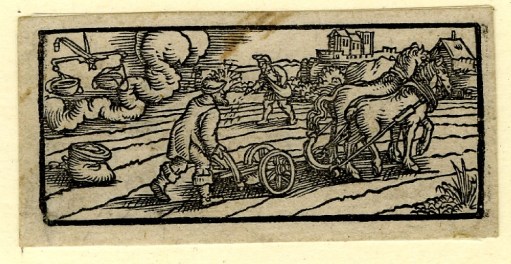
Collis stands on a dunghill.

I have no objection whatever to standing on a dunghill. There is no place where I am more content to stand. But for how long? That’s the question. The dunghill today is rightly celebrated by poet, by prophet, and by priest. It is numbered amongst the highest riches of a land. I never feel better employed than when dealing with one. Thus engaged I can qualify for the approval of Sir Albert Howard and the tributes of statesmen, while also providing a perfect subject for a woodcut. True. But consider the reality. It is 2 p.m. There are three and a half hours to go. There is an icy wind. Also a drizzle. There is no one to talk to, and if anyone turns up there will be nothing to talk about. Though I am ‘close to the earth’ the dunghill soon ceased to be anything but an object, heavy and clogging. One wonders ‘what is the time?’ Alas — only 3.15!

–John Stewart Collis in The Worm Forgives the Plough

woodcut 16th cent Brit Museum
Woodcut from British Museum collection – 16th century

pieces and versions of gingerbread

Mr. Glad and I were taking a walk along the bike path yesterday afternoon when he noticed a sweet aroma in the air. “Gingerbread or something like that,” he guessed. Ah, gingerbread, I thought, that is just the thing for a birthday cake tonight.

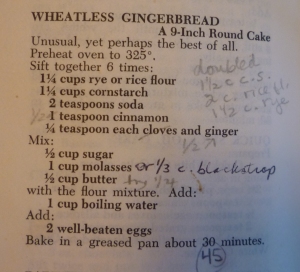
Our friend May was going to be at our house for dinner and I had planned a belated birthday celebration; when we got home I began to put this one together. It’s the recipe I’ve used most often for 40+ years, the original idea of “Wheatless Gingerbread” found in Joy of Cooking.

I wrote about my history with that cookbook last year, and my intention to get the latest edition, which I have since done — actually, it was a gift from my husband — partly because it is the 75th Anniversary Edition. This book includes many recipes from previous editions, plus many new and modern ones, and I do like it. So far my only complaint is the sans serif font that it is printed in.Wheatless Gingerbread in Joy

But it doesn’t have this strange recipe that I customized into many incarnations, hoping to make it ever healthier and more to my liking. Always I was trying to make pastries and baked goods less sweet because that way you can also better taste the butter and everything else.

(It just occurred to me that if you make your cakes too sweet you also won’t be able to be as discerning as Bettie Botta of tongue twister fame, who “said this butter’s bitter if I put it in my batter it will make my batter bitter but a bit of better butter will make my bitter batter better.”)

The last version before this had been enough to fill a lasagne pan, because healthy gingerbread is something you can’t have too much of, if you have at least a couple of hungry kids around. But! Now we don’t have any of those – so last night I made yet another improved version, cutting the old quantities in two again. Also, May can’t eat milk products, so I substituted coconut oil for the butter in this one.

The original recipe that called for cornstarch had the most tender and crumbly texture, and even this improved cake does not hold together well (as we found last night!). Especially if it’s children who will be eating it, either have a dog to lap those tasty crumbs off the floor, or take the cake outdoors for a picnic.

Wheatless Gingerbread

1/3 cup coconut oil
1/3 cup dark molasses
1/2 cup sugar
1 cup boiling water
3 extra-large eggs
1 1/2 cups whole rye flour
1 cup brown rice flour
2 teaspoons baking soda
2 teaspoons ginger
1/2 teaspoon cinnamon
1/2 teaspoon cloves

Put the oil, sugar and molasses in a bowl and pour the boiling water over them. Stir to melt. Beat the eggs in a small bowl. Sift the remaining dry ingredients together. Add the eggs to the liquid ingredients, then stir in the dry ingredients and pour into a greased 10- or 11-cup pan.

Bake in an oven preheated to 325° for 40-45 minutes or until a toothpick inserted comes out clean.

border grey-divider-no-background-hi

When it was nearly time to serve the cake I began to tell May about my memory of a birthday cake she had made for me almost 30 years ago, and how when it broke into pieces she used extra ice cream in the seams to reassemble the pieces. This had made an extra yummy cake and no one minded a bit. We laughed about this and other evidence of our similar cooking styles.

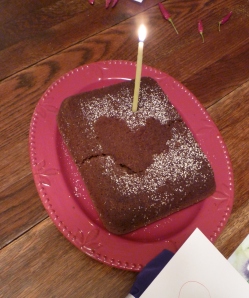
May was hovering with her camera over her cake, which made me think to remove it to a plate to make it more photogenic,May gingerbread 14 and what do you know? It broke into three pieces! May thought it a special sign of blessing that the shallow divot off the bottom was in the shape of a heart. So that it would be visible for the photo op, before I set that last piece back into place I sprinkled a little powdered sugar on the rest of the surface.
There were no complaints about our warm and homey, lovey and spicy treat. Happy Birthday, May!

Collis thinks on the land.

The author of The Worm Forgives the Plough finds that hoeing is a fairly pleasurable sort of farm work, writing of it, “I have never since had a combination of similar qualities for softening the blows of monotony.” And yet…

This job, and the previous ones, brought me up against one of the fallacies concerning agricultural work held by the citizen of our mean cities. It is supposed that ‘on the land’ you have ‘time to think’, and that conditions are such that the mind can indulge quietly in wise expansive meditations in the open air. Certainly the place to think is the open air. But not during work.

To be able to think consecutively about anything you must concentrate, and there are few jobs on the land that you can do so automatically as to be free to really think. Perhaps hoeing should be one of these. For a short time it is. Then the body interferes with the mind. The back begins to ache. You become physically preoccupied. You become tired. And then the mind, instead of being able to concentrate upon something consecutively, indulges either in fatuous daydreams or nurses petty grievances or dwells upon the worst traits of one’s least pleasant friends.

At such times I have often been appalled at my mind and wondered if others could have such rotten ones. And if a Great Idea does descend, well, I stop working to take it in, and rest on my hoe, and look across the land (as a matter of fact, I don’t: I carefully gaze on the ground in case anyone is looking — for he who gazes towards the earth presents a less agriculturally reprehensible spectacle than he who looks toward heaven).

–John Stewart Collis in The Worm Forgives the Plough

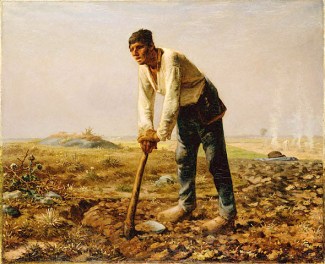
Man-witha-hoe Millet
Jean-François Millet, Man With a Hoe