Monthly Archives: September 2021

As large as alone.

Mountains are giant, restful, absorbent. You can heave your spirit into a mountain, and the mountain will keep it, folded, and not throw it back as creeks will. The creeks are all the world with all its stimulus and beauty; I live there. But the mountains are home.

– Annie Dillard
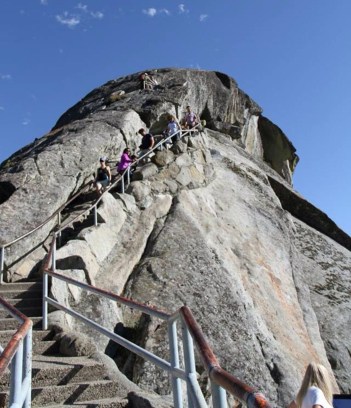
Moro Rock in Sequoia National Park – web photo

A granite dome was the focus of my mother’s most memorable hiking experience. She told me many times the story of how, at the urging of my father, she climbed Moro Rock when she was great with child (me). That is, so far, my only experience of it.

On our yearly camping trips decades later, my own children’s father would hike to the summits of other domes of rock with them, and a few of those times I was along. Lembert Dome was long my favorite, looming over Tuolumne Meadows on the Tioga Pass, in Yosemite National Park. Even at three years old Pippin could get to the top of it, with someone to hold her hand on the gradual ascent up the back slope.
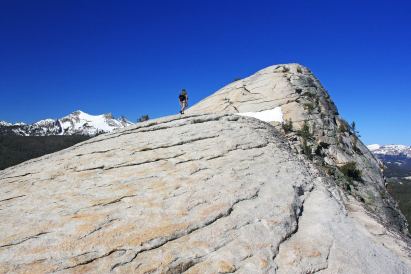
Lembert Dome in Yosemite – web photo

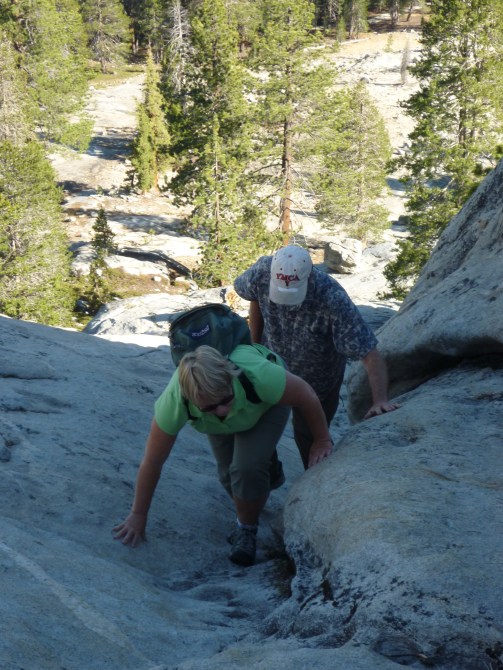
In the latter half of my life, my favorite dome is the one behind our mountain cabin. Several features of it make it accessible to me, the most important one being that I can walk to its base in a few minutes. I read recently that one summer, a small group of us climbed to the summit of this dome in the morning and again in the evening of the same day. My late husband took the picture below of our companions coming up behind him, about eight years ago. You can see why I wouldn’t want to try it alone.
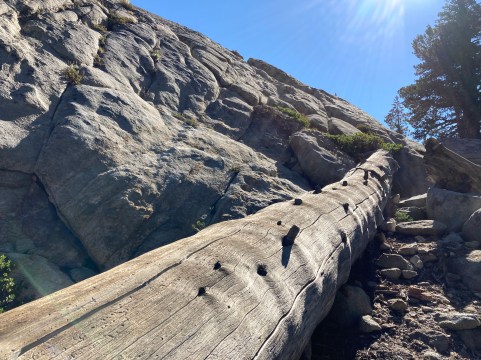
During my recent mountain retreat, I set out one morning before breakfast, thinking that I would just walk over that way to get a view of the lake from the other side of what we have nicknamed Gumdrop Dome. Within ten minutes I had changed course and decided to approach from a different direction and to do a new thing: walk all the way around the base. I came through the trees to the north side, and headed to my right, around the west side of the rock. That side is a steep wall, decorated by veins of different colored minerals, and by lichens.

I refreshed my memory just now about different types of clast, or broken rock. I think what lies there at the bottom of the wall would not be classified talus or scree, but is just plain clast. On this side you can clearly make out where the base of the dome is.

I walked along in the clast, it moved under me, and then — whoopsie! Down I went on my behind. While I sat, I thought I should take advantage of the camera angle:

It wasn’t the only time I fell. A few minutes later I stumbled forward, and scraped my hand on some of that sharp granite. My euphoria was untouched; it was such incredible good fortune, that I should find myself completely alone, yet in rich company: God, and a friendly monster of a rock. Still, I navigated more carefully after that. The boulder to the right of the pine cones in the picture below is an example of the coarsest grit of granite imaginable; and the one below it, also.

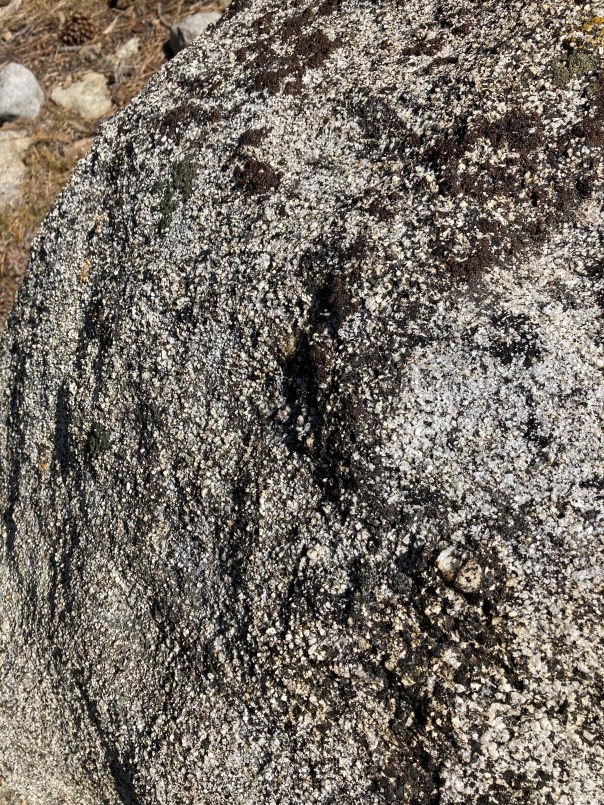
I began to search for stones, keepsakes of my solitary walk around “Gumdrop.”

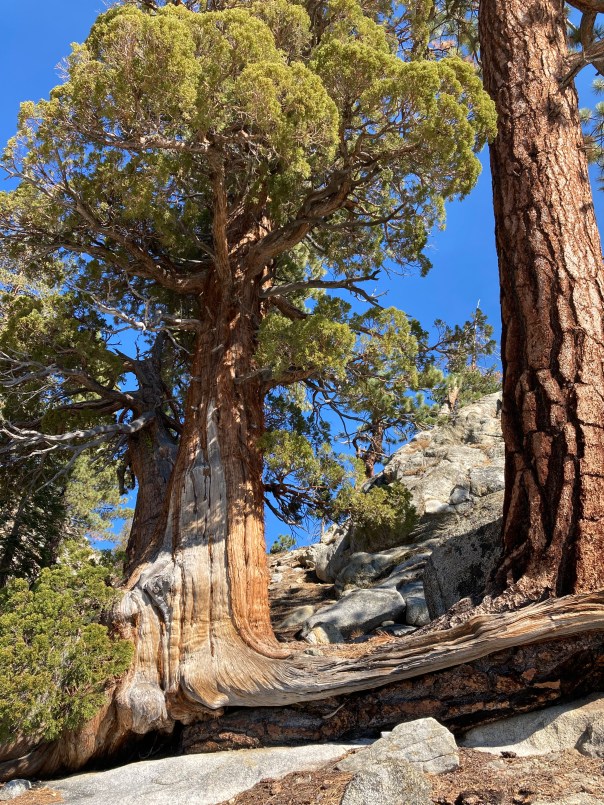
On the back side, the line between dome and not-dome is vague, as that granite face stretches away in an ever flattening  grade, down into the trees. There is still lots of rock there, but giant conifers grow out of cracks in it, and their duff lies thickly on top. Granite domes like this are called bornhardts; there are several theories about how they form.

For a long time I gazed at the wide views from my high perch, a flattish boulder-bench, and felt the cool breeze growing warmer as the sun rose to my left.

“O, Lord, how manifold are Thy works! In wisdom hast Thou made them all.”

From here you can see other domes in the distance, but of course you can’t get a good idea of what the dome you are standing on looks like. The best vantage point I’ve ever had is from the lake, as in this picture that was taken some years ago:

This area below I call the amphitheater. It’s a good place from which to watch the show!

If I had brought a snack, I might have stayed hours longer. It was all delicious and satisfying as a feast for the soul, but pure bliss was not going to prevent me getting shaky (elevation about 8500′) if I kept putting off nourishment such as was waiting for me back at the cabin; so I stood up and continued my explorations.
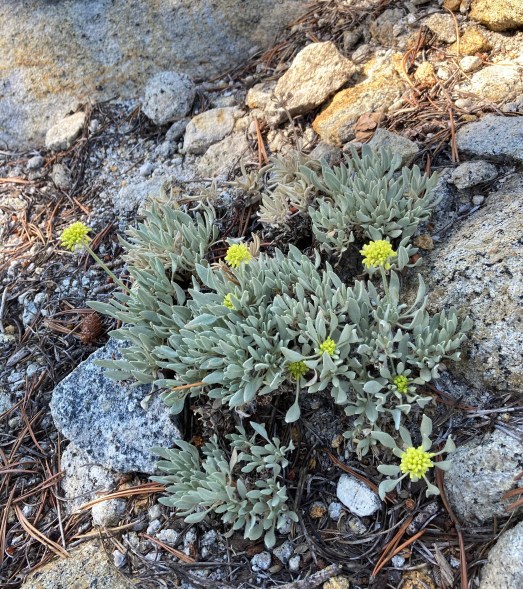
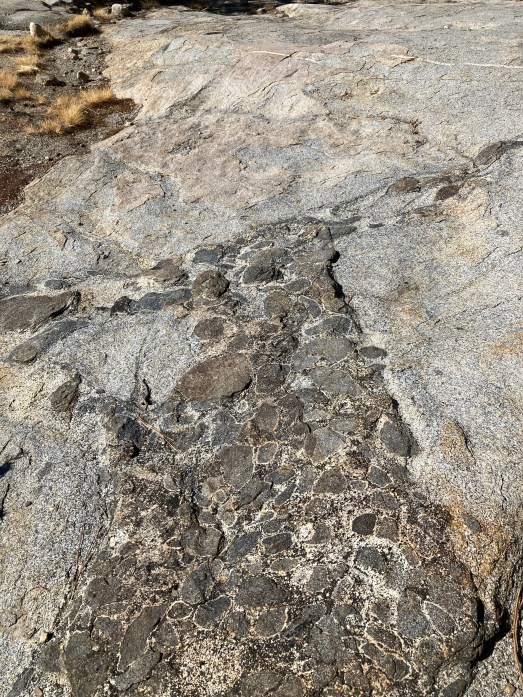
Frosted Buckwheat

This couplet below does not at all fit with the stones that I collected on the dome, as far as their smoothness, or the number of them. But the poet’s metaphor echoes somehow that of Annie Dillard at the top of this post, and they both understand what I left behind on that mountain dome, and what I brought home.

“may came home with a smooth round stone
as small as a world and as large as alone.”
-E.E. Cummings

Here is my last look at Gumdrop, when I had circled around to my starting place. From this angle it seems that it might not be impossible to climb that particular slope. I wonder…. Well, next time I have a companion, I’ll have to bring him or her to this place and give it a try! But for now, Good-bye Gumdrop! Good-bye mountains! Thank you for inviting me. I had a good time!

When the poor and needy seek water.

I drove boldly past many “FOREST CLOSED” signs on my way up the mountain earlier this week. The United States Forest Service has closed them because of the drought and fire danger. Our cabin is one of a group on a little piece of private property in the middle of the forest, so I brought along proof of ownership. There are currently no fires nearby, and the skies are clear and blue, but the air was brown-tinged a few thousand feet lower down, from the smoke that drifts in from fires in the north.

So I saw few other vehicles or people, but the hummingbirds, chipmunks and jays are more to be seen than in my recent memory. This forest family stared at me as I passed:

My sister came up for a couple of nights, and we talked until late. She drove us down to the lake bed in her “mule,” and we walked around for awhile. The part of the lake visible through the trees from our cabin showed a bit of blue water when I arrived, but the next morning it had turned to mud. The water is used for irrigation, so it’s not an unusual situation at the end of the summer, and not surprising that it would be the case this year.

As soon as I entered the forest, on the last leg of my journey, the noise and strain that had been with me on the highways began to be absorbed by the deep silence, and the fullness of presence, not only of living and growing trees and animals, but massive rocks. Those slabs and domes were here eons before the lake, and they comfort me.

Sister Nancy showed me an osprey nest when we were down at the shore/lake bed, and though it was kind of far away, I took a picture anyway. I didn’t see the greater context while I was focused on it, and was surprised when looking at my pictures later, to see what looks like a cloud picture. Just to the right of the odd blue dot is the osprey nest at the top of a tree.

Something has gone wrong with my settings on my devices, and I can’t seem to insert most of the pictures I wanted. I really don’t want to spend any more time up here fiddling with technology, so this may be my only post about my little retreat. I am hardly disappointed that the lake is so low, because The Mountains are where I am, and they are so much more. When I saw this reading for a church feast this morning, it made me think about the living waters that God provides, the Living Water that He is for our souls, no matter how dry the landscape:

Comfort ye, comfort ye my people, saith your God.  Speak ye comfortably to Jerusalem, and cry unto her, that her warfare is accomplished, that her iniquity is pardoned: for she hath received of the LORD’S hand double for all her sins. The voice of him that crieth in the wilderness, Prepare ye the way of the LORD, make straight in the desert a highway for our God. Every valley shall be exalted, and every mountain and hill shall be made low: and the crooked shall be made straight, and the rough places plain: And the glory of the LORD shall be revealed, and all flesh shall see it together: for the mouth of the LORD hath spoken it. When the poor and needy seek water, and there is none, and their tongue faileth for thirst, I the LORD will hear them, I the God of Israel will not forsake them. I will open rivers in high places, and fountains in the midst of the valleys: I will make the wilderness a pool of water, and the dry land springs of water.  Drop down, ye heavens, from above, and let the skies pour down righteousness: let the earth open, and let them bring forth salvation, and let righteousness spring up together; I the LORD have created it. Go ye forth of Babylon, flee ye from the Chaldeans, with a voice of singing declare ye, tell this, utter it even to the end of the earth; say ye, The LORD hath redeemed his servant Jacob. And they thirsted not when he led them through the deserts: he caused the waters to flow out of the rock for them: he clave the rock also, and the waters gushed out. Sing, O barren, thou that didst not bear; break forth into singing, and cry aloud, thou that didst not travail with child: for more are the children of the desolate than the children of the married wife, saith the LORD.  (Isaiah 40:1-5; 41:17-18; 45:8; 48:20-21; 54:1)

Our lake in a wetter year.

Doing sensible and human things.

Not only is my mind typically scattered to the four winds, but it is also buffeted and pushed down and downright dominated by currents of thought — and current events — that somehow turn into raging hurricanes. But in my daily life, they are only passing and mental hurricanes, so when I read this quote from my daughter Pearl, I was freshly encouraged to call frequent moratoriums on the practice of wondering whether it might be a Viking or a bomb or a car wreck that will eventually make my loved ones suffer.

“In one way we think a great deal too much of the atomic bomb. ‘How are we to live in an atomic age?’ I am tempted to reply: ‘Why, as you would have lived in the sixteenth century when the plague visited London almost every year, or as you would have lived in a Viking age when raiders from Scandinavia might land and cut your throat any night; or indeed, as you are already living in an age of cancer, an age of syphilis, an age of paralysis, an age of air raids, an age of railway accidents, an age of motor accidents.’

“In other words, do not let us begin by exaggerating the novelty of our situation. Believe me, dear sir or madam, you and all whom you love were already sentenced to death before the atomic bomb was invented: and quite a high percentage of us were going to die in unpleasant ways. We had, indeed, one very great advantage over our ancestors—anesthetics; but we have that still. It is perfectly ridiculous to go about whimpering and drawing long faces because the scientists have added one more chance of painful and premature death to a world which already bristled with such chances and in which death itself was not a chance at all, but a certainty.

“This is the first point to be made: and the first action to be taken is to pull ourselves together. If we are all going to be destroyed by an atomic bomb, let that bomb when it comes find us doing sensible and human things—praying, working, teaching, reading, listening to music, bathing the children, playing tennis, chatting to our friends over a pint and a game of darts—not huddled together like frightened sheep and thinking about bombs. They may break our bodies (a microbe can do that) but they need not dominate our minds.”

—C.S. Lewis, “On Living in an Atomic Age” (1948)

I also don’t need to spend (all my) time researching how bombs are made, or why the Vikings are so ruthless. Which is great, because it leaves more time for writing a chatty blog post to my friends, which is a very human thing to do, and I hope sensible as well.
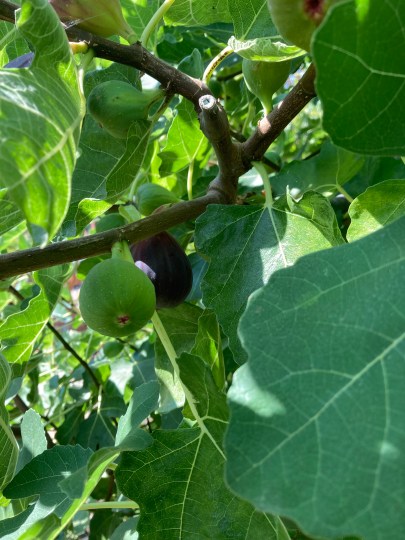
September 1st really felt like the first day of fall! It hasn’t warmed up much since, but I’m sure we will get some hot days in the next weeks. My fig tree is absolutely loaded, and one of the four winds that my mind goes to is Preparation for Preserving. Get out the dehydrator, and gear up for the harvest: pushing through the perennials and bushes that surround my tree, and stooping under the low-hanging branches to extract the plump fruits, which are revealed by contrast with the big green layers when one by one they turn black.

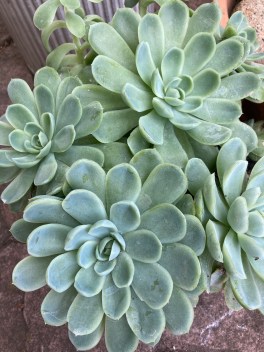
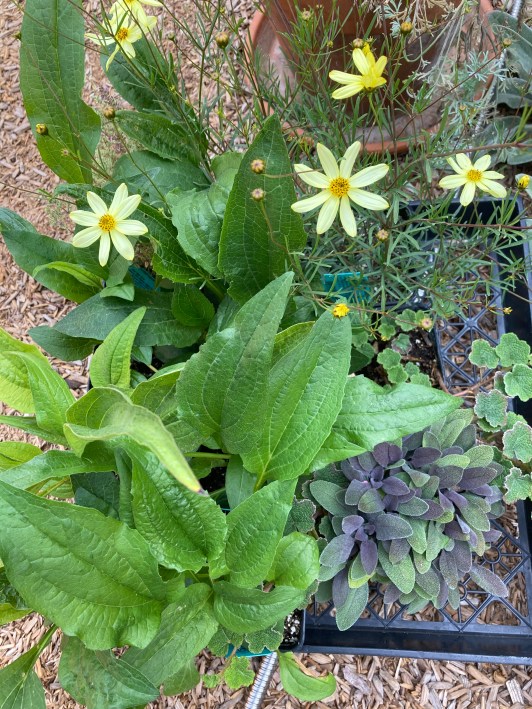
I went to a nursery the other day to lay in a supply of echinacea purpurea plants to set out this month. Some areas of my “new” landscaping need reinvigorating after six years, and I have been longing for the standard echinacea species that I used to have. The white ones in my front garden are thriving, the multicolored ones in the back are not.

A friend who was moving across the country asked if I would like any of the potted plants he’d kept on his small patio. I evidently hadn’t paid much attention to them when I’d visited his duplex, because I said I’d take them all, and was quite surprised to end up with 37 pots of plants. Three of them are quite large, and two of those are gorgeous jade plants.

So — I have more lovelies in my garden to keep me company and give me good work to do. This morning I  went out to take pictures of a couple of them to post here, and ended up watering. Not one but two blue jays were visiting my property, and adding to the ambiance with their scratchy voices that make me feel for a moment that I am in the mountains. I noticed a ripe fig, and ate that as a fast-food breakfast. Then… a few ground cherries for dessert! Ah… September.

On this morning’s wing.

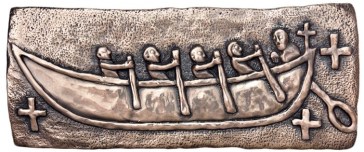
This day being the Church New Year, it seems good to imagine ourselves as pilgrims setting off across an ocean of calendar days stretching away in the distance far out of sight. Each date is a commemoration of people and events that still impart God’s love and providence to us, “whatever storms or floods are threatening.” Each rotation of the sun is a reference point on our life’s journey, and I’m glad for the chance to be in church on this feast of the First One; our parish will be singing the hymn of thanksgiving, “Glory to God for All Things.” 

THE CALL OF THE DISCIPLES

He calls us all to step aboard his ship,
Take the adventure on this morning’s wing,
Raise sail with him, launch out into the deep,
Whatever storms or floods are threatening.
If faith gives way to doubt, or love to fear,
Then, as on Galilee, we’ll rouse the Lord,
For he is always with us and will hear
And make our peace with his creative Word,
Who made us, loved us, formed us and has set
All his beloved lovers in an ark;
Borne upwards by his Spirit, we will float
Above the rising waves, the falling dark,
As fellow pilgrims, driven towards that haven,

Where all will be redeemed, fulfilled, forgiven.

-Malcolm Guite