 My father scorned Meyer lemons. Growing his own lemons made him, and all of our family, partial to the intensity of a Normal Lemon. If anyone wants to give me lemons, Meyer or otherwise, I will never turn them down, but I also prefer what I grew up with.
When I cook with lemons I usually think of my father and our trees. If as I child I ever found my father lying on the living room floor it was not because he’d been wrestling with my brother, but more like he’d been wrestling with those trees. During pruning season he’d invariably put his back out doing that necessary work on our ten acres (We had twenty more acres in oranges.) That would be more than a thousand lemon trees.
I learned to drive a tractor before I was old enough to drive a car, because Daddy needed me to pull a trailer between the rows when my sisters and I were picking the second, smaller crop of lemons that wasn’t worth hiring a whole picking crew for.
In those pictures that I retain in my mind, my brother wasn’t old enough to buckle down and help yet. He was sitting under a lemon tree crying, and the dust mixed with his tears to make a miserable face. I must say that he’s more than made up for it in the years since, and is one of the most buckled down and hardworking people on the planet.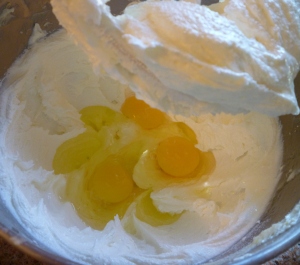
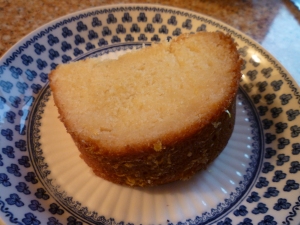
The latest thing I cooked with lemons is this meltingly appealing cake, which Mr. Glad requested for his birthday last month. That he wanted cake was very strange, because it’s been Blackberry Pie as long as anyone can remember, and a good month to be born if you want that. But I was happy to oblige with the cake, and I devoted most of one Saturday to making it, so I had plenty of time to enjoy the process.
In the past I’d only baked this glazed cake for tea parties that I used to have in a bygone era. Now that it’s been revived in my repertoire I’ll want to make it more often. It uses a lot of lemons in the form of juice, and in this recent case, even more fruits to get enough lemon zest to impart the deep lemony flavor. It can be made up to three days ahead and freezes well.
Lemon-Sour Cream Cake
INGREDIENTS:
1 3/4 cups flour
1 teaspoon baking soda
1 teaspoon baking powder
1 cup unsalted butter, room temperature
1 cup sugar
3 large or extra-large eggs at room temperature
1 tablespoon minced lemon zest
2 teaspoons lemon extract
1 cup sour cream
The Glaze:
1 1/2 cups powdered sugar
1/2 cup strained fresh lemon juice
2 teaspoons finely minced lemon zest
INSTRUCTIONS:
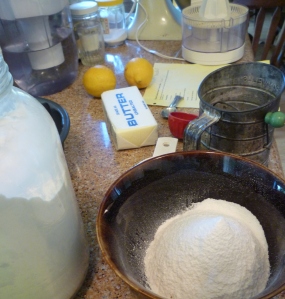
Preheat the oven to 350°. Butter and flour a 9-inch lightweight Bundt pan. Sift the flour, baking soda and baking powder together into a medium mixing bowl. Set aside.
In a medium mixing bowl, using an electric mixer on medium speed, or in a food processor fitted with the metal blade, beat the butter and sugar together until light and fluffy, about 4 minutes. Beat in the eggs, minced zest and lemon extract and mix for 2 more minutes.
Reduce the speed to low or pulse with the food processor. Add half of the flour mixture and mix until well combined. Add half of the sour cream, mixing constantly, then add the rest of the flour and sour cream, ending with the sour cream.
Pour the batter into the prepared pan. Bake for about 35-40 minutes, or until a skewer inserted into the center comes out clean. Let cool in the pan for 10 minutes, then invert onto a wire rack and remove the pan. Make the glaze while the cake is still warm.
To make the glaze, using a fine-meshed strainer, sift the powdered sugar into a small, non-aluminum bowl. Add the lemon juice and lemon zest and whisk to break up lumps.
Transfer the cake to a rack placed over a rimmed baking sheet lined with wax paper. Using a long skewer, poke holes in the cake at 1-inch intervals, almost going through to the bottom. Slowly pour the glaze over the cake, giving it time to absorb as you pour. Let the cake cool to room temperature. Cut into wedges and serve.
Every time I make this cake, about 1/4 cup of the glaze ends up on the baking sheet under the cake, and would be wasted and washed down the drain in all its precious lemonzestiness if I didn’t find a way to use it. This time I whipped some heavy cream and slowly drizzled the syrup into it at the end when it was getting nice and thick. I froze the mixture in custard cups, and ate one of them the next day. It was quite delicious!

 asked to work in Britain’s Land Army. “Since it was clear to me that I would be given some home job for which I should be entirely unfitted, I asked to be excused in favor of agriculture.”
 the contest in Half Moon Bay in Northern California. It weighed 2,058 pounds, which is not even as big as the world record set yesterday in Germany. But it currently
  Only once did anyone in our family enter a contest like this; it was Kate in ’98, and in this picture she is smiling in spite of the fact that I had stupidly broken the stem of her potential prize before it was half-grown. You are supposed to move the fruit to a pallet when it is small, and let it grow huge there, so it will still be easy to transport if it gets to be a few hundred pounds.
 Gladsome Lights