Category Archives: art

War and Architecture – Part 2

My recent posting about how cities memorialize their history in the buildings they renovate or build from scratch generated comments that added a great deal to the discussion going on in my own mind.

Emily at Back Bay View is “suspicious of postmodernists like Libeskind who want to make their patrons uncomfortable and to force them to think. Granted, trying to recreate the past too precisely sometimes results in a sentimental/themepark like effect. But, on the other hand, for how many years can you exist in/with a building that is a criticism of the human person? At some point, I would think, the discomfort will fade and the intended self-conscious effect won’t take place.

“Wouldn’t it be more healing to build structures that promote healing, rather than criticism? Couldn’t you say that the old building doesn’t represent a severe authoritarian past, so much as an orderly past, a past that preceded the Nazis by centuries, and an attempt to restore order is an act of hope? Whereas the architect who intends to break self-delusions promotes a discomfort with the self that leads not to hope but to melancholy?”

Frances informed me that Kurt Vonnegut’s novel Slaughterhouse-5 is about the bombing of Dresden, and also shared her experience of living and traveling in Germany: “I’ll always remember Freiburg, which was heavily bombed during WWII. When they rebuilt it, they used the original, medieval plans, so that it was exactly the same as before.”

Emily’s comments sent me back to the review I wrote of Architecture of Happiness, and I figured out that one basic reason I couldn’t like the new military museum was its failure to abide by the first principle of good architecture laid down in that philosophical book:
“Order. But not over-simplified. We like to see complex elements arranged in a regular pattern. What the author calls the ‘perverse dogma’ from the Romantic Period, that all edifices must be of original design, led to chaos in the landscape. ‘Architecture should have the confidence and the kindness to be a little boring.’

“I was wondering if perhaps a museum might get away with such a brash statement, where being made to think isn’t a bad thing, but you are probably right, the statement will lose its effect. (I hope in the meantime it squelches those Neo-Nazis a bit)…and yes, the jarring buildings fail to offer hope or show harmony. But without reference to or undergirding by the Christian gospel, an artist is unlikely to find those elements, and will drift from melancholy right on to nihilism.”

We have to ask, as Jody did, “If you were to rebuild Dresden and not look back, but forward, how would you go about it? I agree that “onward and forward” is the best, but would there not be little bits of the past that one would want to honor, I wonder? (not the ugly, of course)”

Emily also “…went to the Marine Corps Museum in Quantico, VA, which has a very similar slanted pyramid design which is supposed to recall the photo of marines raising the flag at Iwo Jima. (and a statue is right in front of the museum so that reference isn’t missed). But in the case of the MCM, the glass pyramid doesn’t interrupt another building like Libeskind’s design, since it’s located outside the city and rises above the treeline and catches the sunshine. So a very similar design in a different context has a completely different effect.

“Likewise, I couldn’t help thinking of another glass pyramid, the one designed by IM Pei as an additional entrance to the Louvre. I don’t know the philosophy behind it, but it just strikes me as out of context and so a little silly, like a non sequitur comment. Maybe there is some reason for its being, but it was lost on me, your average tourist.”

Kari hopes that “we can find a way to heal the past without forgetting, and to go forward in peace, love, harmony. The Holocaust brings us face to face with forgiveness and with how to forgive in the face of the unforgivable.”

I wanted to share this discussion with anyone who might have been interested in the topic but who didn’t get in on the ensuing and improving thoughts. Since I wrote the original post we had the anniversary of the bombing of Hiroshima, which got me thinking about further aspects.The Witherspoon Institute’s Public Discourse page now has an article on the subject, wherein the author points out links to the whole Allied strategy. Consequentialism is a word that was new to me, discussed here on the Witherspoon page and on Touchstone’s Mere Comments. The Ochlophobist questions our utilitarian mindset that can’t tolerate the absolute moral principle.

I’m in over my head as usual, but it’s obvious that some of my readers are good at this kind of swimming. I hope I am learning something from them as I flail about.
Architecture of War and History

The uses and abuses of architecture, that subject that interests me but which I barely dabble in, got my attention again recently through an article by George Packer in the Feb 1, 2010 issue of The New Yorker. In his “Letter from Dresden: Embers,” Packer writes that the German city “has the unstable character of a place with a romantic self-image and a past that it would rather not discuss.” But we will discuss Dresden’s past, and ask also, if its latest building project in present time is vandalism, or an enlightening statement.

Before reading Packer’s piece I was fairly ignorant about this city, but as is often the case with New Yorker articles, this one led me on several tangents. The gist of Packer’s thesis is that Dresden is well served by having a gutsy architect like Daniel Libeskind to design its new national military museum, because the artistic violence of his plan is exactly what Dresdeners need to shake them out of their nostalgia and set their view of history straight.

Since reading that article I’ve gone on to learn a little more about the architect, the city, and what took place there toward the end of World War II. I also happened to read a novel that ties in to the reluctance of Germans to talk about the war and come to grips with that painful history. Of course, I haven’t taken my own photos. But if I do get to Germany I’ll be sure to visit these buildings and write another more personal blog post. For now, I want to set down what little I learned–I should say, the questions that have been raised–and if I put it here it’s available for anyone else who might like to know.

It was on February 13, 1945 that the Allies bombed Dresden, an event that some say resembled the horror of Hiroshima, and that the Neo-Nazis brand as equal to the Holocaust. What troubles people about the Dresden of today is the city’s selective reporting of its history, the portrayal of its wartime past as only victimization.

Matthias Neutzner is a local historian interviewed for the New Yorker article: “Neutzner said that Dresdeners remained unusually resistant to the past: ‘The city was erased in one night, and it was very easy for German propaganda to transform this city of art into a city of innocence which had nothing to do with the crimes of war.’

“In Dresden, Neutzner said, the story of the war has effectively been reduced to just one day: ‘It started and it ended on February 13, 1945.’ Neutzner’s aim is to get the city’s residents to remember ‘that this was the sixth year of a huge war, that there were twelve years of Nazi crimes, there were eight small concentration camps in Dresden with three thousand prisoners. All this is completely unknown in Dresden.'”

The diaries of Victor Klemperer are held up as an essential source text for those who want the whole story. He was one of the fewer than 200 Jews who remained in the city on that day of destruction in 1945, out of more than six thousand prewar. Published in the 1990’s, the three volumes in English are I Will Bear Witness, To the Bitter End, and The Lesser Evil. Packer writes that they tell “in mundane and relentless detail how the humanistic city of his youth turned into a place of terror that ostracized, humiliated, warehoused, tortured, and, finally, annihilated its Jews.”

Since the war the city has been busy rebuilding, trying to restore architectural Dresden as much as possible to its lovely pre-war state by recreating buildings like the Frauenkirche cathedral. This activity contrasts with the attitude of another war-torn city, Berlin, where the “new architecture often has the quality of what Bertolt Brecht called Verfremdung, or the V-effect–estrangement, distancing. Berlin makes little attempt to hide the worst decades in German history. After 1989, the city placed its vanished Jews near the center of its collective consciousness, understanding that this was part of the price of reclaiming its international status.”

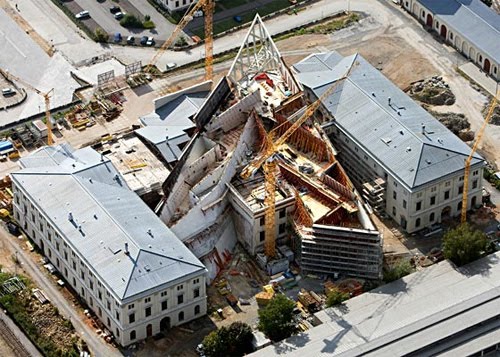
It was the Jewish Museum in Berlin, shaped, as one person said, “like a deconstructed Star of David,” that in 2001 made a name for Polish-American architect Daniel Libeskind, the one chosen to design the Military History Museum in Dresden, a renovation of the former military arsenal building that has been serving as a museum since 1897.

Not everyone likes this architect’s style. Back in 2003 Deroy Murdock cautioned against Libeskind and his art in a National Review article quoting heavily from the architect’s own words, poetic and otherwise, calling his poetry grotesque and his Berlin museum ghoulish. Murdock was lobbying against Libeskind as a contestant in the running to design the new World Trade Center in New York, and in fact, he did end up designing the overall site plan.

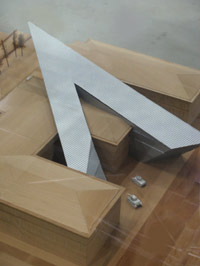
I must admit that Libeskind’s poetry strikes me as twisted and broken, not lovely. But history shows mankind to be perverse as well, and Libeskind thinks it’s healthy to face one’s past and its ugliness, so that you can get a more balanced and true understanding of reality from which to make progress. The arrow-shaped addition to the old museum, cutting through the building just as the Holocaust made a gash through the 20th Century and human history, nonetheless rises to a higher elevation where visitors will get a broad and fresh perspective on the whole city, a view that wasn’t possible from the former museum.

Spiegel Online quotes Libeskind as saying, “…sentimentality is not a foundation on which you can build a new city.” To make a sure foundation, it would be necessary to know where the bedrock is, and where the sand. The architect has built in a degree of disorienting experience a step above the mere visual. Packer writes, “The effect of these [oddly angled] inclinations, Libeskind said, should be above all physical: ‘It’s like a collapse, isn’t it? You feel it in your knees….You can’t be neutral in these spaces.'”

He goes on to say, “The triangular structure on the front of the arsenal points to the direction from which Dresden was bombed. It also interrupts the smooth flow of that big arsenal. It creates a question mark about the continuity of history and what it means. It gives people a point of reflection.”

It’s these philosophical question marks that get my mind’s wheels turning. I can see how trying to recreate the city as it was in the 1930’s would convey that you want to go back to that better time. But was it any better, the society and people who participated in the extermination of their fellow humans? Even if it were, going back is not an option. We need to live where we are now, and go forward, trying to learn from the past, even though it speaks to us of our failings.

The new military history museum is scheduled to be completed this year and to open in 2013. Studio Daniel Libeskind’s statement about the project explains: “The central theme of the Military History Museum is the human being: those who went into the war and those who have remained at home; people of different eras and people of different generations.”

As the facade of the old building “represents the severity of the authoritarian past in which it was built, the other [new “arrow” facade] reflects the openness of a democratic society and the changed role of its military. In the new elevation of the Museum both are visible at the same time and one through the other.”

Packer concludes: “…though the museum is crude architecture, its bluntness should give it power as a civic institution: nothing more subtle than this could offer Dresden the possibility to break from its self-delusions.”

Update: Comments generated a Part II to this discussion, here: Architecture of War and History, Part II

An Olive Tree is More Than Interesting

In a recent post I said that my birthday olive tree was “an interesting gift.” I suppose it was because I was dead tired that I couldn’t think of a more telling word. I’m embarrassed to use such an uninteresting word as interesting. Ugh. The truth is, to receive the gift of an olive tree on the occasion of getting older made a huge impression on me. If I hadn’t needed to finish that post quickly and make dinner…well, enough of the excuses.

I love to look at these trees, so as I was browsing them on the Internet I pasted some pictures here. Vincent Van Gogh painted several scenes of olives.

A post about olive trees was one of the first in my string of blogs. And recently on my tree-rich trip I saw old California orchards. My childhood was near the groves that made Lindsay Ripe Olives famous, though as I have mentioned, I don’t like the fruits, and my family never had an olive tree on our property. Olive oil gelato? Very West-Coast, and I would be willing to give that a try.

You can adopt an olive tree growing in Italy, like the one at top, and then receive its produce for a year. I suppose you have to adopt it, or a different one, again the next year. Not very good parenting.

Montenegro is the home of this pocked giant, which is reputed to be 2000 years old. The longevity intrigues me, along with all the Biblical references, which I haven’t even begun to think about. Mention of them often goes along with general descriptions of abundance and productivity of gardens, and with pomegranates and figs and vineyards.

There’s a story of the olive tree who was asked to be king, and the olive branch in the dove’s mouth after The Flood. Doors for the Temple were carved in olive wood. Many people make reference to it being the tree of Peace, and God knows I need that–I need Him.

What does it mean, “I am like a green olive plant in the house of my God.” ?  It means alive, if it is green. Let me flourish in Your House, O Lord. Let me live in You.

Getting back to the trees themselves, the grove I would most like to visit is this idyllic one in Turkey , the fifth-largest seller of olive oil in the world– but trying to get to second place. Olive oil I do much appreciate, and can imagine having a picnic on the warm yellow grass, of bread dipped in oil, sitting on a blanket under the sun. Once during my sojourns in that very country, I helped women in shalvar* gather olives from the ground where they’d fallen. I even sampled one of the wrinkly brined olives they cured in flat pans spread around under the trees, and had to restrain myself from immediately spitting it out.

*(I tried in vain to find a picture of these baggy pants that so many women still wore in Turkey in the 60’s and 70’s. These days a version has become high fashion, and the ones worn by chic models are not the ones I saw and wore. Perhaps this will be be the subject of a future post.)


The Garden of Gethsemane figures prominently in the events of our salvation history, into which we entered last week through the services and events leading up to Pascha. And this tree lives there. What if it is also 2,000 years old?

I planned to post this blog before Pascha, but now here we are post-Gethsemane, post-Golgotha. Wherever olive trees, any trees, are living, this week they are dancing.