Category Archives: books

Homey doings in early spring.

This month I had two occasions when friends visited me for one or two nights, two different friends each time. It was fun to have people to cook for. About an hour before the first pair of guests were to arrive I found out that one of them couldn’t eat the bread I had planned to serve with soup, because of gluten intolerance. I have just enough time to make muffins, I thought, using Bob’s Red Mill gluten-free flour again. I mixed up the wet ingredients, and then — could not find that flour anywhere.

Though I rarely bake anymore, I have a dozen sorts of flours in a refrigerator in the garage. I rummaged through those and decided to use one cup of cassava flour and one cup of buckwheat flour. The latter was the sort one would use for buckwheat pancakes, that is, from roasted groats. Some people don’t like that flavor, so I was taking a chance that my guests would.
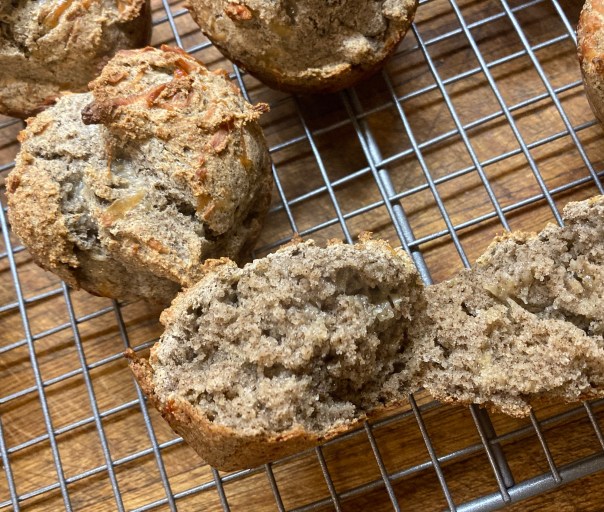
The muffins turned out very nice, we all thought. But the cassava flour is a little heavy, and I think if I try this again, I’ll use more buckwheat and less cassava. That very evening I discovered the missing flour, in the wrong refrigerator.

The last time I made pancakes I did not use buckwheat flour, but I did use this beautiful batter bowl that I received as a Christmas gift. It holds an amount of batter that is just right for one person, and its presence on my kitchen counter has encouraged me to make pancakes for just myself, for the first time ever.

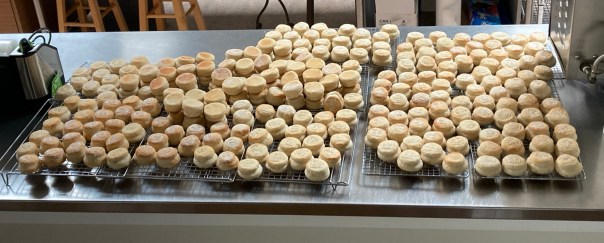
Another type of bread I helped to bake recently was the little prosphora that our parish uses as one type of altar bread at Divine Liturgy. That day we only made these small ones, and two people prepared dough. One of the dough makers used more flour than usual, and we ended up with a record number of prosphora — so while they were cooling I took their picture:
Lent is coming right up — for us Orthodox it begins on Monday. Many people I know like to choose some “spiritual reading” for Lent, and I have done that many times. Our women’s book group has often chosen a book to read together and discuss after Pascha. But this year we didn’t; we still haven’t discussed the last book we chose, to read during Advent.

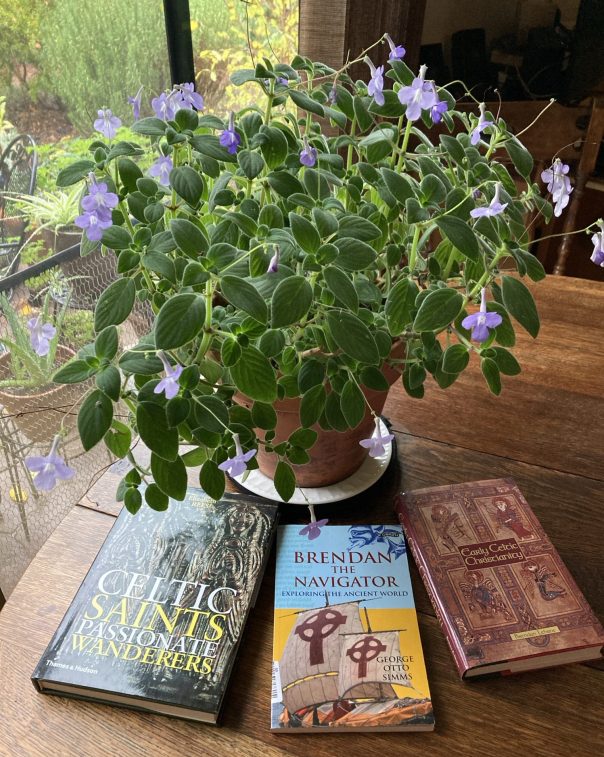
At one point I thought I would read The Seer: The Life of the Prophet Samuel and its Relevance Today during this season. And then I looked around my house and noticed so many other worthy titles. Maybe I would cast lots among these below, and let God decide for me:

But the finality of that action frightened me. It’s not likely that I will finish any of these big books during Lent anyway, because I always seem to use any extra time to attend the lovely Lenten services at church. So in the end I decided to read (from) all of them, and I’ve stacked them up next to my reading chairs as my Lenten Library; my plan is to read at least a little from one or two of them every day. Being goal-oriented does not come naturally!
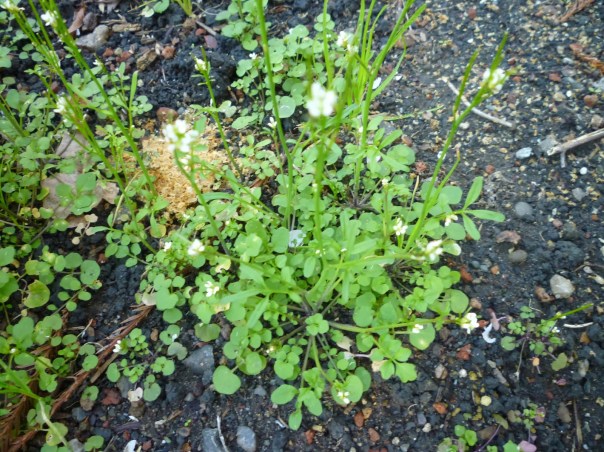
hairy bittercress

The last couple of days have been sunny at times, and the weeds in the garden are getting my attention, as they grow like weeds in springtime. So I got out there and pulled a bunch. I try to keep a thick layer of mulch on my garden to prevent weeds, but I guess I got behind in adding to that layer. I’m hoping to do that this week.

The anemones and crocuses that I planted at the end of November are starting to bloom, and the muscari and daffodils are showing leaves; obviously so late in the fall was not optimal for getting them in the ground. One reason I got busy weeding was to make sure they won’t be hindered from lifting their pretty faces to the sun. Of course, it’s good for me to do that with my own face when I get the chance, and I trust that will be the case more and more as springtime unfolds, in the earth and the air, and in these anemones.

Tea and stollen for the whirled.

Early this morning I waved good-bye to the last Christmas guests as they drove off toward home in Colorado. A few minutes later I was back in bed, and soon after that had fallen asleep while listening to Jonathan Pageau’s podcast on “Christmas: The Anchor of Reality.”
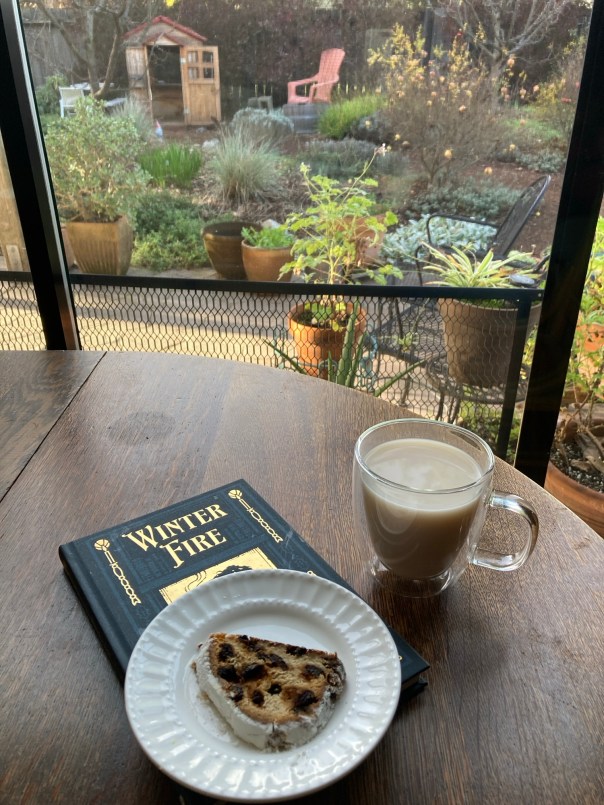
Now it’s afternoon, I just finished breakfast, and decided to try one of the new teas I received recently from Tea Runners. The grandchildren who just departed liked this one, called Winter Wonderland Rooibos. I added half and half, and served up a slice of the stollen Soldier gave me for Christmas.


I was arranging my stack of Christmas books and realized that I have not read Winter Fire during either of the Christmas seasons since I got it; it is subtitled Christmas with G.K. Chesterton, and is compiled by Ryan Whitaker Smith. So I opened its pages and browsed a little, and remembered that it is arranged as somewhat of a 30-Day Advent collection. Yet for myself I think it will be a good read in the next few days, as winter has only begun here, and I could use more meditation on the Incarnation, as I process all the events large and small that have whirled around me of late.

There are so many things I want to write about, to highlight here, of our splendid Glad celebrations over the last ten days, but at this point my head is still spinning a bit too crazily, and my heart just wants to go to church, light a candle on St. Basil’s Day and The Circumcision of Christ, and give thanks for all that God has done.

Gift from a friend at church.

I like rain and roasted onions.

Rain… rain… rain… It’s been raining All. Day. It’s night now and still raining. I’ve been exulting in it, because I didn’t have any responsibilities that required my going out. I could tend the fire, chat with my daughters online about their weather, roast onions, read, and even accomplish one housecleaning task that has been hanging over my head for months: cleaning the ceiling exhaust fan in a bathroom. Yippee!

The nodding violet that I brought indoors last week before freezing weather arrived looked so lovely with the rainy light behind it, I had to take its picture.

Sir Gawain by Howard Pyle

On the table by the violet are a few of the books I bought to go with an online course I am taking this fall: “Christian Wonder Tales.” It is taught by Martin Shaw, the mythologist and storyteller whom I met at the Symbolic World Summit last winter. Tolkien’s Sir Gawain and the Green Knight didn’t get in the picture, but is another title he recommended, and I have it upstairs.

Who knows if I will read any of these books to the end — I haven’t even finished The King of Ireland’s Son, by Padraic Colum, which is quite delightful. Also perfect for listening to, because the narrator Gerard Doyle’s Irish brogue, telling the stories-within-stories as is the custom with Irish stories, has me journeying entranced from the Irish cottage to the castle and back again, meeting mysterious characters and challenging assignments around every bend in the road.

Now to the topic of food: Back when my friend Susan was also my housemate, sometimes I would walk in the front door to another sort of captivating story, the aroma of which was the essential part. What are you cooking?? I would ask, drawn immediately into the kitchen, and it took a few repetitions of this encounter before my nose remembered what she had told me: “It’s only roasted onions!” I eventually had to start making them myself.

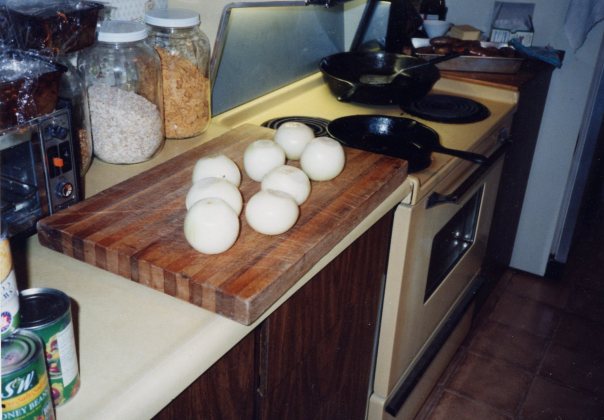
(Above, onions in my kitchen as it was 28 years ago. Notice bread rising in pans at left. The only thing that is the same now is cast iron pans always on the stove top.)

To keep up with my appetite for them, I’d need to roast a batch of onions once a week, but it ends up being more like twice a year. As soon as they are out of the oven I always serve myself a little bowl of them, which seems to be about one onion’s worth… or two — so I usually double the recipe below. Do you roast onions? You can find many recipes online; here is my version:

ROASTED ONIONS

3 large onions, yellow or red
2 tablespoons olive or other oil
1 tablespoon balsamic or other vinegar
1/2 teaspoon kosher salt
fresh ground black pepper to taste
(1 tablespoon chopped fresh thyme) – I never add this

Cut the onions vertically into quarters or sixths, and then slice those wedges crosswise as thick as you want; I make mine 1/8 to 1/3 inch thick. Toss them in a bowl with the other ingredients and roast in a sheet pan at 375 to 400 degrees for 45 minutes to an hour, stirring occasionally, until they are as brown as looks good to you. I think sometimes, in an effort to get them crispier, I have overcooked them and made them a little tough.

This evening I didn’t use balsamic vinegar, because recently I was given an extra special bottle of “plain” red wine vinegar with a noble heritage. Just as bakers like to pass their sourdough starter around to friends, so chefs and winemakers often share a vinegar mother (also called a vinegar scoby). My vinegar was fermented with a mother whose mother belonged to Alice Waters, and whose grandmother grew in Julia Child’s kitchen. Does that make my onions taste better? You know, I think they might just be the best I’ve ever made!

Apples and apples and a book.

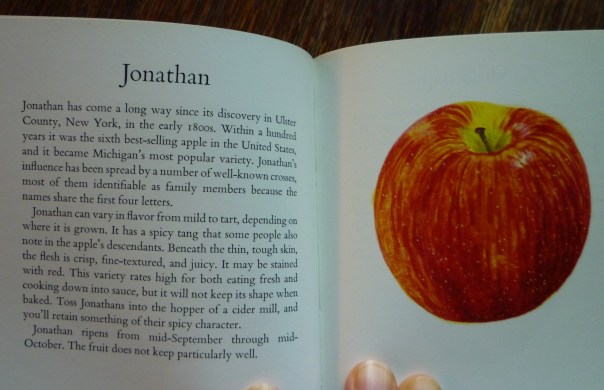
From the book Apples, by Roger Yepsen.

My kitchen and both refrigerators are overflowing with apples right now, as I recently made my annual visit to the apple farm I am so fond of. I’ve made jars and jars of applesauce to put in the freezer, at this point mostly from unpeeled Jonathans, which after it has cooked down and been put into pint jars, makes as pretty and pink a picture as I have ever had a hand in painting. It’s a good time to revisit as well this passage from a favorite novel, which I first shared ten years ago:

             – – – – – – – – – – – – – – – – – – – – – –

Willa Cather’s novel My Ántonia held a special place in the hearts of both my late husband and me, perhaps in our conjugal heart ? by reason of our sharing the story together more than once, and reading it on our own as well. When I’ve read it aloud it’s not uncommon for me to start sobbing at places in the narrative where the pathos hits home.

I was surprised to see recently a review in which the reader did not enjoy Cather’s writing, saying it was dry and lacking emotion. Those qualities might be why I appreciate her skill at capturing the story and drawing us in. Cather gives us the perspective of Jim, and we experience with him as narrator the various levels on which he is in love with our heroine and all that she represents, and he makes us fall in love with her, too.

Our differing response from the reviewer above probably has something to do with what we bring to the story. Though we haven’t lived in Nebraska or known any Bohemians, perhaps we are like Jim (and Willa Cather) in our grieving for the past, for the lifestyle of the pioneers and their farm life, for the good hardworking people we have lost; as I understand it, that was a theme that reappears in many of her works, but she accomplishes it without what might be called “emotional” prose. Mr. Glad and I both have farming in our roots, and our love for nature and the outdoors (and for people) is only encouraged and expanded by reading books like this.
I thought to transcribe some passages from the book on my blog, representative snatches for my own enjoyment and yours, as a way to savor again some moments from my reading experience, and perhaps introduce people who haven’t yet made friends with these characters and their world.

In the novel, there is no question but that Jim must leave the country life and go away to school and to city life. The passage below is from the last part of the book when he returns many years later for a visit, and I appreciate the way it conveys something of Ántonia’s character and also the mood of this season of the year.

At some distance behind the house were an ash grove and two orchards: a cherry orchard, with gooseberry and currant bushes between the rows, and an apple orchard, sheltered by a high hedge from the hot winds. The older children turned back when we reached the hedge, but Jan and Nina and Lucie crept through it by a hole known only to themselves and hid under the low-branching mulberry bushes.

“As we walked through the apple orchard, grown up in tall bluegrass, Ántonia kept stopping to tell me about one tree and another. ‘I love them as if they were people,’ she said, rubbing her hand over the bark. ‘There wasn’t a tree here when we first came. We planted every one, and used to carry water for them, too — after we’d been working in the fields all day. Anton, he was a city man, and he used to get discouraged. But I couldn’t feel so tired that I wouldn’t fret about these trees when there was a dry time. They were on my mind like children. Many a night after he was asleep I’ve got up and come out and carried water to the poor things. And now, you see, we have the good of them. My man worked in the orange groves in Florida, and he knows all about grafting. There ain’t one of our neighbors has an orchard that bears like ours.’

“…The afternoon sun poured down on us through the drying grape leaves. The orchard seemed full of sun, like a cup, and we could smell the ripe apples on the trees. The crabs hung on the branches as thick as beads on a string, purple-red, with a thin silvery glaze over them. Some hens and ducks had crept through the hedge and were pecking at the fallen apples.”

–Willa Cather

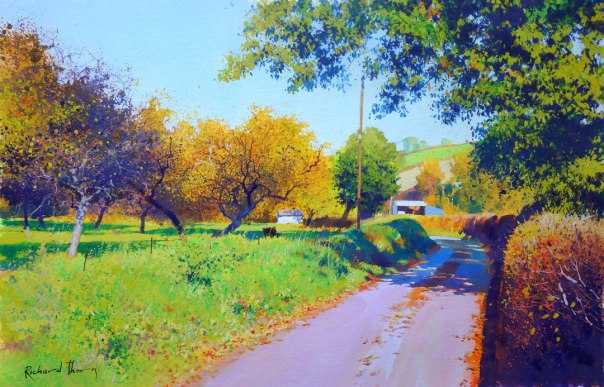
Orchardside by Richard Thorn