Category Archives: church

St. Andrew and His Cross

Where we sang this morning

Happy St. Andrew’s Day! I had the honor and joy of celebrating the feast in church this morning. Added to the usual liturgy and communion were prayers and song lifting up one of our dear elderly parishioners who died in the Lord early today. Now the memory of his repose will always be tied to this feast.

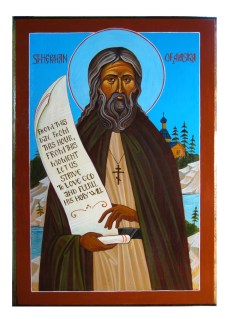
Andrew was the first of Jesus’s disciples, and centuries ago became the patron saint of Scotland and other countries. I wore my tartan plaid skirt as I always do on November 30th, and this year I had a new purple Celtic scarf to wear, recently brought from Scotland by Pearl.

Some of you might remember that I wrote about this years ago; I’m sorry to say that while trying to repost those thoughts this morning I deleted them instead. Ah, well, it turns out to be a blessing, because the accident caused me to find that just today John Sanidopoulos has written a thorough history of how it happened that the Scots chose this saint for their patron, and his cross for their official national flag.


This form of cross is called a saltire and is linked to St. Andrew because he was crucified on a diagonal cross in the first century. I learned that the first use of the X-shaped symbol was on medieval soldiers’ clothing, probably a white image on a black background. And today there are many Scottish nationalistic garments and items that hearken back to this design, like this belt buckle.


It was only in the last decade that Scotland made St. Andrew’s Day an official bank holiday. The nation also has another flag you might be more familiar with, the Lion Rampant, the unofficial national flag that belongs to the kings and queens of Scottish history. And there is the Union Flag of the entire U.K. Time was, Scotland could not legally fly its official satire on its national holiday of St. Andrew, but that sorry situation has been rectified of late.

These national days and flags have been part of the cultural consciousness since the 14th century, a consciousness that naturally changes from generation to generation. The original and deeper meanings of this cross are probably lost in the background fog of the mind of the nation.  It is encouraging to think that even if they have largely forgotten him and their Christian heritage, St. Andrew continues to pray for the people of Scotland.

A sleeping place is blessed.

When our rector went to a nearby cemetery to bless a section designated for new gravesites, I was eager to go along and be among those praying and singing. A small group of us gathered at noon after a morning of rain. The light changed often as the clouds came between us and the thin autumn sunshine. The trees cast shadows in the middle of the day, and I never took off my fleece jacket.

Not long into the service three words, “quickly flowing life,” pressed on my mind, referring to our earthly existence. It seemed the perfect time of year for this opportunity to turn our minds to death and corruption; I could see the vineyard across the street all in gold, and apples had fallen from trees all around the awning that had been set up for us.

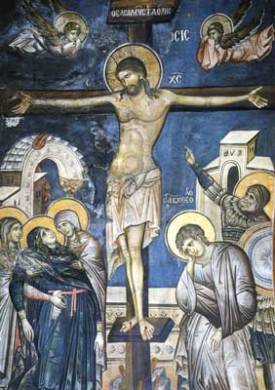
Strangely enough, my husband was in another town not far away, attending the funeral of a Christian man. His body was put into the grave at about the time we were hearing the Gospel reading, about how Joseph of Arimathea took Christ’s dead body and cared for it. Here is the account from the Gospel of John:

After these things Joseph of Arimathea, who was a disciple of Jesus, but secretly for fear of the Jews, asked Pilate that he might take away the body of Jesus, and Pilate gave him permission. So he came and took away his body. Nicodemus also, who earlier had come to Jesus by night, came bringing a mixture of myrrh and aloes, about seventy-five pounds in weight. So they took the body of Jesus and bound it in linen cloths with the spices, as is the burial custom of the Jews. Now in the place where he was crucified there was a garden, and in the garden a new tomb in which no one had yet been laid. So because of the Jewish day of Preparation, since the tomb was close at hand, they laid Jesus there.

Our bodies are temples of the Holy Spirit, and when at death our souls are separated from our bodies it is right that they be laid in the earth to await the resurrection. Fr. Alexander Schmemann (in an article that is worth reading in its entirety) makes clear what is Christian faith as regards this event:

…it is with faith or unbelief, not simply in the “immortality of the soul,” but precisely in the Resurrection of Christ and in our “universal resurrection” at the end of time that all of Christianity “stands or falls,” as they say. If Christ did not rise, then the Gospel is the most horrible fraud of all. But if Christ did rise, then not only do all our pre-Christian representations and beliefs in the “immortality of the soul” change radically, but they simply fall away.

…..

He alone arose from the dead, but He has destroyed our death, destroying its dominion, its despair, its finality. Christ does not promise us Nirvana or some sort of misty life beyond the grave, but the resurrection of life, a new heaven and a new earth, the joy of the universal resurrection. “The dead shall arise, and those in the tombs will sing for joy…” Christ is risen, and life abides, life lives… That is the meaning; that is the unending joy of this truly central and fundamental confirmation of the Symbol of Faith: “And the third day, He rose again according to the Scriptures.”

The soul won’t be separated from the body forever, but for a time the body will be as asleep, while we anticipate our rising, when we will sing with joy at the final defeat of death. Until then, this spot on the earth would be as good as any for waiting.

When the service was over, we were invited to pick as many apples as we wanted from the trees, which I think were Golden Delicious. It didn’t take me long to finish my apple. The service was less than an hour. In a couple of months there won’t be any leaves left on the vines or the apple trees, and the years of each of us are quickly flowing.

Lord, teach us to number our days, that we may apply our hearts to wisdom.

[We had no idea of it at the time, but not three years after I wrote this post, my husband joined the ranks of those waiting here for that rising.]

Correct this ugliness.

The desire to be beautiful seems to be common to mankind, but the very atmosphere of this age is toxic with something that feeds a disease, making us obsessed with our image. One part of the toxic mix is the overwhelming abundance of pictures of faces and bodies in magazines and on every electronic device, forming a kind of lesson plan on How to Look. I was happy for a respite this morning when I read St, Nikolai’s homily for the day in The Prologue of Ohrid.

HOMILY
on the beauty of Christ above all other beauty

Thou art fairer than the sons of men (Psalm 45:2).
 

Holy Scripture does not ascribe any particular value to physical beauty, and in general to anything transient. That is why everyone who reads Holy Scripture should take care to be sufficiently attentive and wise to transfer the praise of physical beauty to the soul and to spiritual values. Without a doubt, spiritual beauty gives a wondrous attractiveness to the most unattractive body, just as an ugly soul makes even the most attractive body repulsive. The Prophet David, pouring forth good words (Psalm 45:1), says to his King, the Lord Jesus Christ: Thou art fairer than the sons of men. 

The Lord Himself created His bodily cloak as He wanted. Had He wanted to appear in the world as the physically fairest of men, He could have done so. But there is nothing in the Gospel to indicate that He drew followers to Himself or influenced men by His appearance. He Himself said: the flesh profiteth nothing (John 6:63). Therefore, it is clear that David was not speaking of the physical beauty of Christ, but of His spiritual, divine beauty. This is clearly seen in the following words of the Psalmist: Grace is poured forth upon thy lips (Psalm 45:2). So it is that the unsurpassed beauty of the Son of God is not in the form and shape of His lips, but rather in the stream of grace that flows from His mouth. 

Again, the Prophet Isaiah speaks of Christ: He had no form or comeliness; and when we shall see Him, there is no beauty that we should desire Him (Isaiah 53:2-3). Do Isaiah and David agree? Perfectly well. David speaks of Christ’s inward beauty, and Isaiah speaks of Christ’s external abasement. Isaiah said that He would not be seen as a king or a rich man, but as a servant and sufferer.

O Lord Jesus Christ, Thou art fairer to us than all men and angels: glory to Thine immortal and unending beauty. O gracious Lord, correct the ugliness of our souls, which are disfigured by sin, we pray Thee.


To Thee be glory and praise forever. Amen.

The Power of a Great Melancholy

“Automat” is a picture of sadness — and yet it is not a sad picture. It has the power of a great melancholy piece of music. Despite the starkness of the furnishings, the location itself does not seem wretched. Others in the room may be on their own as well, men and women drinking coffee by themselves, similarly lost in thought, similarly distanced from society: a common isolation with the beneficial effect of lessening the oppressive sense within any one person that they are alone in being alone. In roadside diners and late-night cafeterias, hotel lobbies and station cafés, we may dilute a feeling of isolation in a lonely public place and hence rediscover a distinctive sense of community. The lack of domesticity, the bright lights and anonymous furniture may come as a relief from what are often the false comforts of home. It may be easier to give way to sadness here than in a living room with wallpaper and framed photos, the décor of a refuge that has let us down.

In this second chapter of his book The Art of Travel, Alain de Botton writes about people who travel more from an unhappiness at being home than from a desire for recreation. He includes reproductions and commentary on other paintings by Edward Hopper (whose “Automat” is the painting at the top of the page): “Gas,” “Compartment C, Car 293,” and “Hotel Room.”

The themes in the paintings here seem primarily to be isolation and loneliness, but to expand the scope of the chapter titled “Travel Places,” the author also introduces the life and writings of Charles Baudelaire, whose work was a significant influence on Hopper, it turns out.

Baudelaire

Baudelaire, who from an early age wanted nothing more than to flee from home, all his life “felt more at home in the transient places of travel than in his own dwelling.” Not that he ever seems to have escaped the restlessness he describes: “Life is a hospital in which every patient is obsessed with changing beds. This one wants to suffer in front of the radiator, and that one thinks he’d get better if he was by the window.”

My own childhood and temperament having made me a perpetual home-lover, I’m unable to fully understand these dissatisfied impulses, but I have done a bit of solitary traveling now and again. I liked it because I like being alone, but I also always had caring people on one or both ends of my journey, and a measure of peace knowing that the One Who loves me most was right with me. 

Otherwise, I might have said with Baudelaire:

Carriage, take me with you! Ship, steal me away from here!
Take me far, far away. Here the mud is made of our tears!

I’ve struggled for weeks to write on this part of de Botton’s book, knowing that the topic is really too difficult for me, but wanting to tackle it because it’s fundamental to our existence. What line divides a peaceful solitude and a painful loneliness? Can any one of us hope to understand another person’s experience of isolation? Is loneliness an essential ingredient of human life, at least a step on our way to maturity?

In this book on travel we can’t expect to find a deep exploration of these ideas. Or even a nod to the question of whether we in the 21st century experience our loneliness any differently from Hopper’s subjects. In the whole book there is not a mention of cell phones or the array of social networking tools that seem to prevent any of us from being part of a scene such as de Botton describes in the paragraph above. Perhaps it’s a deliberate omission, and he hopes to gently propel the reader back to a low-tech experience of being alone.

But being with strangers in an airport or service station nowadays likely means being surrounded by people using electronic devices that exclude them from any here-and-now community, lonely or otherwise. We know that many of them/us are doing this in an effort to have friends, to be in community, all the while missing possible opportunities to connect with people present in the same room. How might this development change the dynamics of a place like the automat?

De Botton writes about his own bad feelings being transformed while sitting in similar place, into a “gentle, even pleasant kind of loneliness,” and he values Hopper’s paintings that “allowed their viewers to witness an echo of their own grief and thereby feel less personally persecuted and beset by it.”

Hopper – Night Shadows

As I pondered the meaning of loneliness, I thought for a long time that de Botton is trivializing it. Along the way I read various writers on the subject in hopes of understanding everything better. Of course de Botton writes from his own experience, and it must be that his own feelings are not on the level of acute alienation, nor is he destitute of support, to use some synonyms. If he had known what some people feel as catastrophic and terrifying, what John O’Donohue, in Anam Cara: The Book of Celtic Wisdom, calls “…the solitude of suffering, when you go through darkness that is lonely, intense, and terrible. Words become powerless to express your pain…” I don’t know that he would make these fairly easy remedies, such as looking at paintings and riding on trains, sound plausible.

De Botton is such a pragmatist, as evidenced by his use of religion, that if he had in fact suffered an agony of soul I would expect him to be one of the many people who tell us that loneliness is the human condition. Get over it, make use of it, learn to live with yourself and with the knowledge that you are completely alone and there is no fixing it.

Even Jesus was lonely, after all. In his darkest hour, when he might have taken some comfort from his friends at least standing by, they fell asleep and left him all alone and feeling forsaken. And this shows that he did take on the whole of the plight of being human.

It’s an aspect of our lives that we in the modern age are especially prone to and sickened by, but it’s not what we were made for. We were made in the image of God, The Holy Trinity, where all Life resides — God in three persons, a unity of Love, as Bishop Timothy Ware explains in his book The Orthodox Church:

Our social programme, said the Russian thinker Fedorov, is the dogma of the Trinity. Orthodoxy believes most passionately that the doctrine of the Holy Trinity is not a piece of ‘high theology’ reserved for the professional scholar, but something that has a living, practical importance for every Christian. Man, so the Bible teaches, is made in the image of God, and to Christians God means the Trinity: thus it is only in the light of the dogma of the Trinity that man can understand who he is and what God intends him to be.

God is personal, that is to say, Trinitarian. This God who acts is not only a God of energies, but a personal God. When man participates in the divine energies, he is not overwhelmed by some vague and nameless power, but he is brought face to face with a person. Nor is this all: God is not simply a single person confined within his own being, but a Trinity of three persons, Father, Son, and Holy Spirit, each of whom ‘dwells’ in the other two, by virtue of a perpetual movement of love. God is not only a unity but a union.

If all the humans you know fail in their love toward you — and they likely will — and if you feel alienated from society, from God, even from your true self, your salvation does not lie in accepting this situation as All There Is. As St. Augustine said, “Thou hast made us for thyself, O Lord, and our heart is restless until it finds its rest in thee.”

In the Church we can be brought into communion with the Holy Trinity and with other people who are learning to participate in that “perpetual movement of love.” This is the opposite of alienation, but we may have to go through the Valley of the Shadow of Death to get there. If that’s what it takes for us to realize our need, and to become desperate enough to cry out to the only One who will never disappoint us or hurt us, we might consider it the power of a great melancholy.

This is the fourth in a series on The Art of Travel. The other posts are
Introduction
Possessing Beauty
What Van Gogh Can Do