This portion of another pastor’s letter was passed on to us via our rector this week; it was written by Orthodox Bishop Irenei of London. I am comforted when our shepherds in Christ lead by their example of faith and love. I hope that you all have similar fortifying influences in your life, but if you can use one more good word on this topic…
The Church of Christ has endured through many centuries — in the course of which she has been confronted with countless illnesses and diseases, small and great — in solid faith and with peaceful hearts, each member of the Church knowing that he or she is part of no worldly or man-m ade institution, but the Harbour of Life that is Christ’s Body. We are fed the food not of men but of angels; we are inspired by the truth, not of this world, but of God Himself; and we are ruled, not by worldly fear which grows and begets more fear, but by the peace of Christ which surpasseth all understanding (Philippians 4.7) and brings unfailing comfort, whether in times of peace or peril. In the present moment, therefore, I urge you to be not afraid (Isaiah 43.1) nor let the concerns of the moment shake you from the firm foundation that is unhindered faith in the living God, Who heals the sick and restores the broken-hearted. The present situation may be a cause of great upset in the world around us, but in the Church, and in our Christian lives, we continue unhindered and undeterred in all that God has delivered into our hands for the salvation of our souls.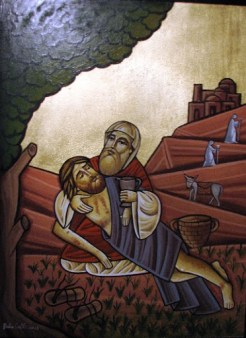
…local governments will be issuing various instructions and protocols for managing and controlling the spread and effects of this momentary health challenge: we urge all our faithful to be acquainted with these practical instructions…in all such things we should be examples to the world of pious trust in God that leads not to undisciplined alarm, but rather to a continuance of life in an untroubled spirit and undisturbed reliance on the Divine Will.
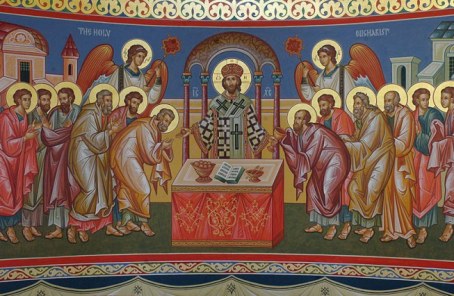
In our churches, we shall continue with the celebration of all our rites, customs, Divine Services and above all the offering and receipt of the Holy Mysteries in precisely the same manner as we have always done. No genuinely believing Christian can for one moment accept that the Holy  Mysteries might bring or be the source of sickness or ill-health: by no means! The Mysteries of Christ are the true medicine of our souls and bodies, and bring nothing but life—and life eternal. Any whose hearts are troubled by present matters should pray fervently for an increase of faith so that fear can be cast aside; and the Church will continue her ancient witness to the love that is beyond fear, bringing the Holy Mysteries to the world, and to each of us, in a time when it needs them profoundly. Do not be afraid! As we sing so frequently in these Lenten days, God is with us! And He is merciful and loving, quick to hear and heal and save.
—With love in Christ,
IRENEI, Bishop of London and Western Europe (ROCOR)
 Long ago in Fantasyland, I thought my remodeling project might be done before Lent 2019. And again this year I thought so, but I had less hope than last year. 🙂
 But I do have the loveliest bed, plenty of food to eat, and I have a bathroom. My wonderful house has windows through which sun often shines. I have hope of my affliction coming to an end. Millions of people in the world would love to experience my problem. Besides, God knows what I need, doesn’t He? He does. The last fifteen months have not gone the way I expected, but I can’t help but see, even with my bad spiritual eyesight, much good coming out of “everything,” and I’m not talking about my closet makeover.
 The providence of God was crystal clear this week, when it’s the first week of Lent, and precisely for the first three days of this special week my project stalled; it wasn’t the first occasion when I could appreciate the timeliness of delay. Unlike most truly homeless people I have a car and could drive to church! I love to attend Matins and other services that are at 8:00 a.m. during Lent, and it’s not difficult during this season of my life when I can’t sleep past 5 or 6. And as often happens, when we have said the last “Amen,” I’m not eager to leave.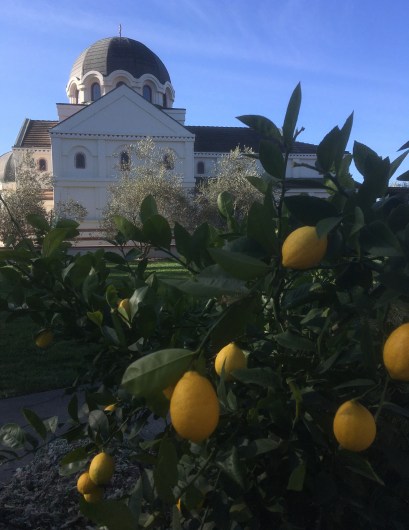


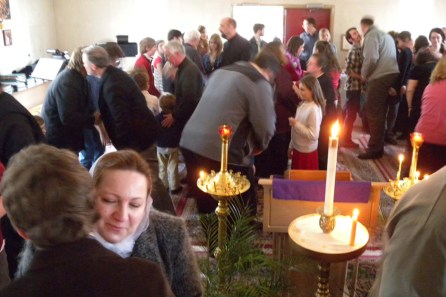

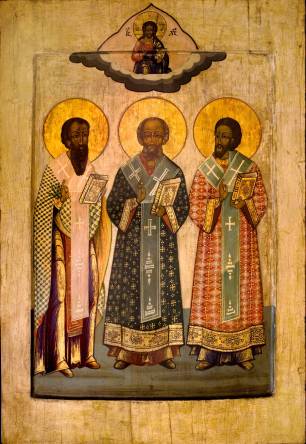 Our Orthodox commemoration of the
 Gladsome Lights