Category Archives: church

St. George

From Everywhere Present by Fr. Stephen Freeman:

“The body of Christ is one Body. There is only One Church — not divided between those who have fallen asleep in Christ and those who remain behind. Whether we are here or in the hand of God, the struggle is the struggle of the whole Church. My success or failure in my spiritual life is not my private business, but the concern of a great cloud of witnesses. Neither are they watching only as disinterested bystanders. They urge us on and support us with their prayers. Were they to watch us without participating at the same time in our struggles, the watching would be like torture. As it is, their watching is prayer and participation of the deepest sort.

“It is for this reason (among many) that many services in the Eastern Church contain the phrase, ‘Lord Jesus Christ, through the prayers of our holy fathers, have mercy on us and save us.’ It is a humility of sorts, a demurring to the prayers of greater Christians — but it is also calling on a reality that abides. We are not alone. The great cloud of witnesses stands with me and in me in prayer.

“Every prayer we ourselves offer is a participation in the life of the world. We have a participation in the great cloud of witnesses, but we also have a participation in everyone who is. The prayer of a righteous few has an amazing salvific impact on the life of the world. If they’d had but a few more righteous men, Sodom and Gomorrah would still be standing. To this day we do not know how many or how few, in their righteous prayers, preserve us before God”.

Today, April 23, we remember Holy Greatmartyr, Victorybearer and Wonderworker George, and ask him to also remember us to God.

I like the oatmeal bread better.


A week ago I put some sourdough sponges to ferment, and on Monday and Tuesday I finished the bread from them. First was the batch made with Manuel’s Rye Sour starter. I made it with whole grain flours and lots of seeds: sesame, black sesame, poppy, sunflower, and pumpkin. Did I leave anything out? I had a vision of a nourishing lenten bread.

Seeded Sourdough

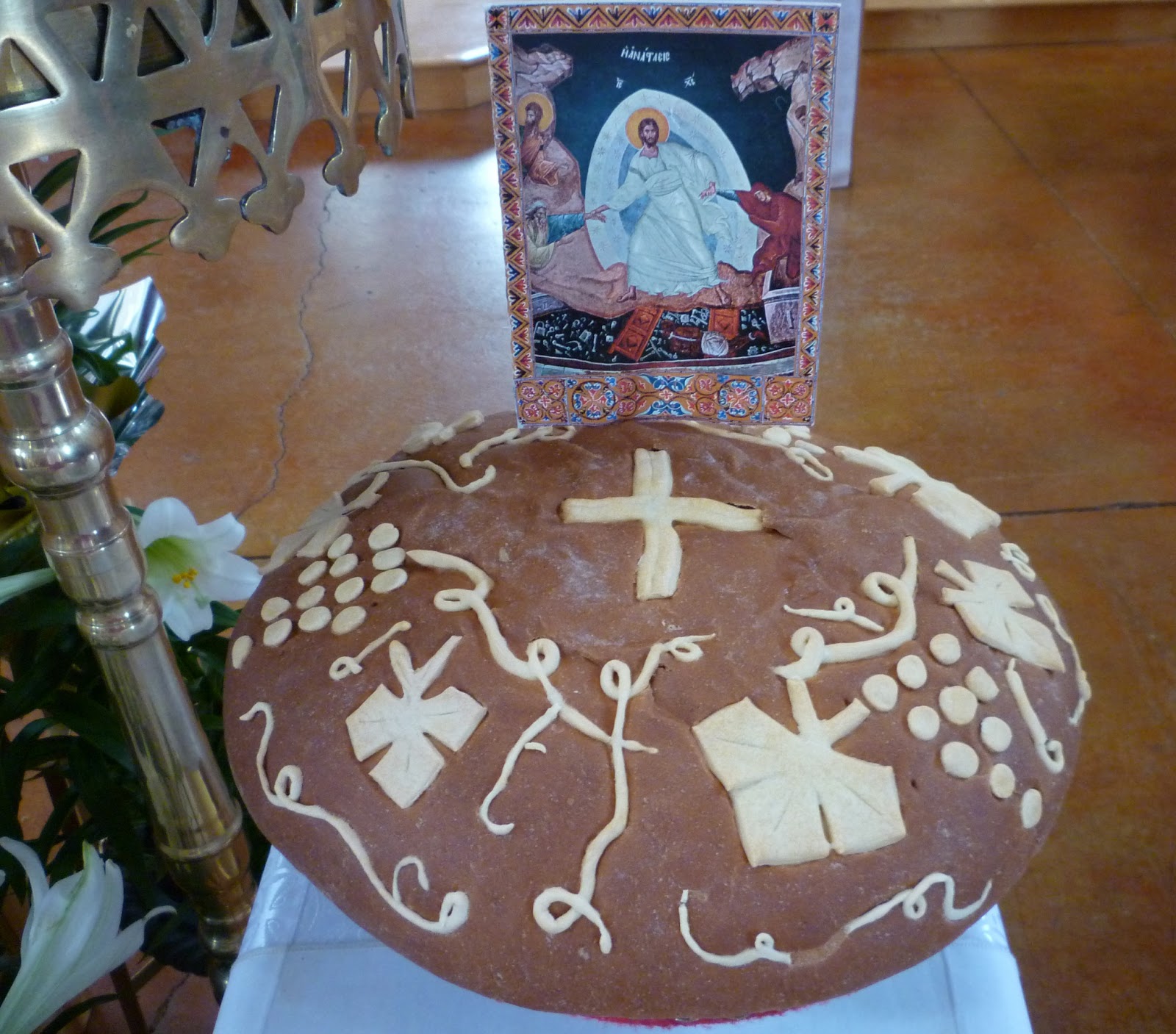
The next day I was on the Communion bread team at church, and that morning we produced the most gorgeous “lambs,” but I didn’t have my camera, so I will show you a photo of one from the past. Ours this week were much browner and more evenly browned, having baked in the new convection oven.

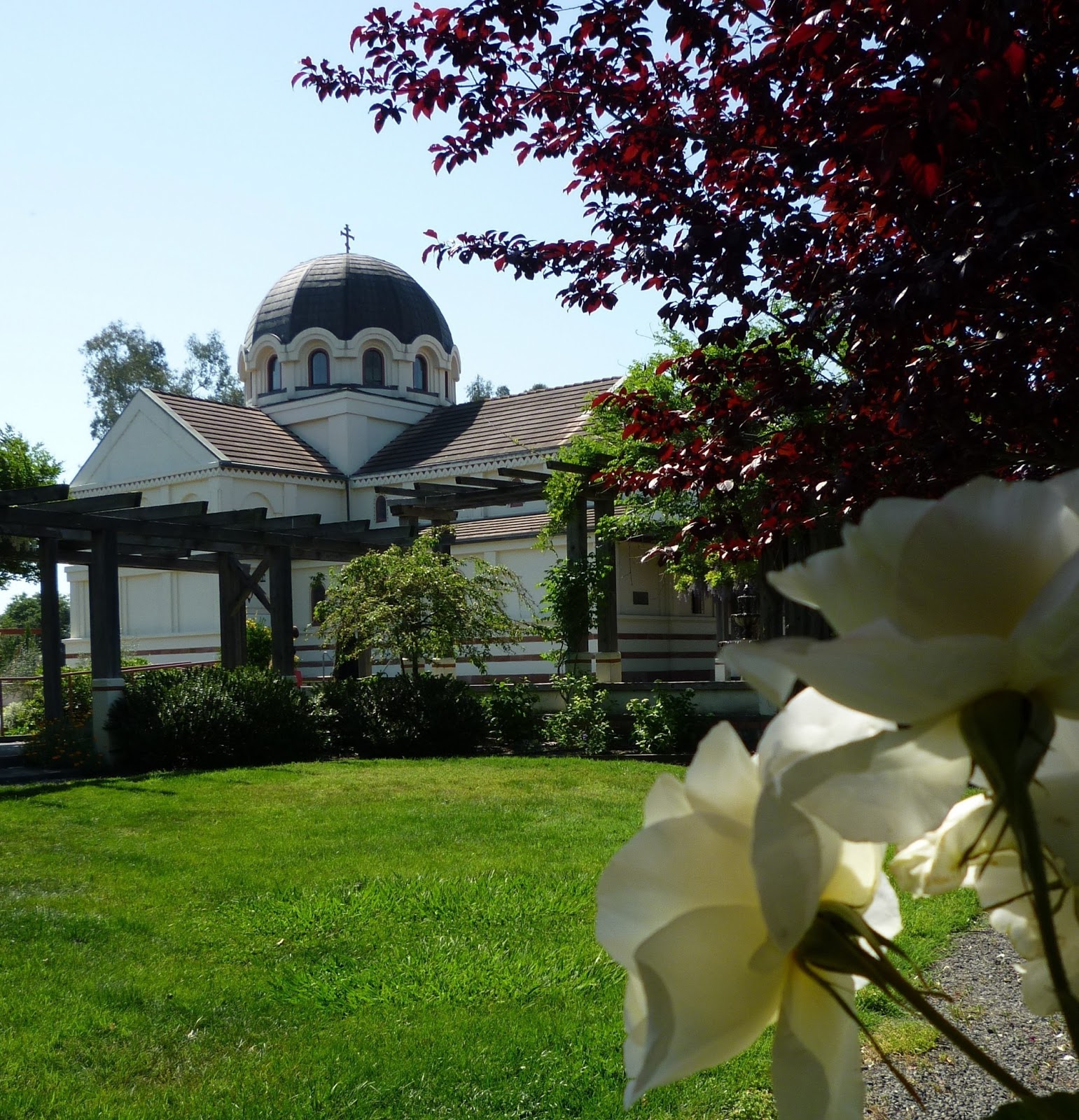
It was at church I took these photos of wisteria later in the week. It surrounds the courtyard where the fountain was actually working that day.

As soon as I got home Tuesday I began to finish up the other dough, made with the pineapple starter. (Of course it has no pineapple flavor remaining.) I had decided to make that batch heavy on oatmeal and had added several cups of rolled oats to the sponge the day before.

Both the breads came out pretty well — but I have decided to end my Sourdough Experiments. I think the natural yeasts in the air of our town just don’t make a sour flavor that I like. The odd thing is, they are very active and powerful yeasts, compared to the ones where we used to live, which had a more agreeable flavor.  They work nearly as fast as commercial yeast.

The pineapple starter is a bit nicer, so I didn’t throw it out yet, but I keep thinking that I prefer the smell of regular bread in the oven, and out of the toaster. (Perhaps I should try biscuits or pancakes with that starter.) And I like oatmeal bread a lot better with butter in it as well as on it, so considering the small amount of bread we two eat, I may as well just not bother during Lent. I have learned a lot from my experiments. And I think all the bread I’ve been squirreling away in the freezer will do nicely to make grilled cheese sandwiches a few weeks from now.

Sourdough Oatmeal Bread

Addendum: In the old days either Pippin or I would bake 5-loaf batches of un-sour oatmeal bread once or twice a week as our household’s basic bread. It was a more traditional shape of loaf; these loaves are flattish because I haven’t yet worked out how much dough fills my new extra-large loaf pan and it came out a bit short.

I want to become a stronger swimmer.

A view from our front yard

As a man whose head is under water cannot inhale pure air, so a man whose thoughts are plunged into the cares of this world cannot absorb the sensation of the world to come.

                       ~St. Isaac the Syrian

I’ve definitely had that underwater feeling lately — so I was relieved to take part in a lenten service at church today, one designed to clear the head of transitory concerns. During Communion in the time of Lent, we sing lovely meditative hymns to the words, “O taste and see that the Lord is good.”

Because that world St. Isaac speaks of comes to us in the Eucharist. We breathe the pure and sweet air of the Holy Spirit, a taste of the world to come and tonic to strengthen us for the labors of this world.

Mr. Glad and I have all sorts of busyness on our plates these days, and much of it is of a proper and happy kind, helping and loving people. But there is the other sort, as when one’s computer crashes and requires hours of trouble transporting, repairing, restoring. For me that’s the sensation of drudgery.

There’s the fence that falls down and needs replacing, which means hours of talking to the neighbor and the lumber store, and more hours actually tearing out the old and putting in the new. This kind of work often blends into another: The old bodies of us humans wear out and need more frequent maintenance, trips to the chiropractor or pharmacy.

It’s helpful that the melody of the “taste and see” hymns stick in my mind pretty well, so I can remember and come up for a gulp of that Air of Life, Sweet Jesus. I may not be walking on water, but I’m not drowning.

It’s not about feeling balanced.

From another site:

No frail human morality can ever hope to contain the overflowing fullness of life with which Christ desires to rejuvenate the faithful.

…The world will not be saved by optimistic humanism that believes human progress and morality will eventually save the world. For Dostoevsky and the church fathers, man’s deepest problems are not moral, nor even psychological, but ultimately existential and ontological. It’s not about following the rules or feeling balanced. It is a matter of choice and it is a matter of human nature being touched by the hand of God Himself.

Only by daring to leap towards God in spite of the good and evil that exist in the heart can the believer hope to get beyond the contradiction of the human condition. In order to avoid descending into nihilism, Dostoevsky offers his readers another path: the acceptance of suffering and affliction in the context of a relationship with God. It is only in this context that man is able to recognize a path out of his fallen condition. It is only this Love that is able to transform suffering into salvific joy.

Read more here: Ancient Christian Wisdom blog