Category Archives: history

Pink flowers are not all she gives.


It may not have been fellowship exactly, but my time today with my fellow creatures the plants was intimate and  lovely, and I spent hours pruning three of the trees. That is something God does to us, and maybe that’s why it makes me feel particularly tenderhearted toward my horticultural “children.”

First the plums, for which I had to move up their solstice pruning a week because I won’t be here at the summer solstice. Lots of other weeding, feeding, planting — and naturally, trying to take pictures of insects. I was eating breakfast in the garden when I noticed syrphid flies on the toadflax, and wondered how I could ever have confused them with bees. They don’t have the same flight pattern at all, and they even buzz more like flies.


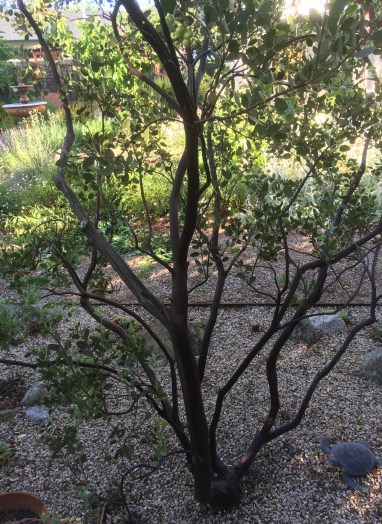
The last thing I did was to spend an hour with the manzanita bush that I’d named Margarita a few years ago, about the same time I told her history. (You can see more pictures of her via that link.) It was this task that brought me into the sweet communion with the plant that is enjoying her 15th spring on the property! I can tell she is happy because she’s putting out lots of new green leaves, while the berries are still mostly green, too. I must never have paid much attention to this tree in other Junes, because I hadn’t seen the contrast of the new growth with the old leathery leaves, many of which are turning brown, which is normal.

In order to survey the wandering branches and find the dead wood and make decisions about how to thin Margarita while keeping her twisty and graceful form, I must have walked around and around her a dozen times, noticing and snipping twigs and whole branches that were revealed as needing removal, one by one with each changed view. I mused about how she has grown and changed; countless parts of her have died and been cut away, but she gradually has become a little taller. Since her youth when I realized that she wanted to grow northward, time and again I have helped her to do it in a nice way, and every year she gives me pink flowers for Valentine’s Day.

She is a dear.

Lifting the eyes without horror.

In White Road, Olga Ilyin writes her memoirs of the years 1919-1923 in Russia. I am not very far into the book, but I want to share a short passage describing one Siberian winter morning as she was fleeing eastward with the White Army and some members of their families. Each night they would billet with sympathetic peasants, and move on the next day.

“It was one of those windless mornings…when the air is frozen to the crispness of glass and every sound engraves itself on the darkness with such precision that you can trace its outline with a pencil.

“I had just come on the porch of our cottage. I loved to be the first one to come outside with Bibik [her baby] to steal a moment of quiet before the noise and movement of departing troops, to gaze at the stars overhead, and listen to my footsteps on hard-packed snow fall into silence like notes of music.

“And yet, how could I? For these were the same stars I had watched with horrified eyes on the night when I fled from home; the same stars at which my father had looked from an open truck just a week later when a firing squad drove him to where he was shot. Never again, I had felt, could I lift my eyes without horror to this unyielding gulf between God and man, hammered in by myriads of frightful metallic nails. So, why should I come out to catch a moment to be alone with them? How was it possible that again the stars should reassure me of the wonder of life, telling me that nothing great could really be broken or vanquished? At least within us.”

Boundaries and Ages

A few weeks ago I tagged these two poems from the Japanese, to read again. Just now I notice that the poets were contemporaries of each other, and that in both poems there is the needed attention to the poet’s experience, but also reference to political or historic settings. Even though I probably miss many poetic allusions and metaphors because of my unfamiliarity with the realm of Japanese literature, I find these more interesting and thought-provoking than the more minimalist haiku.

The writers who create and give us their creations are also fascinating to me. It’s nice to be able to read a bit of biography, but you know that they are telling the most important things in their poetry. Both here are considered haiku poets. Takami was arrested for Marxist writings and communist activities while at university, but later recanted, and years later became director of the Japanese Literature Patriotic Association. In addition to his poetry he published various memoirs including 3000 pages of wartime diaries.

The minor planet Kusatao was named for Kusatao Nakamura in 1994.


AT THE BOUNDARY of LIFE and DEATH

At the boundary of life and death
what exists I wonder?
For instance, concerning the boundary of county and country,
during the war, on the border of Thailand and Burma,
although I saw it when I crossed through the jungle,
nothing unusual was found in that place.
There was nothing like a boundary line drawn.
Also at sea when passing directly over the equator
nothing special like a beacon mark was visible.
No, at that place was the wonderful dark blue sea.
On the Thailand-Burma border was a wonderful sky.
On the life-death boundary too might there not be something hung like a wonderful rainbow,
even though my surroundings
and also my self
were a devastated jungle?

-Jun Takami (1907-1965)


Sailing in autumn,
being inside
one huge and deep blue disk.

In the baby carriage,
onto the joggled apple
continuing to hold.

Falling snow!
The Meiji period, far
away it has gone.

Greenness everywhere
and inside it my own child’s
teeth starting to grow out.

-Kusatao Nakamura (1901-1983)


(The ocean painting is detail from a print by Hiroshige, “The Whirlpools of Awa.”)

Christmas Peppernuts

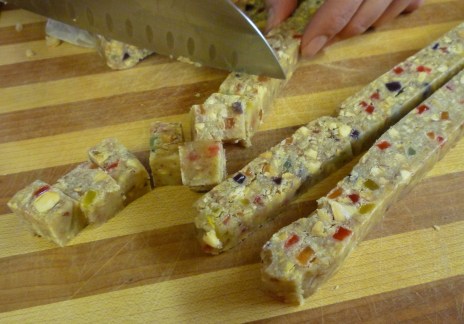
The last time I ate our family’s version of peppernuts, it was in a February that seems very long ago now. Mr. Glad and I were at Pippin’s when she pulled a slab of dough out of the freezer, left over from her Christmas baking. My hands weren’t sticky so it was easy to take pictures that I saved to put with the recipe “someday.” Trying to post every day this month along with Pom Pom has prodded me to make good on promises I’ve made in this regard.

This cookie is a version I cobbled together from the assortment that fill the pages of Peppernuts, Plain and Fancy, given to me at least 20 years ago by my Dutch homeschooler friend Anita.  I just now found my little copy, about 5×6″, on a remote shelf and browsed through it for only the second time. When I first received the book, I was looking for the likeliest of the 26 varied recipes to try, but after traveling from front to back and from Paraguay to Russia and back to Kansas, I decided to take ideas and ingredients from several of them.
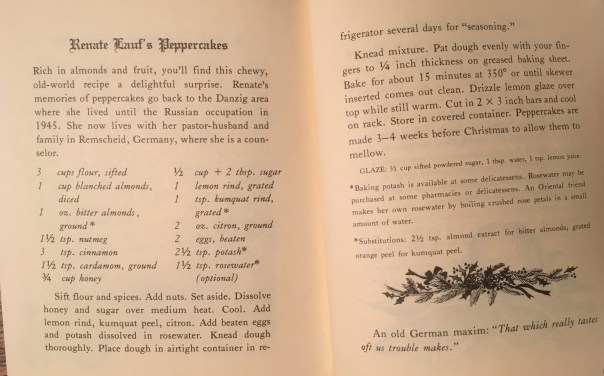
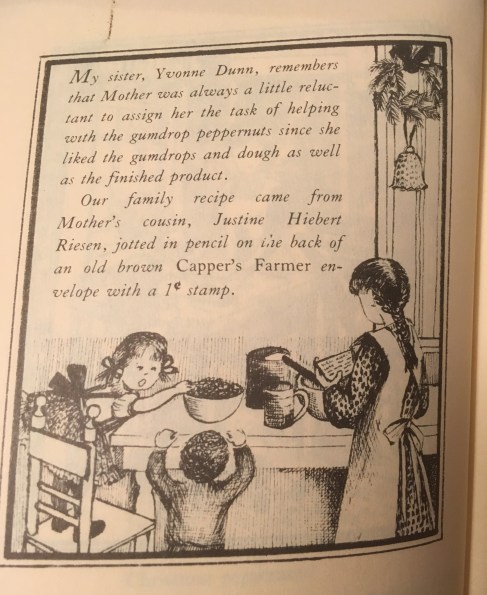
I had forgotten until tonight that not all of the varieties in the book are even spicy, like true pfeffernusse are. I found a couple of recipes for White Peppernuts, and ingredients as different as ammonia and lemon, peppermint and fresh coconut. As you can seen from the few pages I have shared, these are true Family Recipes, some of which have unusual sources and have been passed down through many generations.

“Original peppernut recipes probably were copied from the Germans, Dutch and West Prussians when Mennonite families moved about Europe in search of religious freedom. Then, when our grandparents left the Ukraine for America in 1874, they brought this lovely tradition with them, baking peppernuts in their ‘grasshopper ovens’ those early Christmases on the Kansas prairies.”

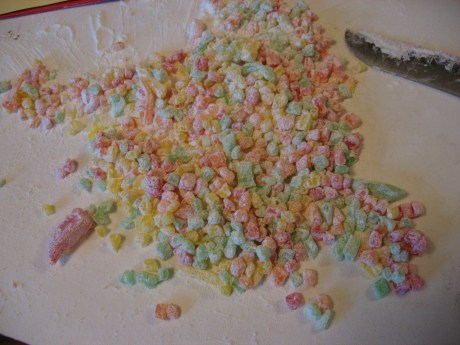
Some years it can be hard to find fruit-flavored jelly candies in the stores; they are a version of gumdrops, not gummy candies, and aren’t spicy, and it seems their availability is subject to trends. I don’t want to use spice drops because there is already plenty of spice in my recipe. The easiest way to dice the candies is to dust frequently with arrowroot or cornstarch. In the photo down below that is what makes the pieces white.

One year I had a much larger batch of dough than this recipe makes, and I was using it from the freezer for many months after. I didn’t always have time to make “nuts,” so I cut bar-shaped cookies and they were good, too!

CHRISTMAS PEPPERNUTS

½ stick butter, 2 oz.
½ c. honey
1 c. sugar
2 eggs
¼ c. milk
½ T. soda in ½ T. hot water
1 tsp. lemon zest
4 c. white flour
6 oz. diced, fruit-flavored jelly candies
2 c. toasted almonds, chopped
2 tsp. ground star anise
½ tsp. cinnamon
2/3 tsp. ground black pepper
¼ tsp. nutmeg

Mix all, form dough into large “pancakes,” and freeze. While still firm, cut into “nuts” or bars. Bake at 350 degrees 8-10 minutes on greased foil on insulated cookie sheets.
Should be golden brown if you don’t want them cake-y.

Be careful now! Remember that “Old German maxim” quoted on the page above:

That which really tastes
oft us trouble makes.

These do really taste. 🙂