Category Archives: Lent

Springtime in the Soul

Dogwood In Yosemite Park

If you are stopping by here during Lent, you probably won’t find anything new. I put some links in the sidebar to things I’ve written before and that bear re-reading, so I humbly declare. I will be reading other blogs and thinking about your comments, so I hope that you will feel free to send along a note, even on the oldest posts, which are often about timeless subjects after all. Or an e-mail — my address is on my profile page.

About those security words that Blogger wants us commenters to decipher: I squint and guess at them, and half the time get them wrong once or twice while I am trying to comment on someone’s blog — so just in case any of my readers feels the same deterring effect here, I have removed that part of the commenting process on my blog. I always put comments through the filter of my visual approval anyway, so unless something terrible happens I’ll continue to use only that means to keep ugly things off these pages.

In Latin and other Romance languages the word for lent has something to do with 40 days, but Wikipedia tells us that “in the late Middle Ages, as sermons began to be given in the vernacular instead of Latin, the English word lent was adopted. This word initially simply meant spring (as in the German language Lenz and Dutch lente) and derives from the Germanic root for long because in the spring the days visibly lengthen.”

Of course, on the southern half of our globe, it’s Autumn during Lent, but even there, the repentance that is the central theme of Lent can be, as Metropolitan Kallistos says, “an opening flower.” Springtime in our souls!

The Lenten Prayer of St. Ephraim the Syrian
O Lord and Master of my life!
Take from me the spirit of sloth, faint-heartedness,
lust of power, and idle talk.
But give rather the spirit of chastity, humility,
patience, and love to Thy servant.
Yea, O Lord and King!
Grant me to see my own errors
 and not to judge my brother;
For Thou art blessed unto ages of ages. Amen.

What was I thinking…

In Ephesians 5 we are told to redeem the time: See then that ye walk circumspectly, not as fools, but as wise, Redeeming the time, because the days are evil. Wherefore be ye not unwise, but understanding what the will of the Lord is.”

That admonition comes to mind as I read this poem, published just last year in the New Yorker. It’s by W.S. Merwin, whom I mentioned previously here and here in regard to his book The Folding Cliffs, which captivated me and gave me for the first time an interest in visiting Hawaii. By the way, my husband and I will be doing just that next month to celebrate our 40th wedding anniversary, which is one reason I don’t think I will be blogging much until after Easter/Pascha.

But back to the poem — it seems to me it speaks of how we can only make up for lost time by being attentive to the gifts that are coming to us right now, attentive to the presence of God. He is giving Himself in the present moment, and He has given us the lenten season to help us tune into that Reality, to come back to it and to Him.

THE NEW SONG

For some time I thought there was time
and that there would always be time
for what I had a mind to do
and what I could imagine
going back to and finding it
as I had found it the first time
but by this time I do not know
what I thought when I thought back then

there is no time yet it grows less
there is the sound of rain at night
arriving unknown in the leaves
once without before or after
then I hear the thrush waking
at daybreak singing the new song

–W.S. Merwin

Tears in Psalms

As we approach Lent, the beautiful hymn “By the Waters of Babylon” is sung at Orthodox services and starts to set the tone for the season in which we cultivate “joy-creating sorrow.”

Psalm 137

By the waters of Babylon,
there we sat down,
yea, we wept, when we remembered Zion.
We hanged our harps
upon the willows in the midst thereof.
For there they that carried us away captive
required of us a song; and they that wasted us
required of us mirth, saying,
Sing us one of the songs of Zion.

Psalm 58:8

Thou tellest my wanderings:
put thou my tears into thy bottle:
are they not in thy book?

Psalm 116:6-8

The LORD preserveth the simple:
I was brought low, and he helped me.
Return unto thy rest, O my soul;
for the LORD hath dealt bountifully with thee.
For thou hast delivered my soul from death,
mine eyes from tears, and my feet from falling.

Psalm 126:5

They that sow in tears shall reap in joy.

Listening at the end of Lent

About now I begin to think I really should hold my tongue and start listening harder. Here are some things I’m hearing:

1.  Do not show forth a useless fast.

2.  Can’t you see that the world is on fire, burning! Temptation is everywhere. The devil has set such a fire that even all firefighters in the world could not put it out. It is a spiritual fire. Nothing but prayer is left for us now, prayer that God may take pity on us! You see, when a fire spreads and the firefighters can do nothing about it, people turn to God and pray for a heavy rain. The same happens with the spiritual fire started by the devil; only prayer is needed so that God may help us.

Wherever you may turn, one thing is clear: things are falling apart! It’s not, for example, that we have a house and a window or something else that needs fixing and we can take care of it; it is the entire house that is in shambles––and worse yet, the entire village. We are spinning out of control. Only God can step in and make a difference. He’s got to roll up His sleeves, take a screwdriver and with a slap here and a caress there fix the mess. The world is harboring a blistering wound, full of puss, that needs to be opened and treated; but it’s too soon to open it now. Evil must come to term as it did in Jericho, a long time ago.
––Elder Paisios in With Pain and Love for Contemporary Man

3. A word about how we relate to the saints.

4. “There’s no taking snakes with sugar-tongs.”  -Proverb

5. From yesterday’s Orthodox matins service:

O wise Lazarus, prepare now for thy burial; for tomorrow thou shalt die and leave this life. Look at the tomb in which thou shalt dwell. But Christ will bring thee back to life again, raising thee on the fourth day.

Be glad, O Bethany: for Christ shall come to thee, performing in thee a great and fearful miracle. Binding death with fetters, as God of all He will raise up Lazarus, who was dead and now magnifies the Creator.

Come, let us make ready to meet the Lord, bringing to Him palms of virtue. So shall we receive Him in our souls as in the city of Jerusalem, worshiping Him and singing His praises.

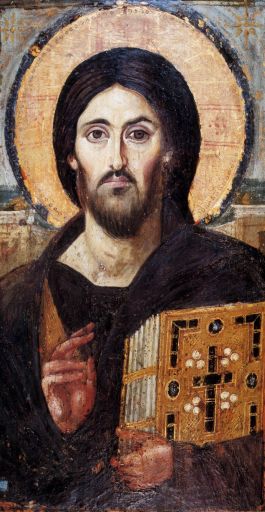
Sinai,_Christ_Pantocrator,_6th_century