Category Archives: love

Let’s open our hearts up to this.

I don’t know if I have ever before considered the difference between the betrayals of Judas and Peter. In a recent podcast for Holy Week Sister Vassa Larin gave a talk on this subject that I found very moving.

Judas is most famous for handing Jesus over to the authorities for the price of 30 pieces of silver. Right up until that momentous event he had been the disciple who had the responsibility for “the bag,” that is, he was the treasurer for the company of Jesus and his friends.

In the Gospel of John we read this telling account:

Then, six days before themary christ-at-bethany Passover, Jesus came to Bethany, where Lazarus was who had been dead, whom He had raised from the dead.  There they made Him a supper; and Martha served, but Lazarus was one of those who sat at the table with Him. Then Mary took a pound of very costly oil of spikenard, anointed the feet of Jesus, and wiped His feet with her hair. And the house was filled with the fragrance of the oil.

But one of His disciples, Judas Iscariot, Simon’s son, who would betray Him, said, “Why was this fragrant oil not sold for three hundred denarii and given to the poor?” This he said, not that he cared for the poor, but because he was a thief, and had the money box; and he used to take what was put in it.

But Jesus said, “Let her alone; she has kept this for the day of My burial. For the poor you have with you always, but Me you do not have always.”

What Sister Vassa points out is the lack of love for the Lord that Judas shows  here. She gives an example from modern life, to help us imagine: What if you are a mother whose son brings you flowers, and all your husband can say about the gesture of love is, “What a waste of money!” What would that tell you about his own love for you? And how would you feel?
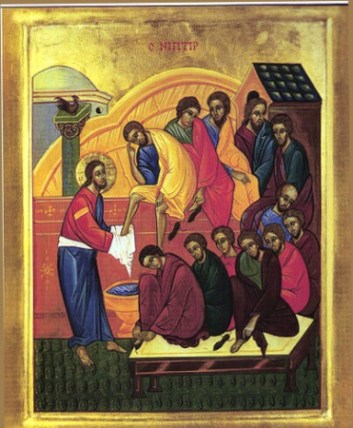
Christ washing feet interruptingthesilence

We don’t know why Judas had failed to respond to the love of Christ and to reciprocate, but it seems that even at that last supper where he was present with the other disciples, Jesus was giving himself to Judas until the end, humbly washing his feet right along with the others, and offering him in particular a piece of bread from His own hand. As Jesus was speaking about how they ought to love and serve one another, He was doing the same. But Judas did not get it. In the words of Canticle Nine for Holy Wednesday, “…in exchange for money he rejects fellowship with Christ….how hast thou forgotten what Christ taught thee, that thy soul is more in value than the whole world!”

Afterward, when he saw that Jesus was condemned, he regretted what he had done, but Sister Vassa says it seems to be for ethical reasons that Judas regrets it, and not because he sinned against someone he loved. He distances himself from his sin and from the Lord even in his words, not using the name of Jesus but only referring to him as “innocent blood” that he had wrongfully betrayed. Judas immediately gives in to despair and commits suicide. He did not have the loving connection to Christ that would have been the starting point for going in a different direction, back to the fold where he had previously been loved and accepted. As Sr. Vassa says, “Even if you betray someone, love enables you to weep and repent; there is a connection, a personal relationship that still exists even when you fall short.”

mystical supper monreale

Peter, on the other hand, soon after saying that he would lay down his life for Christ, three times denied that he even knew the Lord. He was cut to the heart when Jesus looked pointedly across the courtyard at him, and he realized he had done just what the Lord had warned him about earlier that evening. Peter went out and wept bitterly, which is an appropriate response if you have betrayed and hurt someone you love.

And if you are the betrayed? Some of us may have to share this experience of the human condition, as Christ did. Only God can forgive sins, but as much as possible we would want to respond as our Savior did to Peter, and be glad if those who sin against us are repentant and come back.

Sister Vassa: “When Peter is restored by the risen Lord, the conversation is not about saying sorry, it’s not explicitly about pardon or forgiveness, ‘Let’s get down to analyzing what you did wrong.’ No, it is about affirming love. Three times Christ asks, ‘Do you love me?’ The Lord does not say, ‘What do you have to say for yourself? What have you Peter Christ - do you love medone?’ Peter is allowed thrice to affirm that which is salvific for him; that’s what saves Peter. It’s not even faith; love precedes faith.”

During Holy Week there are many doors through which we might enter to be with the Lord, many personal stories we can relate to, some more than others, but all of which are instructive. Let’s stay with Him, Who is Love. Thanks to Sr. Vassa for her wisdom, and I will close with a longer passage from her podcast:

We can’t forgive sins – only God can forgive sins. “Your sins are forgiven you!” We are so used to hearing that, we almost take it for granted, but this was not clear to those who hadn’t met him yet. This was an incredible gift.

Most of us don’t know what it’s like to live without constant forgiveness. If there were no forgiveness, there would just be suicide. Where do you place those failures? What do you do with your sins? Just how dark would it be? Let’s contemplate the great self-giving and forgiveness going on this week, amidst the great darkness and betrayal and falling short, all the evil in the world crashing down on our Savior who’s not avoiding it. He’s taking it all on, accepting it, walking through it, letting it crush him, letting it kill him, and then he’s descending into the very hell of us, and bringing our humanity out in new life and having overcome all of that darkness. Let’s open our hearts up to this.

Lenten love and lettuces.

For the letter “L”, Lent is a natural choice of subject, considering the season we Orthodox are in. This year Pascha or “Greek Easter” is five weeks after Western Easter, so we are still in preparation. Everything that we experience or do is placed in the context of our efforts to draw close to Christ and to be ready for the glorious celebration of His Resurrection. If I don’t see that connection on my own, someone around me is sure to say, upon hearing that I’m sick, or my car broke down, or about any number of news items, failings or challenges, “Ah, well, it’s Lent!”P1030845(2)

Sloughing off the unnecessary, becoming more like Mary than Martha, letting go, focusing on the eternal things and soaking up the encouragement of our mother the Church through the heart-sustaining services of this period of the calendar — these are some of the things we try to work on.

When on April Fool’s Day my computer’s hard drive failed, I lost several months’ worth of data and many hours of work that I have to do over, including hundreds of photos and I don’t know what else, because somehow my backup program had also failed since December. My Computer Guy was more distressed than I was; I realized deep down that this loss was of nothing essential to my life. I said something like that to him, mentioning Lent, and he remarked lightly that my attitude inspired him to consider what sort of sacrifices he himself ought to be making. “Oh, no,” I wanted to say, “It’s not about making sacrifices!” But exactly what it is about, I wasn’t prepared to expound. I do know that I did not choose to give up a big chunk of visual and literary records.Christ washing feet of disciples

What Lent is about can be summed up in this prayer that we pray hundreds of times throughout the weeks and the services. It doesn’t say anything about sacrifice or even about food.

The Lenten Prayer of St. Ephraim the Syrian

 O Lord and Master of my life!
Take from me the spirit of sloth, faint-heartedness,
lust of power, and idle talk.
But give rather the spirit of chastity, humility,
patience, and love to Thy servant.
Yea, O Lord and King!
Grant me to see my own errors
and not to judge my brother;

for blessed art Thou unto ages of ages. Amen.

And though to be truthful, there is mention of sacrifice when we come together, it’s in the moving hymn we sing on our knees at one of the Lenten services:

Let my prayer arise in Thy sight as incense,
And the lifting up of my hands

As an evening sacrifice.

I happen to be reading a book that seems very Lenten in its mood and themes. This novel by Eugene Vodolazkin, Laurus, is filling my mind so much the last few weeks, I originally planned to dedicate the whole of “L” to it, even though I’m still in the middle of the book. It’s about the Middle Ages, a holy fool, and kairos. The main character demonstrates the kind of self-emptying that results in making space for God.Image result for laurus

His motivation for asceticism is love for someone for whom he wants to pray, and he does not want to be distracted by being too comfortable. Eventually he comes to feel out of touch with his body, almost insensible to its condition, and free. You might think that such a person would also be oblivious to the natural world around him, but Arseny seems to be more intimate with the creation and appreciative of its beauty than the average person. Perhaps the Holy Spirit allows him to see and interact with things more directly and clearly than we who only have our natural senses.gl lettuce IMG_2014

Speaking of Nature, I am trying to cooperate with her and grow some vegetables. On Friday I set out some little lettuces and also some kale and leeks. The lettuce is of two varieties of Romaine: Forellenschluss (which I probably bought for its name that is so fun to say) is the speckled kind on the left in the photo; it’s an heirloom variety from Austria. The plain green is a heat-resistant lettuce from Israel and is named Jericho.

That Lenten prayer is useful all through the day, and everywhere we go. I feel the spirit of love in regard to my garden, but I need the spirit of patience. I pray the Lord takes from me the lust of power, but I don’t expect it will happen as quickly as I lost all those digital photos.

Did you know that “the English word Lent is a shortened form of the Old English word len(c)ten, meaning ‘spring season'”? Whatever hemisphere we live in, we can with God’s help tend our hearts, and make this season the springtime of our soul. 

Callas and Comfort

gl calla bouquet 3-16 P1030732When we broke up and filled in the swimming pool last summer, the surrounding planting beds were also excavated and new dirt was brought in for the new plants to grow in. In one corner where calla lilies had grown for a decade, we put in native California currant bushes.

Then the callas sprouted again, up through the little blooming ribes. I’ve had to go out every few days and yank out perfectly healthy lilies when they start to encroach too closely around the young plants that I am trying to encourage.

One morning last week when my daughters and I were packing up to visit the cemetery and have a picnic afterward, we discussed going to tP1030837he store to buy some flowers to lay on their father’s grave, because I said I didn’t have any flowers in the yard to take.

I suppose I was thinking about how the snowball bush didn’t yet have any flowers ready to pick. Last year at this time it was loaded with flowers, and one reason I did not take out the old thing was that I anticipated having its beautiful blooms to put on my husband’s grave every March. snowballs crp 15

Well, I had forgotten the calla lilies! Brave and hardy plants that keep coming…. We picked plenty to take to the cemetery, and since then have had more in vases in which they seem to fall naturally into elegant arrangements.

As you can see, we had other home-grown flowers to use — a few surviving ranunculus from the front yard, and even a Bird of Paradise from Pearl’s garden. Several freesia blooms were left after their extravagant display a couple of weeks ago. Scout and Ivy helped by decorating their grandpa’s grave, and their father drew us together by reading these words:

gl grave 3-16 P1030745

For I am sure that neither death nor life, nor angels nor rulers, nor things present nor things to come, nor powers, nor height nor depth, nor anything else in all creation, will be able to separate us from the love of God in Christ Jesus our Lord. (Romans 8:38-39)

Just now I’m reminded of another passage from I Thessalonians, which is also about our togetherness in the Lord (and it ties in nicely with my “C” post):

For the Lord himself shall descend from heaven with a shout, with the voice of the archangel, and with the trump of God: and the dead in Christ shall rise first: Then we which are alive and remain shall be caught up together with them in the clouds, to meet the Lord in the air: and so shall we ever be with the Lord.  Wherefore comfort one another with these words.

Wing to wing, oar to oar.

Amy and Leon Kass edited an anthology of “readings on courting and marrying.” I have a copy of the book, which I bought after hearing them interviewed at length on the Mars Hill Audio Journal. In that series of discussions, “Wandering Toward the Altar,” they said that they found, from talking with many of their students — and they were both university professors — that modern young people aren’t prepared to fall in love in the way their ancestors found so easy. They hoped that providing certain thoughtfully-chosen literary readings for these impaired youth might compensate for the unfortunate changes iAmy and Leon small_0n society as a whole that had led to this sad situation, which did not facilitate good marriages, and worked against people getting married at all.

I have always wondered if their project bore fruit, if the Kasses ever heard of anyone being helped toward a normalization of love and marriage by the reading of their anthology. I’d like to go back and listen again, to think more about their assessment of the problem and its causes, but that is not the subject of my post.  I mention them because for the title of the anthology they used a phrase from Robert Frost, found in a poem he wrote on the occasion of his daughter’s wedding. That poem is the main thing I wanted to share here.

For the Kasses the poem captures “the togetherness of the married couple empowered to resist the flux of wind and water. Frost is not the first to use the language of speed or quickness to show how love may quicken the life of a couple into a vitality that far exceeds what each partner might attain alone. But Frost also plays on the archaic meaning of ‘speed,’ ‘prosperity or success in an undertaking,’ as well as on its Latin root, spes, meaning ‘hope,’ to point to the possibility of rest within motion, permanence within change, the eternal within the perishable.”

~ Amy A. Kass and Leon R. Kass, from Wing to Wing, Oar to Oar: Readings on Courting and Marriage

THE MASTER SPEED

No speed of wind or water rushing by
But you have speed far greater. You can climb
Back up a stream of radiance to the sky,
And back through history up the stream of time.
And you were given this swiftness, not for haste,
Nor chiefly that you may go where you will,
But in the rush of everything to waste,
That you may have the power of standing still —
Off any still or moving thing you say.
Two such as you with master speed
Cannot be parted nor be swept away
From one another once you are agreed
That life is only life forevermore
Together wing to wing and oar to oar.

~ Robert Frost