
Category Archives: poetry

On the vanity of earthly greatness.

Charlemagne, by Albrecht Dürer

ON THE VANITY OF EARTHLY GREATNESS

The tusks that clashed in mighty brawls
Of mastodons, are billiard balls.

The sword of Charlemagne the Just
Is ferric oxide, known as rust.

The grizzly bear whose potent hug
Was feared by all, is now a rug.

Great Caesar’s bust is on my shelf,
And I don’t feel so well myself.

-Arthur Guiterman

This is a fun poem. The poet joined the theme by embarking on his own transformation to dust some time back. I also like these other lines he wrote, on changes he saw happening around him:

New motor roads are dustless,
The latest steel is rustless,
Our tennis courts are sodless,
Our new religions—godless.
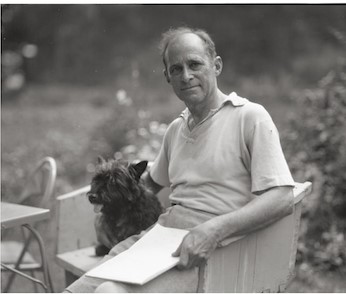
Guiterman in 1932


I’m sure that countless swords that have been swung through the ages are pretty rusty by now, but I happened to see this article about the Frankish king’s most famous sword, “Joyeuse” — and that one is not rust yet, because it has been preserved in the Louvre for many generations. Has any of you seen it?

Flying at Night

Back in May, I wrote about how I had been given a nighttime airplane ride with my son-in-law as pilot. I have had the experience on commercial flights, too, and found it enthralling whenever we were flying low enough to see the patterns of lights down below. I wonder if I will have that chance again…

FLYING AT NIGHT

Above us, stars. Beneath us, constellations.
Five billion miles away, a galaxy dies
like a snowflake falling on water. Below us,
some farmer, feeling the chill of that distant death,
snaps on his yard light, drawing his sheds and barn
back into the little system of his care.
All night, the cities, like shimmering novas,
tug with bright streets at lonely lights like his.

-Ted Kooser

View from plane – Wisconsin

Let the day grow on you upward.

Is this poem about death, about a body laid to rest in the grave? In particular the line about ants walking over the eyelids makes me think so.

EARTH

Let the day grow on you upward
through your feet,
the vegetal knuckles,

to your knees of stone,
until by evening you are a black tree;
feel, with evening,

the swifts thicken your hair,
the new moon rising out of your forehead,
and the moonlit veins of silver

running from your armpits
like rivulets under white leaves.
Sleep, as ants

cross over your eyelids.
You have never possessed anything
as deeply as this.

This is all you have owned
from the first outcry
through forever;

you can never be dispossessed.

-Derek Walcott

The wide and luminous eye.

IN POSITION

I want to tell you about time, how strangely
it behaves when you haven’t got much of it left:
after 60 say, or 70, when you’d think it would

find itself squeezed so hard that like melting
ice it would surely begin to shrink, each day
looking smaller and smaller – well, it’s not so.

The rules change, a single hour can grow huge
and quiet, full of reflections like an old river,
its slow-turning eddies and whirls showing you

every face of your life in a fluid design –
your children for instance, how you see them
deepened and changed, not merely by age, but by

time itself, its wide and luminous eye; and you
realise at last that your every gift to them – love,
your very life, should they need it – will not

and cannot come back; it wasn’t a gift at all
but a borrowing, a baton for them to pass on in
their turn. Look, there they are in this

shimmering distance, rushing through their kind
of time, moving faster than you yet not catching up.
You’re alone. And slowly you begin to discern

the queer outline of what’s to come: the bend in
the river beyond which, moving steadily, head up
(you hope), you will simply vanish from sight.

-Lauris Dorothy Edmond (1924 – 2000)
New Zealand

Waikato River, New Zealand