“Today the whole creation is watered by mystical streams.”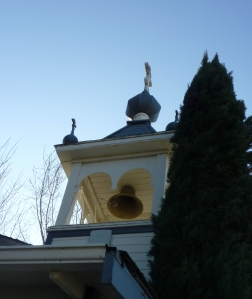
This was one of the lines from the rich 7th-century composition of Patriarch Sophronios of Jerusalem, which was among the readings of Theophany and the Great Blessing of Water that we heard yesterday. More than ever before, I experienced the feast as a shining of The Light of the World and the refreshment of The Living Water, partly because of words like this in the service.
The quantity of verbal expression of various aspects of our faith is really overwhelming, and I can only process what seems to be a small fragment, each time when the different feasts roll around again.
First we celebrated Divine Liturgy in our “big church.” I had the same experience as last week, in the way the morning sun streamed down through a high window and hit me in the face. This time I wasn’t completely blinded; if I squinted just so, the candles and lamps flickering around the church appeared, for those few minutes, as they might outdoors on a foggy night, perhaps carried by worshipers in a procession of the “Feast of Lights.”
It happens that a photo was posted to our parish Facebook page, taken by someone who was there that day last week, and it shows the church with the bright beam that angled across the altar and nave and fell on me. Mr. Glad said, “You need to find another place to stand,” and I answered, “Oh, no, I like it when that happens.” Actually, I don’t often get to be in that place.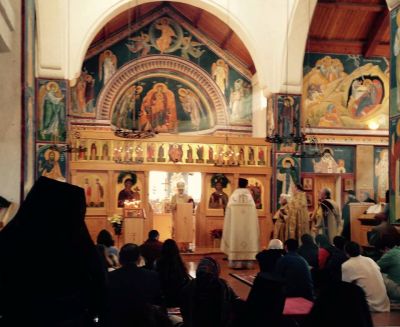 Both times I was on the left in front of a pillar. On Theophany, when the light was coming in the chandeliers were also being set swinging nearby; we were singing a hymn, and the sweetest incense was beautifying the air to honor the Lord.
After Liturgy we processed to the “little church” for The Blessing of Water, accompanied by the bells and singing together. The service opens with:
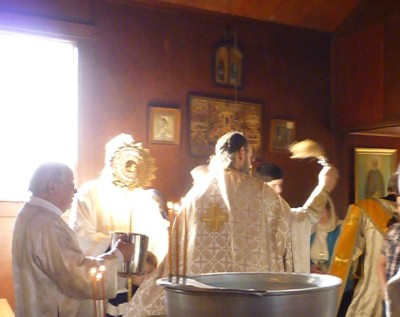 “The voice of the Lord upon the waters cries out, saying, ‘Come all of you, receive the Spirit of wisdom, the Spirit of understanding, the Spirit of the fear of God, of Christ who has appeared.’”
We heard multiple readings from Isaiah such as, “Ho, everyone that thirsts: come ye to the water.”
And more images from the exuberant service of blessing:
The land and the sea have divided between them the joy of the Lord….
King of all, you accepted also to be baptized in the Jordan by the hand of a servant, so that, having sanctified the nature of the waters, you, the sinless one, might make a way for our rebirth through water and Spirit and re-establish us in our original freedom.
The Jordan turned back and the mountains leapt as they saw God in the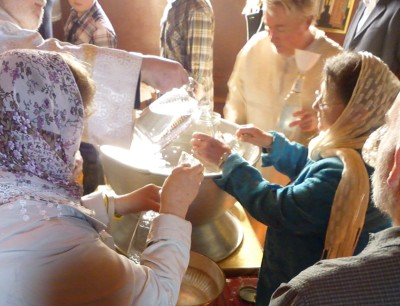 flesh, and the clouds uttered their voice, marveling at what had come to pass, seeing Light from Light, true God from true God, the Master’s festival today in Jordan; seeing him drowning the death from disobedience, the goad of error and the bond of Hell in Jordan and granting the Baptism of salvation to the world.
On the home front, Theophany was the day Mr. Glad wanted to take down the Christmas tree. I resisted that idea for a long time, though I tried not to reveal my stubbornness. We had an easier time getting it out than we’d had installing it.
This morning coming downstairs I was startled by the bare space where the tree had been, but I quickly thought of how we have entered the season of house blessings, when by prayer and faith we will receive much more than we have lost — indeed, a different order of gifts, the “mystical streams” that are so hard to capture in words but impart the very Light of Christ Himself.
Christ Himself told us about these realities, as we read in the Gospel of John, when he said, “He who believes in Me, as the Scripture said, ‘From his innermost being will flow rivers of living water’….whoever drinks of the water that I shall give him will never thirst. But the water that I shall give him will become in him a fountain of water springing up into everlasting life.”
This is the best way to enter a new year.
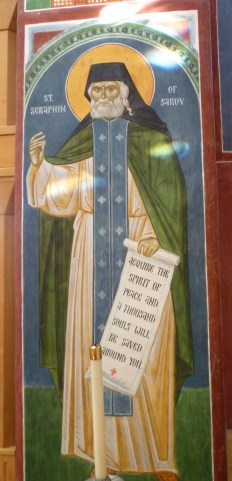 Today we commemorate the repose of St. Seraphim of Sarov, of whom I have written before. He is the patron saint of my Orthodox parish. What a wonderful man! And what a blessed day we had, in spite of cold and even a broken heater in the church. Sometimes lately, when I am cold, I pretend that I am a monastic – and what would a monastic do? Pray, and be warmed by the Holy Spirit. I can’t say that I instantly become a prayer warrior when I think this way, but somehow it helps me to relax, and to at least offer up some kind of plea.