Category Archives: quotes

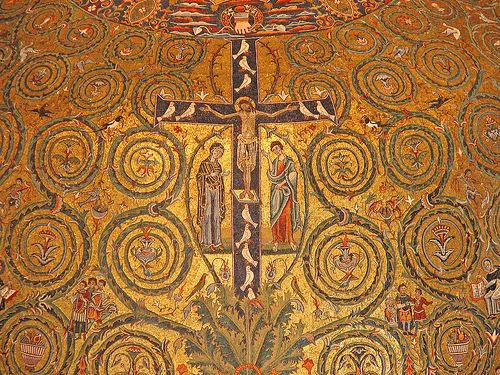
Choose your tree.

Thank you to Leah for posting this excellent word from St. Nikolai.

excerpt: Prayer V

How stupid the servants of the tree of knowledge are! They do not measure their strength in You, but in their num­bers. They do not adopt a law of justice in Your name, but by their numbers. Whichever way the majority of them choose is the way of truth and justice. The tree of knowledge has become the tree of crime, stupidity, and icy darkness.

Truly, the knowledgeable men of this world know every­thing except that they are servants of Satan. When the last day dawns, Satan will rejoice in the number of people in his harvest. All the meager ears of grain! But in his stupidity, even Satan counts on quantity rather than quality. One of Your ears of grain will be worth more than the entire harvest of Satan. For You, O Conqueror of death, rely on the fullness of the bread of life, and not on numbers.

In vain I tell the godless: “Head for the Tree of Life and you will know more than you could possibly wish to know. From the tree of knowledge Satan fashions a ladder for you to descend into the nether world.”

Prayers by the Lake St Nikolai Velimirovic

Rise and go and do the next thing.

I was reminded by another blogger this week of how we need to ask God, not to remove our burdens, but to give us grace to bear them, and to bear them to Him, so that He can use them in our lives to bring us fully into His Heavenly Kingdom.

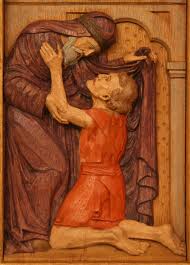
In the Orthodox Church this Sunday of the Prodigal Son is one of our markers letting us know that Lent is approaching, and I’ve been thinking again about what I can learn from the story about this grace I need.

The parable for this week is about a journey, and every journey consists of putting one foot in front of the other, or “doing the next thing.” We are all familiar with this sort of activity when we are ill, and need to take our medicine, follow the prescriptions of our doctors, according to schedule. And don’t stop taking the medicine until you are all well!

The extra effort we put forth during Lent is not to show our zeal but to acquire humility which puts us in the place to receive grace. Paul Evdokimov writes about just one of the many “treatments to be taken” in the Church:

The sacrament of confession is metanoia or transformation more than penitentia. Confession is understood as a ‘clinic,’ that is, a place of healing. That prayer before confession says: ‘You have come to the physician, may you not return without being healed.’ … St. John Chrysostom describes this quite precisely: ‘Time is of no matter. We do not ask if the wound has been treated often but if the treatment has been successful. The state of the wounded one indicates when the disease has been removed.”

“In patience you possess your souls,” the Lord has told us. (Luke 21:19) That is what I have to learn, to say, “I will arise and go to my Father,” as the prodigal did, today, tomorrow, and the next day and the next, until I am completely healed. And I don’t expect to see the day on this earth that I won’t need to stay with the program.

Here are the thoughts I had on this parable a few years ago:

He Came to Himself

One thing that impressed me about the story was the distance factor. The son was in a far country, when he realized what he needed to do. He was hungry and wasted, but he still needed to rise and go, to travel a long way, which must have been a struggle.

All of humanity is represented by the prodigal son, and most of us are still on the journey. Some of us have begun to repent and are a bit farther on our way, but we are all clothed in our flesh, struggling with our sins, anticipating the day when we sit in the Kingdom and feast with our Father, enjoying the restoration of our full inheritance.

In the story, the son receives everything he had thrown away and lost. For now, we have the earnest of the Holy Spirit, and the grace of God to help us continue. Every day I need to decide to take the next step on the way. But I know more than the son in the parable, who hoped for a corner of the pig shed. “…for he that cometh to God must believe that he is, and that he is a rewarder of them that diligently seek him.” (Hebrews 11:6)

I’m afraid I often act a bit nonchalant, as though I am at the gate or even in my Father’s arms already. My initial coming to myself has to be followed up by a constant facing-up to the toil of the road. Maybe I have been sitting on the grassy shoulder wishing the trip weren’t so long, wondering if maybe someone will arrive and carry me the rest of the way.

St. Herman of Alaska reminds me: “The true Christian is a warrior making his way through the regiments of the invisible enemy to his heavenly homeland.”
Accustomed to Tepidity

In the West, Lent begins this week with Ash Wednesday. In the Orthodox Church, we don’t begin until March 17 this year! Pascha is May 5th, more than a month after Western Easter. It seems to me this would make it convenient for you who celebrate The Resurrection of Christ the last day of March to visit an Orthodox church near you on May 5th to experience the Feast of Feasts in its glory, in a way you won’t find elsewhere. But I’ll remind you when we get closer to that date.

For now, I want to re-post from almost three years ago a long quote that seems appropriate for Lent, or for any day or hour when needed.

From Father Moses of the Holy Mount of Athos:

An offspring of [the sin of] pride is censure, which is unfortunately also a habit of many Christians, who tend to concern themselves more with others than themselves. This is a phenomenon of our time and of a society that pushes people into a continuous observation of others, and not of the self.

Modern man’s myriad occupations and activities do not want him to ever remain alone to study, to contemplate, to pray, to attain self-awareness, self critique, self-control and to be reminded of death. The so-called Mass Media are incessantly preoccupied with scandal-seeking, persistently and at length, with human passions, with sins, with others’ misdemeanors. These kinds of things provoke, impress, and, even if they do not scandalize, they nevertheless burden the soul and the mind with filth and ugliness and they actually reassure us, by making us believe that “we are better” than those advertised.

Thus, a person becomes accustomed to the mediocrity, the tepidity and the transience of superficial day-to-day life, never comparing himself to saints and heroes. This is how censure prevails in our time – by giving man the impression that he is justly imposing a kind of cleansing, by mud-slinging at others, albeit contaminating himself by generating malice, hatred, hostility, resentfulness, envy and frigidity. Saint Maximos the Confessor in fact states that the one who constantly scrutinizes others’ sins, or judges his brothers based on suspicion only, has not even begun to repent, nor has he begun any research into discovering his own sins.

Thanks to the rector of our parish for posting this passage in the church bulletin.

I’m jumping in with joy.

blessing-creek1

It’s the Feast of Theophany! How can I not post something on this day when there is blessing abounding to the degree that people want to jump into icy waters over it? I am caught between the impulse to spread the riches around, and the awareness of the extreme limitations of my mind when the meaning of Christ’s baptism is set before me. There is a lot to take in and try to absorb at Theophany, regarding the Baptism of Our Lord.

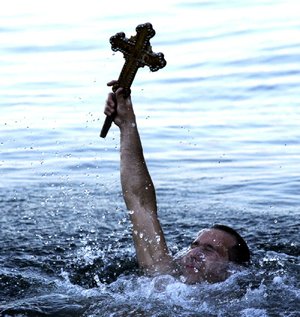
Orthodox Christians celebrate Theophany in various ways around the world. Some release doves as a symbol of the Holy Spirit while others toss crosses into water in remembrance of Christ’s baptism. Young boys or men often dive into the water to retrieve the cross. I know what I’ll do — I’ll post a link to Father Stephen Freeman’s recent blog on the subject. An excerpt:

St. John himself does not seem to understand the purpose of Christ’s Baptism. He is told that “whomever you see the Holy Spirit rest upon and remain” is the Messiah – but he is given little information beyond that. Witnessing Christ’s Baptism and the Spirit resting upon Him, he hears the voice, “This is my beloved Son in whom I am well pleased” (Matthew, Mark and Luke all bear witness to the voice).  The Church later celebrates this manifestation of the Trinity (Christ in the water, the Spirit descending, the Voice of the Father – hence the title “Theophany”).

But with the text alone, on its literal level, we are left with a mystery, without context or meaning. The Tradition of the Church, however, sees the Baptism of Christ in the context of Pascha (Easter) as it sees everything in the context of Christ’s Pascha. Christ’s Baptism is a foreshadowing (and on more than a literary level) of His crucifixion and descent into Hades (just as our own Baptism is seen by St. Paul as a Baptism into Christ’s “death and resurrection”).

When he goes on to explain that in the workings of God in the world, the literal is not all there is, he quotes Fr. Andrew Louth:

Allegory is a way of entering the ‘margin of silence’ that surrounds the articulate message of the Scriptures, it is a way of glimpsing the living depths of tradition from the perspective of the letter of the Scriptures.

There is so much to think about, even if you aren’t part of the Orthodox Tradition in which we will be participating on the praxis level by blessing urns of water, creeks and lakes and oceans of water. In parishes everywhere priests will be blessing houses as my rector described in our newsletter, so as to bring “the joy of the feast of the manifestation of the Holy Trinity to each and every dwelling. Think of the house blessing as a renewal of God’s grace in your home.”

How could we not be welcoming of that? I won’t be jumping into any frozen streams, I hope ever, but I will certainly have the joy of the feast.

O Christ our God,
 Who hast revealed Thyself,
And enlightened the world,
Glory to Thee.