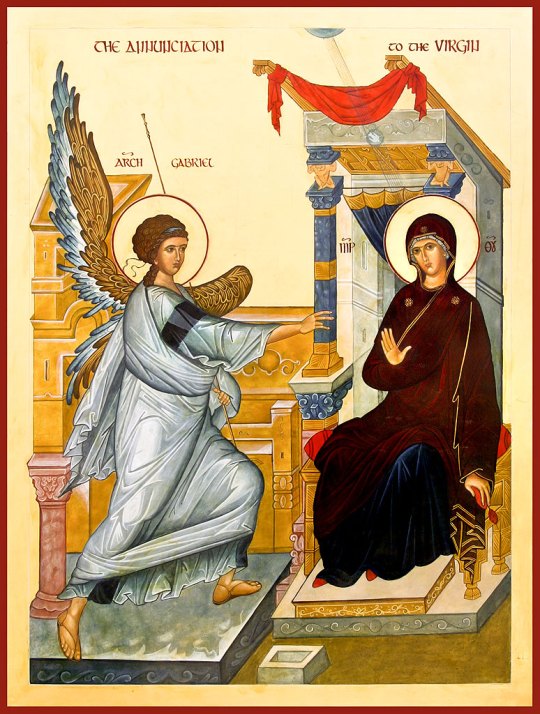
…His wings as drifted snow, his eyes as flame…
The first lines of the carol “Gabriel’s Message” take my imagination straight up to Heaven, and down again to the encounter the Virgin Mary had with the Angel Gabriel. This song of the Annunciation I heard for the first time a couple of years ago. Nowadays, if I so much as think about it once in the morning, or often even without consciously bringing it to mind, it plays in my head all day, beautifully, joyously.
In looking for a YouTube video of it to share here, I found that I don’t like the ones in which boys’ choirs are singing sweetly bird-like. It seems a strong man’s voice should speak the message of the first two stanzas, which come from Gabriel.
This version is my all around favorite, in which a choir sings in lower registers.
This man singing solo is my favorite manly rendition. I like the way he sings it straight, and the only way I’d improve on it is to not have to look at him as the performer.
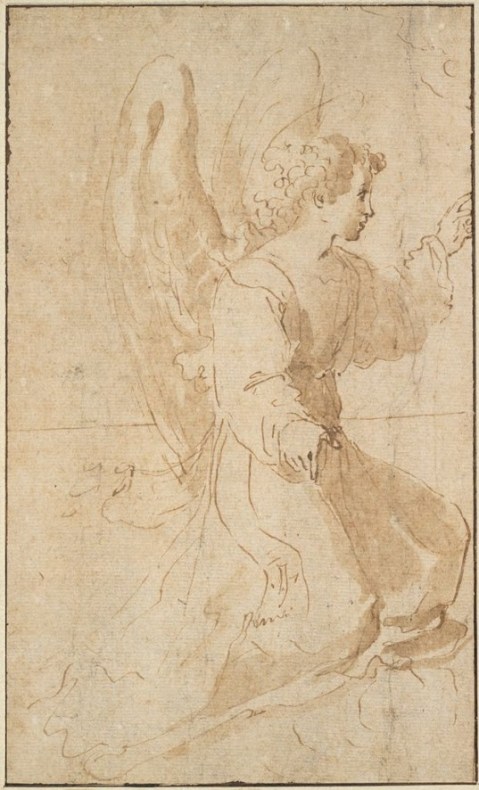
I was interested to see that there aren’t many icons or paintings of Gabriel in which his wings look anything like drifted snow. In fact, the image of drifted snow doesn’t evoke the idea of the strength that would be necessary for the swift messenger of God we know an angel to be. In many paintings Gabriel’s wings look very powerful, and poised to be in flight in an instant, at the next word from God. But the phrase does make me think of purity, and certainly the scene of fresh snow is somewhat other-worldly.
Angels do not have any inherent form; they are spiritual beings who only take on human-like form in order to be seen by those who are given the spiritual eyes to see. We don’t have a record of how the Archangel Gabriel appeared to the eyes of the Virgin, but we do know his message:
GABRIEL’S MESSAGE
1 The angel Gabriel from heaven came,
his wings as drifted snow, his eyes as flame;
“All hail,” said he to meek and lowly Mary,
“most highly favored maiden.” Gloria!
2 “I come from heav’n to tell the Lord’s decree:
a blessed virgin mother you shall be.
Your Son shall be Immanuel, by seers foretold,
most highly favored maiden.” Gloria!
3 Then gentle Mary meekly bowed her head;
“To me be as it pleases God,” she said.
“My soul shall laud and magnify his holy name.”
Most highly favored maiden, Gloria!
4 Of her, Immanuel, the Christ, was born
In Bethlehem, all on a Christmas morn,
and Christian folk throughout the world will ever say,
“Most highly favored maiden.” Gloria!
 Father Stephen Freeman by his writing has been helping us for a long time, to understand how shame motivates our behavior, both good and bad. There is both healthy shame, which we are “hardwired” with, and toxic shame, which often has unhealthy ramifications down through the generations.
 Gladsome Lights