The law the lawyers know about
Is property and land;
But why the leaves are on the trees,
And why the wind disturbs the seas,
Why honey is the food of bees,
Why horses have such tender knees,
Why winters come and rivers freeze,
Why Faith is more than what one sees,
And Hope survives the worst disease,
And Charity is more than these,
They do not understand.
We have helped our neighbor over the years by pruning her overgrown Asian pear tree, and by picking up the fruit that drops throughout the summer months. Recently she did some of this work herself, and put fifty or so pears into a plastic bag and left it under the tree for a week or two. After a while Mr. Glad couldn’t stand it, and he tried to put the whole lot into the trash, but he found it also contained scads of bees, one of which stung him.
[Correction years later: Those probably were not bees, but syrphid flies; I can’t see any of the images clearly enough to know, this much removed from the event. I didn’t know about syrphids at the time, and even after learning how flies differ from bees, I get them mixed up. But this article has some good information still, so I will leave it up. And maybe it is not a yellow jacket, either, but it is a wasp.]
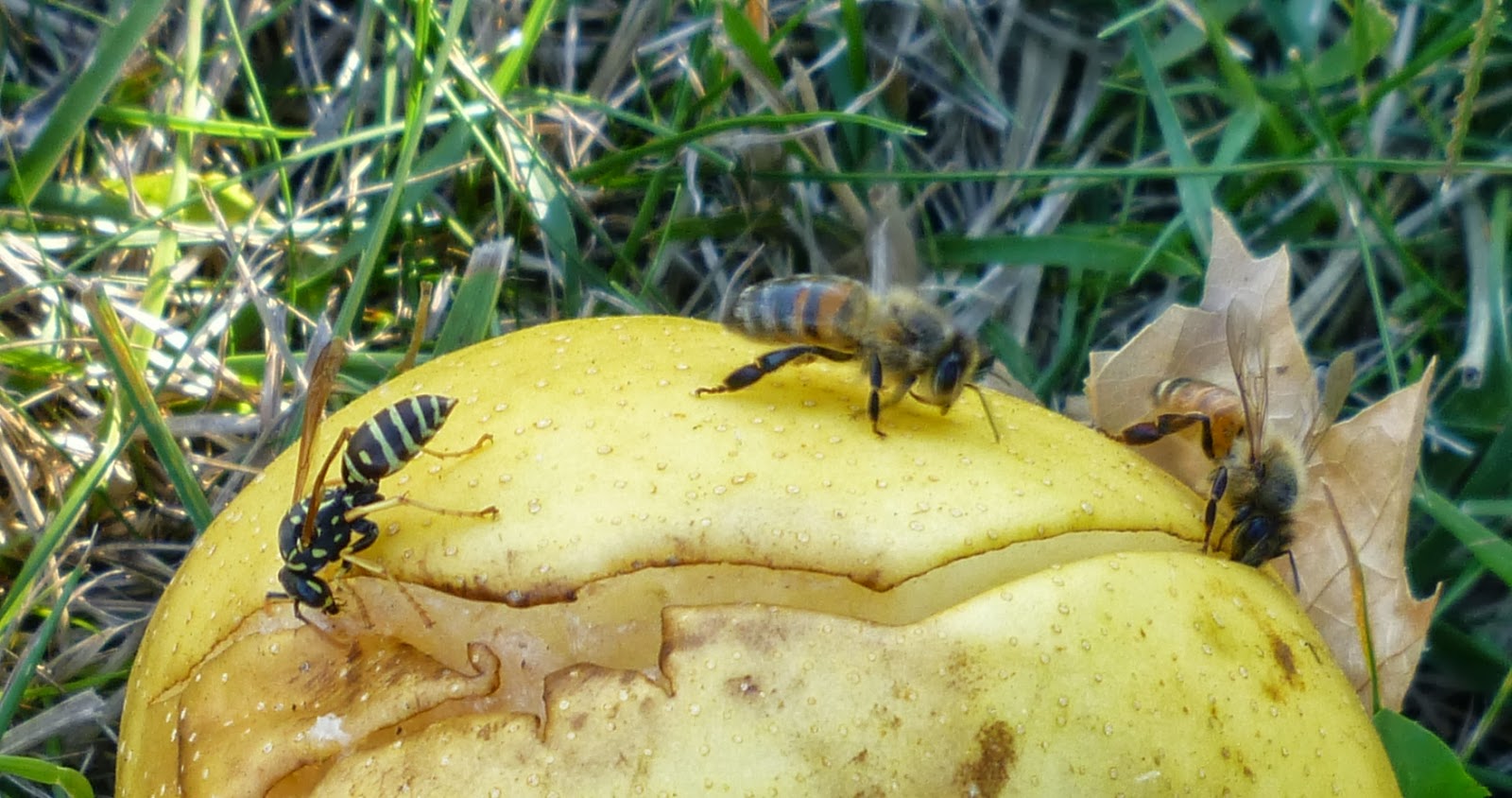
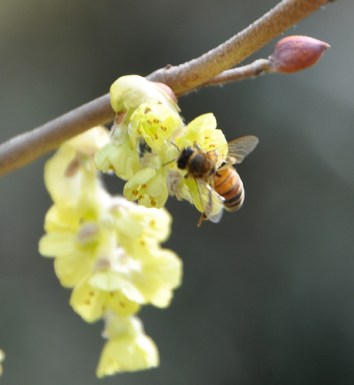
I saw one of those fruits on the sidewalk with 60% of the inside gone, in the process of being excavated by six honeybees. I was so surprised — I didn’t know they would eat fruit. Another day I took pictures of some of the pears lying on the grass, full of bees, and wasps too.
yellow-jacket wasp on left
The few wasps were spending as much time acting aggressively toward the bees as they were drinking pear juice, trying to be king of the mountain. I thought of what I’d read from The Bee Lady, who recently instructed us about the difference in species. She also let us in on the fact that yellow jackets are carnivores, and they will eat bees. I think that is horrid – as if bees didn’t have enough problems already.
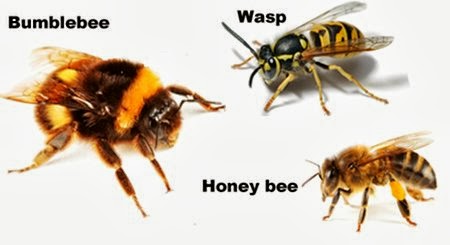
Wasps aren’t bees. Pest removal companies perpetuate the confusion by saying they do “bee removal” when they are talking about both insects. Why can’t they say “Bee and Wasp Removal”? This one has a good chart showing many wasps and bees, even though the company name is not entomologically precise.
To be fair, even wasps do serve a purpose on the earth, as this page points out. I read that one kind of wasp eats black widows, for which I’m sure I must thank the Lord.
I liked this page, too, that delineates some differences between bumblebees and honeybees. Ants, wasps and bees are related species, but they are different species. I am with The Bee Lady on this one — bees should not have to bear the reproach of their cousins.
Ever since I reviewed all those pictures of the blessing of bees and honey, while telling about the Feast of Transfiguration, my love for bees has grown as has my wonderment at honey and the miracle of it all. I’m even eating more honey, such a beautiful food. Wasps haven’t a clue how to make it.
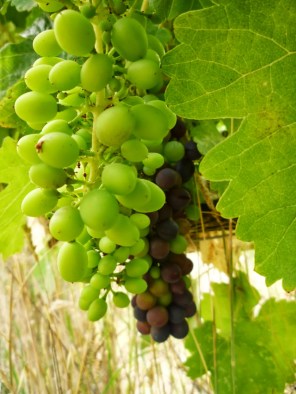
My parish is lucky enough to have our own vineyard right behind the church. This is very handy on the Feast of Transfiguration; at the end of the liturgy we can process out the doors and around the vineyard, to bless the grapes. It’s traditional to bless grapes or apples or any fruit, really, on this day.
Earlier on the feast day morning people brought into the church baskets of fruit and herbs and flowers. I carried a wooden bowl of blueberries and peaches. While we sang and communed and focused on the main event being commemorated, the fruit waited. The incense was particularly sweet that day, and I didn’t notice the smell of the beeswax candles as much as I usually do. Though I could see basil in a couple of the baskets, I didn’t catch its aroma either.
At the end of the service, with the prescribed prayers for the event, Father L. (and all of us) thanked God for all His bounty, and then he sprinkled holy water over the representative sampling.
He explained to us that this is not a superstitious rite we perform, using holy water to do magic on the fruit. When we bless anything in this way we do not make it into something other than what it is, but ask God to reveal it to be what it has always been.
Whatever created things we are talking about, they have always been meant by God to bring us into communion with Him. The service of blessing of fruit brings our thoughts back to Paradise, and the right and good use of the fruits of the earth that God has given us. We are reminded of how in the beginning God made Adam and Eve to be stewards over the Garden of Eden; human beings were called to exercise a loving and thankful dominion over the earth.
Russia
But we by our sin have instead caused destruction on the earth. Mankind more often than not has overused, abused and consumed in perverse ways the gifts of the Creator. Personally, I often gobble my food and eat without attentiveness to Him.
We have prayers for the blessing of bees and beehives and honey, too, usually in a separate service. Around here it’s August 1st, but I found pictures of honey blessings in Bulgaria where they do it dramatically on February 10 (see the bright cross picture down the page).
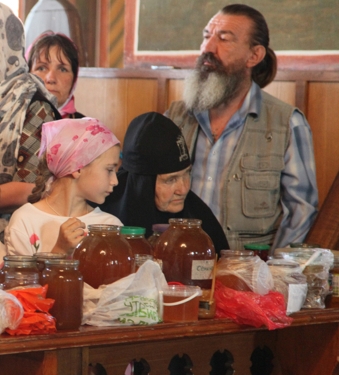
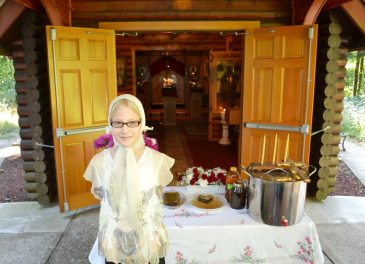
People like to take pictures of little girls and honey, I was happy to discover, and I am posting some of them here. The Russian ones are from Optina Monastery, and the Oregon photos from the Facebook page of New Martyrs of Russia Orthodox Church.
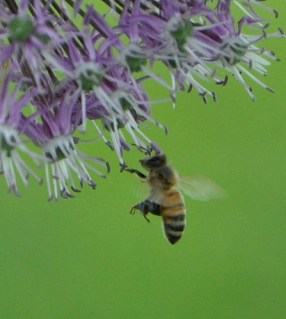
These honey and bee pictures are so enjoyable that I ended up with way more of them than of fruit. I hope you will hop over to the blog of Father Ted Bobosh where he posted a large and glorious photo collection of bees and other pollinators, such as the one I put at the very top, along with quotes about bees and Orthodox prayers for them. Just looking at the pictures will likely make you burst into prayer, too. Here is one of the prayers he posted:
From Father Ted
O God, who knows how to work benefits through human labor and irrational living things, You instructed us in your loving-kindness to employ the fruits and works of the bees for our needs. Now humbly we beseech Your majesty: Be pleased to bless the bees and increase them for the profit of the human race, preserving them and making them abundant. Let everyone hoping in Your majesty and Your boundless compassions, and laboring in the care of these living things, be counted worthy to receive abundant fruits of their labors and to be filled with heavenly blessings in Christ Jesus our Lord, to whom is due glory, honor and worship unto ages of ages. Amen.
The photo above is from my church on Transfiguration, baskets of all kinds of fruits of the earth waiting for the prayers of blessing. Some of them were inspiring in the variety and arrangement of items, but one of my favorite baskets is the big one in front, full of apples picked just that morning.I don’t eat much honey these days, but I get a whiff of it in the candles every Sunday in church, and I can imagine the heady scent emanating from these tables laden with jars and bowls and plates of honey.
Doesn’t it just tell you something about our God, how sweet He is, and how extravagantly generous, that He would give us something as intense and rich as honey? The bees, of course, are also in the business of pollinating the fruit. The whole Creation and its interconnectedness is reflected in the Church and in our salvation history, all of a piece and orchestrated in love by our dear Father God.
Fr. L blessing beehivesBlessing honey in BulgariaHoney blessing in OregonOregon honeycomb
Like the bees, Mr. Glad and I have been using the last warm days of autumn to finish up some outdoor projects. I wanted to have a pot of flowers by the front door, and he had got us started on a new long triangle of lawn-replacement landscaping. Today we finished up the latter, and I took some pictures of various things in the front yard.
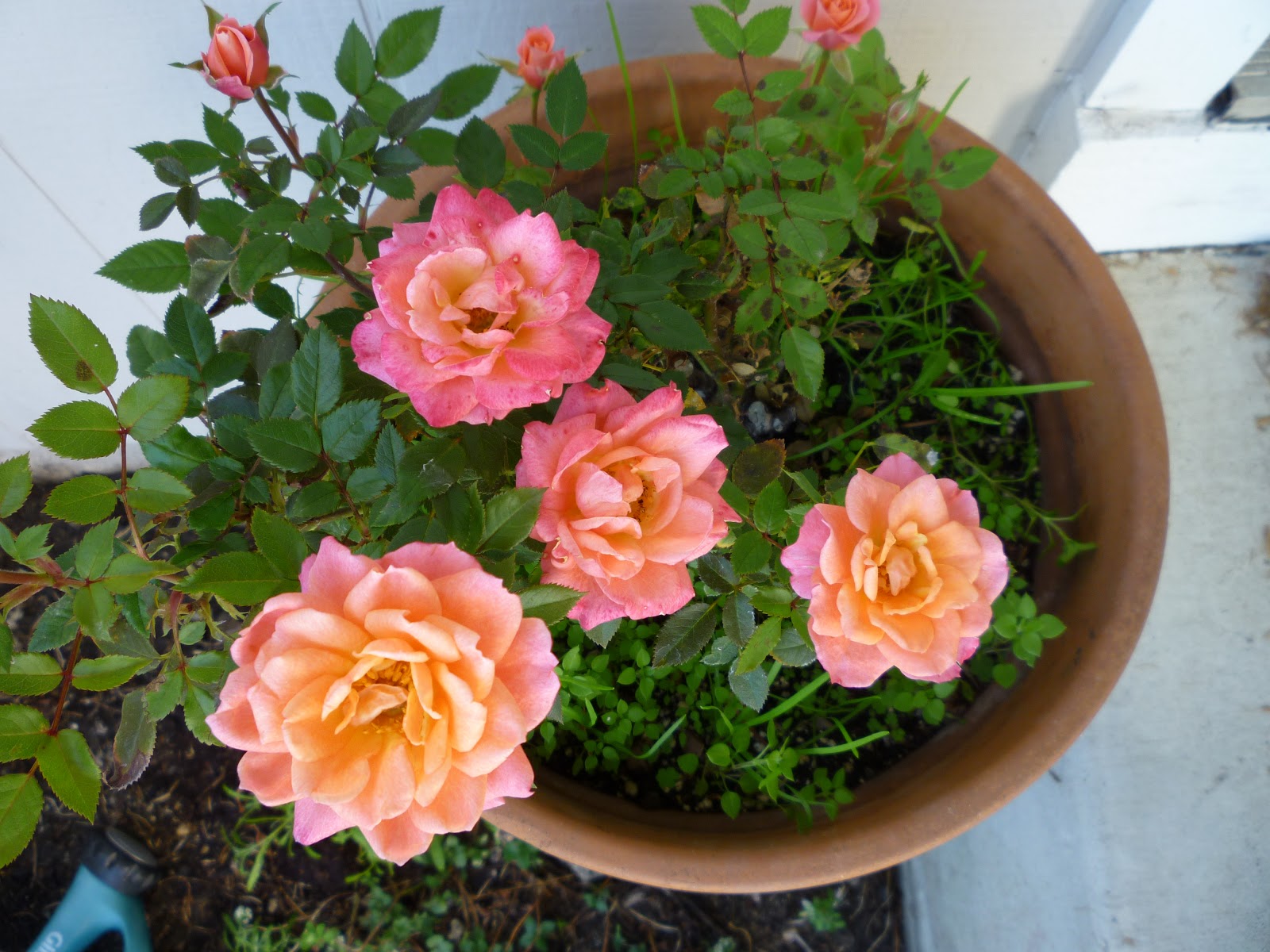
I have several pots now that I can rotate in and out sitting on the upended log by the door. The roses were blooming in the back yard so brought them out front to the place of honor without bothering to pull out the weeds.
This pic shows where the patch of lawn was replaced with some little shrubs and perennials that don’t need much water. They are small now but will spread out before long. Parts of the front yard still need sprucing up for winter, but I wanted to take this picture before the flowers faded from the new plants.
Wouldn’t you know it, the bees have not run out of flowers from which to gather nectar. They were working alongside us, in the rosemary bushes that are in full bloom. Now I think I’ve posted pictures of bees in five or six different flowers. I’ll have to do some research on that and consider doing a bee album!












 Gladsome Lights