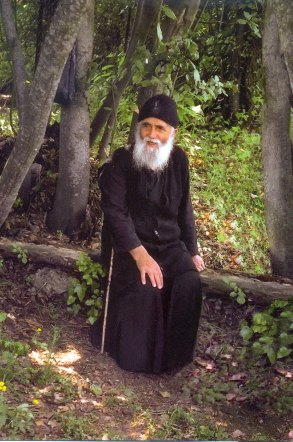
[From St. Paisios] Some people tell me that they are scandalized because they see many things wrong in the Church. I tell them that if you ask a fly, “Are there any flowers in this area?” it will say, “I don’t know about flowers, but over there in that heap of rubbish you can find all the filth you want.” And it will go on to list all the unclean things it has been to.
Now, if you ask a honeybee, “Have you seen any unclean things in this area?” it will reply, “Unclean things? No, I have not seen any; the place here is full of the most fragrant flowers.” And it will go on to name all the flowers of the garden or the meadow.
You see, the fly only knows where the unclean things are, while the honeybee knows where the beautiful iris or hyacinth is.
As I have come to understand, some people resemble the honeybee and some resemble the fly. Those who resemble the fly seek to find evil in every circumstance and are preoccupied with it; they see no good anywhere. But those who resemble the honeybee only see the good in everything they see. The stupid person thinks stupidly and takes everything in the wrong way, whereas the person who has good thoughts, no matter what he sees, no matter what you tell him, maintains a positive and good thought.
+ St. Paisios of Mt. Athos, “Good and Evil Thoughts,”Spiritual Counsels III: Spiritual Struggle
(Elder Paisios was canonized on January 13 last year but he is commemorated on June 29/July 12. )
I just came in from working in the yard where if one is digging, toting and harvesting under the sun, it is hot. My last sweaty session of gardening was in the mid-afternoon, this week when the temperature has been in the 90’s; that workout made me resolve to take the first morning available and head outdoors early to get my seedlings into the ground.
baby collards
Of the seven packages of old seeds I tested, three have sprouted up thickly: collards, kale and parsley.
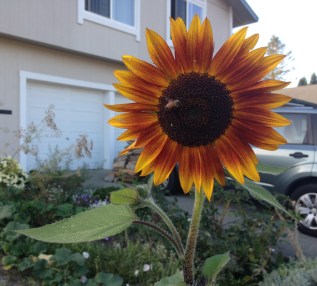
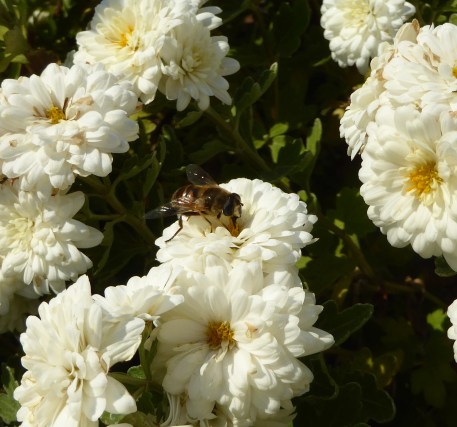
I’ve been intending to plant them for over a week, but every time I get started I end up doing something else, only occasionally preparatory. This morning I spent a while trying to take pictures of the bees drinking from the mums. Last week I accidentally included a bee on a sunflower.
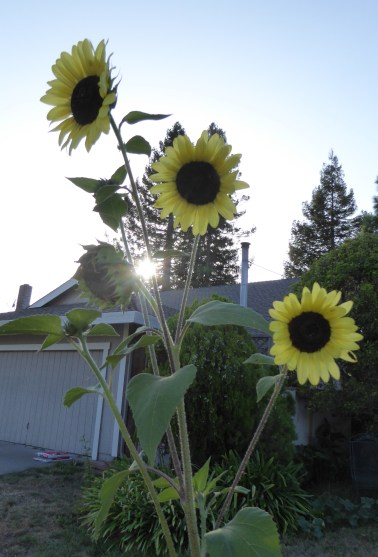
A gardener friend gave me sunflower seeds in the spring, and I bought some plants at the same time. The varieties planted from seed were mostly eaten by birds when they were little, but I do like the few that survived, better than the tall plants that bloomed earlier in the summer.
Lacking a back yard to garden in this summer, I had tucked the sunflowers and some vegetables into the borders of the dead lawn, where the irrigation emitters oversprayed anyway. In the middle of the lawn where this doesn’t happen, big cracks have opened up in several places. I poked a yardstick into one and it went down 30″ easily. That’s a crevasse measuring 36″L x 4″W x 30″D.
I didn’t figure out the volume, but I started filling it with whatever organic material I could find, including flour left over from Y2K, old coffee beans, and a pile of dirt that had been sent over by my Landscape Lady from another installation. I topped it off with some old planting mix, and am thinking of planting some Rainbow Chard seeds in a jagged row.
Rainbow Chard bed in foreground.
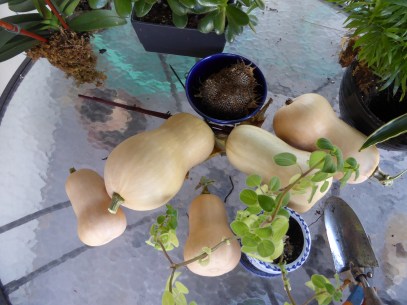
Another task I’ve worked on out front is harvesting my butternut squashes. These are the ones I picked last week, on the patio table where I had been transplanting things into and among pots. The total weight on those was 15#.
(In the blue bowl is a sunflower head from which I will save the seeds.)
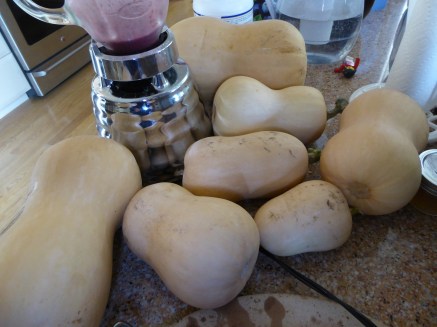
Today I picked the remainder of the fruits, and brought them in when I was too hot to work any longer. That’s never happened to me before noon before! I set them on the counter and then pushed them aside to make a smoothie with frozen blueberries to help me cool down.
This second picking yielded 22#. The prize-winner weighed 7 1/2 pounds. This was my best butternut crop ever.
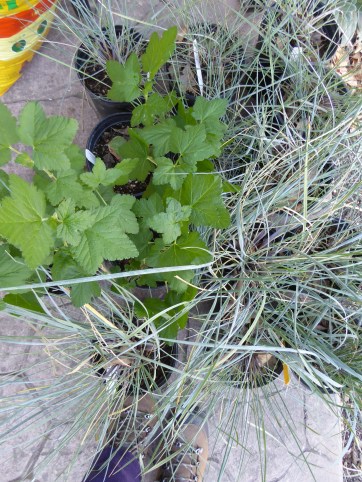
Last week I found a fountain for the back yard, and yesterday when she came with the installer to talk about organizing the upcoming transformation, my Landscape Lady brought along a few plants that she had bought, with apologies for me having to babysit them; they are California natives that she had to get a little early before they sell out. I don’t mind babysitting at all — I am jazzed to have these promises of good things to come, right here on site.
Ribes and Festuca
We discussed the most efficient sequence of the various steps, preparing beds, laying paths and irrigation, planting; who will build the vegetable boxes and how to prepare the greenhouse floor — Did you even know that I am planning for a greenhouse??
The two months during which I have been staring out at a sea of dirt seem like two years, but luckily I have had plenty of other work and fun to occupy my mind while I’m waiting. Now things are starting to happen.
This Yerba Buena grows in the wild in our area, and will like the soil and shade under my pine tree where it can trail around. It’s edible and minty and good for making tea if I want. Lots of things in my new back yard will be edible, including the ribes, also known as Pink Flowering Currant. The Native Americans used to harvest the berries to eat, but I read that they are not that tasty to modern humans, so I plan to enjoy watching the birds feast on them while I relax on the bench nearby. As soon as it is sittable, I hope you will come and watch with me.
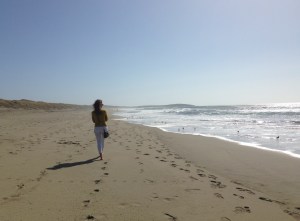
Kate visited me from Washington DC for a few days – it was a joy. When your children are spread over thirteen years, they don’t all get the same upbringing or hear the same stories. We went to the beach and sat on a log for a long time talking and catching up.
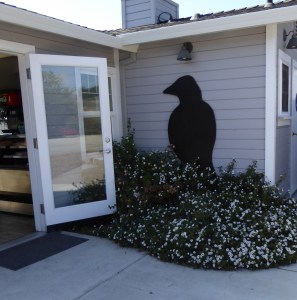
Kate was married just over a year ago near where we went to the beach, in Bodega, at what we fondly called The Birds Church. The fish-n-chips place where we ate in the nearby town of Bodega Bay is called The Birds Cafe. Alfred Hitchcock’s imagination has left an ongoing legacy.
Down on the shore the birds were not scary. Kate took pictures of a gull who hung around our log for quite awhile until he figured out that we didn’t have food. The sandpipers were more naturally seeking for their more natural food. It was the balmiest day I can remember on our typically frigid beaches; even the breeze was warm.
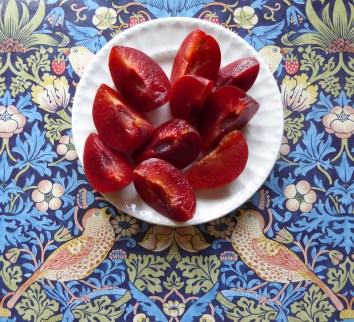
Kate helped me draft a note to leave in neighbors’ mailboxes, asking “Do you have a plum tree?” You see, I fell in love with the Elephant Heart plums that are growing at Pearl’s new house in Davis; they are the best plums I have ever eaten. Though I hadn’t given plum trees a thought before June, I’ve now got it in my head and on the landscaping plans that I will plant one of these trees in my refurbished back yard. These pictures are of fruits that I brought back from my last visit to Pearl.
They are not self-pollinating, so I either need two of them or I need to know that there is another tree in the neighborhood that can be a pollinator. Either another Elephant Heart plum or a Santa Rosa plum will do. I’d rather not have two plum trees, as my yard isn’t that big, and I am not that ravenous for plums. So I hoped to discover another suitable tree around here.
I first asked the neighbors whom I already know. The ones I didn’t know, on my street and the street behind me, I asked by means of my explanatory note, a paragraph with that grabber question at the top, which I dropped off yesterday afternoon. This afternoon two people who received the notes phoned to say that they do have Santa Rosa plums! My tree will be right in the middle of those two trees, as the bee flies.
And now I have two new friends, Rich and Dale. Dale has more than 20 fruit trees in his back yard! Rich planted his Santa Rosa plum as a pollinator for a Satsuma plum that he loved. Next summer we will get together and trade plums — yum.
Over the last several weeks I’ve collected some good Internet finds into this draft which I haven’t yet managed to finesse into a very cohesive offering. Even so, I think I better post it, before it gets even larger.
What does it take for you women to “feel good about yourself”? This blog post, What’s Your Excuse? spins off a provocative photo and discusses our life’s purpose and calling. It’s true we all make excuses for failings, but maybe some of us are focusing on the wrong goals in the first place.
How we live out and demonstrate our priorities has a huge effect on our children. Lisa writes about training our children and about praying for them, in The Prayers of Parents. It reminds me of a book I read when my own children were small, by Andrew Murray, Raising Your Children for Christ. From the blurb on the paperback cover I expected lots of practical advice such as methods of discipline and teaching, but 90% of the book was a month’s worth of devotionals emphasizing the parents’ faith and prayer. Of course, that is very practical – definitely not theoretical! And so is Lisa’s admonition.
From the cultivation of the spiritual life, I will segue into the cultivation of the earth, and a very surprising thesis of this article on the unsustainability of organic farming. Why would this be? I am only beginning to process the complexities of what the writer is saying. I know that the natural and best ways of doing many things are often not the most “efficient,” and that is one reason I am not a big believer in efficiency. But unsustainable? That’s taking it to a new level of disturbing.
People trying to promote natural healing of the earth is one aspect of this article on Mossy’s blog telling about seed bombs. Has any of my readers done this “guerrilla gardening”? Mossy tells you how to make your own at home, but if you search the term you quickly find that you can buy the clay balls ready-made.
I appreciated another blogger‘s treating the subject in more depth and bringing up some issues, such as vendors selling “bombs” that contain seeds of plants that are invasive and undesirable for the part of the country they are marketed to. For example, some people are concerned about sweet alyssum, which I have certainly found to be invasive, but controllable in my own home garden.
I’m happy to tell you that hundreds of hardworking bees are flying around my garden these days. They make me so happy. My husband and I like to sit in the sun in the afternoons watching them buzz all over the lavender nearby. I hope you will go see Kelly’s picture of a honeybee — she caught him in a secret magnolia-blossom cave. I love looking at photos of bees on flowers — they are so hard to get. If any of you have one on your own blog I’d think it the sweetest thing if you sent me the link.
If you haven’t already acquired the habit of reading Fr. Stephen Freeman’s blog, here’s another prod: We Will Not Make the World a Better Place. He discusses “The Modern Project,” modern because, “You will search in vain for the notion of making a better world prior to the 16th century.” Fabian Socialists, the Treaty of Versailles, and the Armenian genocide all figure in his remarks on political theory and history. And a quote: “Stanley Hauerwas has famously noted that whenever Christians agree to take charge of the outcome of history, they have agreed to do violence.”
Last, and important, humor: One of the funniest things I came across this week was on Language Log, a place to read linguists’ comments on many everyday happenings in languages, English and others. From time to time one of their many contributors writes about how Chinese signs get translated in odd and amusing ways. Some are written to forbid urination in various places and the English versions of the warnings can come out saying, “Urination is inhuman,” or “It is forbidden to urinate here. The penalty is bang.”
My pal Chesterton said that there are no uninteresting subjects, only uninterested people. I hope at least one topic here has been interesting to you!
 I just came in from working in the yard where if one is digging, toting and harvesting under the sun, it is hot. My last sweaty session of gardening was in the mid-afternoon, this week when the temperature has been in the 90’s; that workout made me resolve to take the first morning available and head outdoors early to get my seedlings into the ground.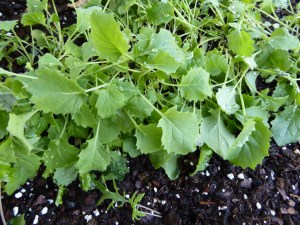
 d up doing something else, only occasionally preparatory. This morning I spent a while trying to take pictures of the bees drinking from the mums. Last week I accidentally included a bee on a sunflower.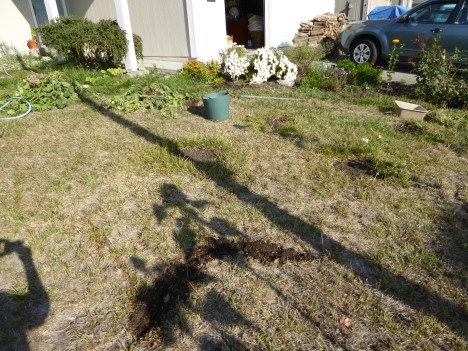
 e fruits, and brought them in when I was too hot to work any longer. That’s never happened to me before noon before! I set them on the counter and then pushed them aside to make a smoothie with frozen blueberries to help me cool down.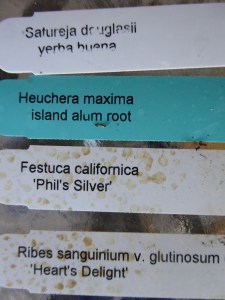


 from Washington DC for a few days – it was a joy. When your children are spread over thirteen years, they don’t all get the same upbringing or hear the same stories. We went to the beach and sat on a log for a long time talking and catching up.
 ongoing legacy.

 me of a book I read when my own children were small, by Andrew Murray, Raising Your Children for Christ. From the blurb on the paperback cover I expected lots of practical advice such as methods of discipline and teaching, but 90% of the book was a month’s worth of devotionals emphasizing the parents’ faith and prayer. Of course, that is very practical – definitely not theoretical! And so is Lisa’s admonition.
 found to be invasive, but controllable in my own home garden.
 odd and amusing ways. Some are written to forbid urination in various places and the English versions of the warnings can come out saying, “Urination is inhuman,” or “It is forbidden to urinate here. The penalty is bang.”
 Gladsome Lights