Tag Archives: Fr. Stephen Freeman

It’s my love language, too.

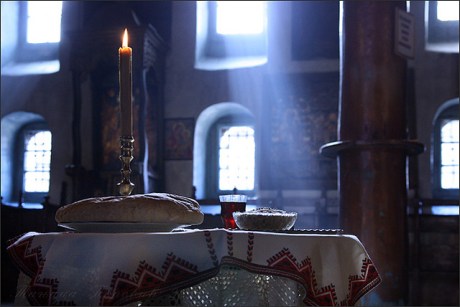
remembering the departed in Orthodox Chrisitian Church - offering bread, boiled wheat and red wine that are blessed by the priest

I want to share an article that is a kind of conversion testimony; it was published earlier this year with the title For the Love, on the blog Persona. The author well conveys the gratitude I also feel for the Church that encourages us above all to love people, and gives us tools for doing that. Tools? What am I saying? The Church gives us The Holy Spirit, a Person of the Holy Trinity Who live in Love, who are the source of any love.

Soon we will be remembering my goddaughter in prayer and song, on the one-year anniversary of her repose in the Lord. These days it is natural for me to think often about the dead, and not only my husband. For that reason I also appreciate what what Fr. Stephen Freeman has to say about our relationship to the departed, and  how, “With the radical individualism of the modern world, the mystery of communion and true participation (koinonia) have been forgotten….” 

The witness that follows is of someone who is discovering koinonia. I join with the writer of Persona in thankfulness for the ways the Church helps me to continue loving my dear Kathleen.

FOR THE LOVE

I attended my first service in an Orthodox Church in December of 2010. In April of 2012 I was chrismated (confirmed) in the church. What I don’t know about the Church could still fill several books, and I’m not very good at being Orthodox.

It’s a tradition that appears confusing and Byzantine to outsiders, with all of its incense and strange pictures, its standing and prostrating and crossing oneself. It seems legalistic, with all of the fasting and written prayers and candle-lighting. Praying to saints and the Virgin Mary? To Protestants, these things are often red flags, warnings of impending Catholicism.

I was frightened when I was first exposed to Orthodoxy. I was educated in a Protestant seminary, where I took classes on the theology of Martin Luther and the spiritual development of women as my electives (I have layers). I found it much easier to read about spirituality than to actually pray. I calmed my doubts with well-reasoned arguments, and I weighed and measured every sermon I heard to assess the soundness of its doctrine. I loved God with my mind.

Yet what drew me to Orthodoxy was not, ultimately the soundness of its doctrine or the reasonableness of its apologetics. From my earliest exposure to the tradition I acknowledged that it was quite likely the oldest expression of Christianity. But what ultimately brought me into the church was not a well-reasoned argument on the merits of prayer to the saints or an articulate defense of the use of icons and veneration of the Theotokos (the Virgin Mary). What ultimately brought me to the church was, quite simply, love.

As I participated in the life of the church, I was moved again and again by the love of the people. Yes, I was attracted by the love shown to me by the priest in my parish, and the new friends I made there. But what changed me, what won me over was realizing that at the root of all the practices that I didn’t understand, that seemed superfluous or legalistic, was love.

The Orthodox do not pray to saints because they feel that they cannot go directly to God. They don’t venerate the Theotokos because they feel that Christ alone is not enough. They don’t prostrate or light candles or fast because they feel they must earn their salvation. The Orthodox Church does what it does because they love – the Trinity, each other, the departed, saints – the Church loves them all. More than that, the church understands that we all love, and it gives us concrete ways to express ourselves.

For me, this all became very real a few months before I became a catechumen and began my (formal) journey towards Orthodoxy. When I was a teenager, someone very close to me passed away. The anniversary of her death approached, and I was sad. When I told my priest, he told me that the Church gives us a prayer service that we can pray on the anniversary of a loved one’s death. I went to the church and we lit a candle and prayed for her, and those of us who loved her.

koliva with roses 4-15

The Orthodox Church understands that we love people. It encourages us to love deeply. And then, when they’re gone, to be comforted by the love the Church has for them, and for us. At the death of a member of the church, listen to how they are spoken of – in glowing terms, seeing only the best, most beautiful parts of the brother or sister in the faith.

The Church invites us to look upon the saints with a similar love. They are not only examples to follow, but as beloved family members. Prayer, lighting candles, keeping their feast days are the ways that we express our love across time, across the chasm of death.

I told my mother recently that Orthodoxy speaks my love language. In Orthodoxy, faith moved from an intellectual proposition that I accepted to a radical love that changed me. I want to love in the way that the Church loves its people. I want to look at others and see the beautiful image of God and love them with fire and determination. I want to feel the genuine affection that I see for bishops and priests and monks. I want that love to move me outward, to serve and pray and be a better version of myself. I want others to know that they are loved.

I fail all the time. I’m not very good at being Orthodox. But I’d rather try and fail at this than succeed at almost anything else.

–from the blog Persona

Death was strangled…

…and other images of atonement are the subject of Fr. Stephen Freeman’s post Knocking Down the Gates of Hell, in which he shares the findings of a research paper he once wrote on Martin Luther’s hymns. Luther’s own atonement theology highly favored the imagery that also dominates that of the early church fathers, in which Christ smashes the gates of Hell and frees all those in chains.

Fr. Stephen shares several verses from various exuberant Orthodox Paschal hymns we are singing this month, such as these I excerpted from his post:

Hell, who had filled all men with fear,
Trembled at the sight of Thee,
And in haste he yielded up his prisoners,
O Immortal Sun of Glory.

Thou hast destroyed the palaces of hell by Thy Burial, O Christ.
Thou hast trampled death down by Thy death, O Lord,
And redeemed earth’s children from corruption.

Though Thou art buried in a grave, O Christ,
Though Thou goest down to hell, O Savior,
Thou hast stripped hell naked, emptying its graves.

Death seized Thee, O Jesus,
And was strangled in Thy trap.
Hell’s gates were smashed, the fallen were set free,
And carried from beneath the earth on high.

Thou didst will, O Savior,
To go beneath the earth.
Thou didst free death’s fallen captives from their chains,
Leading them from earth to heaven.

In the earth’s dark bosom
The Grain of Wheat is laid.
By its death, it shall bring forth abundant fruit:
Adam’s sons, freed from the chains of death.

Wishing to save Adam,
Thou didst come down to earth.
Not finding him on earth, O Master,
Thou didst descend to Hades seeking him.

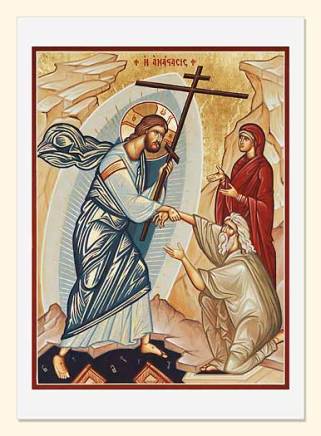
The Paschal icon shows the resurrected Christ pulling Adam and others out of Hades.

db271-resurrectionstvladorthchurch

It’s Bright Monday as I write. This morning’s Divine Liturgy was splendid and full of love and light. We are all giddy with joy and fatigue, and can’t stop greeting one another with kisses and proclamations of “Christ is risen!” In the Paschal Canon where we sing, “Let us embrace each other joyously!” I always hope I will be standing next to someone I can hug at that moment. Today two women I didn’t know were the closest, and I made so bold as to hug them both at once, which they didn’t seem to mind. gl - EB

I realized just in time for the midnight service of Pascha Saturday/Sunday, something I have had to call to mind again and again over the last months, that wherever my late husband is, he lives in the present. The part of me that grieves for his presence the way it used to be, as my earthly lover and companion, can never be satisfied; it is a longing for the past, and God is giving me instead Himself and all His gifts in this present moment. My dear Mr. Glad does not live “back there” in the past, either!

It’s because the various parts of me are not all united that my heart’s faith and love must keep instructing my mind — and other tangled and erratic parts? — that to be here right now with God is the way to stay close to my husband. In the reality of the Resurrection and our Blessed Hope, in the gathering of time and times that is kairos, he and I are more together than we have ever been, and in Love.

gl rose pascha 16


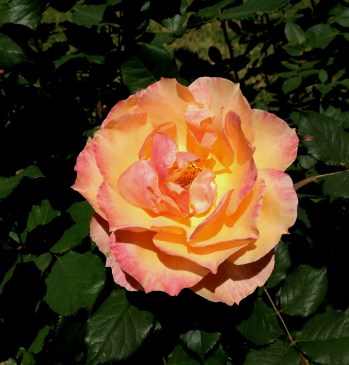
One sweet thing about Pascha coming so late this year is that roses are blooming all over. We have dozens of rosebushes at church that are loaded with flowers (not to mention the white roses that filled bouquets decorating inside the church.) This morning I took a picture of one favorite, to decorate this blog post. Happy Spring! Christ is risen! If you have read this far, I send you my Easter love!


Ironing in the Light.

I took time to do some ironing this morning and it was glorious. How could that be, you wonder? It was the Lord; He is glorious.

I used to “take in ironing” for money when I was a teenager, and I’ve enjoyed the task ever since, at least, when I’m not in a rush. I liked to set up my ironing station in the living rogl P1030303om occasionally so I could watch a baseball game on TV with my husband at the same time. I would in a leisurely fashion catch up on pressing all his work shirts, and my own clothes, which often needed it, too. I know, there are lots of women these days who Don’t Iron. I am not very current that way.
Today I was alone, and I didn’t consider multitasking because I didn’t think I’d be at it very long. The sun was streaming into the great room which I had just rearranged and tidied up, so that is where the ironing board landed. When people are sleeping in that room it gets moved all around; I don’t have a dedicated laundry room.gl P1030299

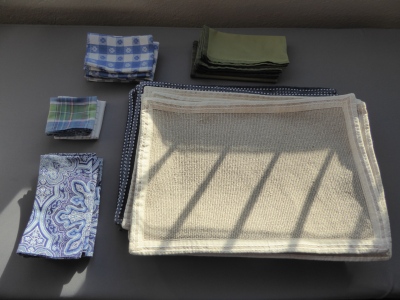
Today I did quite a few placemats, napkins, and handkerchiefs. I noticed the differences in various qualities among the napkins. The paisley napkins Pearl sewed to go with some teacups she gave me. They are perfectly square with meticulous stitching, and the fabric is good quality, easy to press smoothly.

The checkered napkins are ones I made eons ago of soft and thick fabric, nice for wiping one’s chin, but they are not well-sewn or uniform in size or shape. It’s so heartening to have one’s children rise above their examples. The green napkins I bought, and they are of terribly wrinkly and coarse fabric that takes a lot of pressing and steam to get into shape.

The plaid handkerchief is one of many I sewed for Mr. Glad from an old skirt. The fabric is soft and thin enough, but so strong that the handkerchiefs I made have lasted for years and now I am using them myself.

As I was working the wrinkles out of skirts and napkins, I thought about what I had read yesterday on Fr. Stephen Freeman’s blog post, “An Unnecessary Salvation”:

That Christianity in its classical form has always had an instinct for “all things,” is evidenced in the use of “all things” within its services and sacraments. And when those uses are examined, what is uncovered is a “seamless garment” of salvation. Nothing is “by the way.” I have made the statement from time to time with catechumens in my parish that we could begin with the smallest thing, a simple blade of grass, and go from there to give a full account of the entirety of the gospel. It could also be said that if an account of the gospel excludes even so much as a blade of grass, then it has been seriously misunderstood.

I knew that this morning I was being saved by ironing….and I was glad that I could be ironing in peace, in the presence of God, singing my prayers, and my feet weren’t hurting ! and also, I have the best ironing board. I tried to buy an ironing board for one of my daughters a few years ago and I was appalled at how rickety they all are now. I haven’t seen or used one as sturdy, heavy and stable as mine in decades. No wonder women don’t want to iron, if they have to work on flimsy equipment.

The light coming into that room must have made me think of the song, “The Lord is My Light and My Salvation,” and from there, a really old one we sang in the Jesus People days, “I Saw the Lord,” which, as I remember it, continues:

I saw the Lord, sitting upon a throne:
He is high and lifted up,
And His train fills the temple.
He is high and lifted up,
And His train fills the temple.
The angels cry “Holy!” The angels cry “Holy!”
The angels cry “Holy is the LORD!”

Anything less is a bondage.

Fr. Stephen asks rhetorically, “Can You Forgive Someone Else’s Enemies?” with a look at the words and actions of Jesus in the Gospels, and reflecting on the story of The Brothers Karamazov. He writes:

Forgiving is “loosing.” Refusing to forgive is “binding.” The imagery of loosing and binding helps move the imagination away from a legal construction. When we sin, or even when we are involved in sin, we become bound. There is a binding that occurs because we ourselves were the cause of the sin. There is a binding that occurs because we ourselves were the victim of a sin. Thchrist forgiving resurrection 2ere is a binding that occurs because we simply witness the sin. There is even a form of binding that occurs to the whole of humanity because of the diminishment of even one of its members. If everyone were somehow only responsible for their own actions the world would be quite different. As it is, the action of one involves the binding of all. Adam’s sin has left us bound ever since. We are not being held legally responsible for Adam’s action. We are existentially and ontologically bound by Adam’s sin.

These truths are hard to grasp, even for the intellect, and Fr. Stephen helps me quite a bit at that level. But to live in the reality of our freedom, to acquire and absorb and give this kind of liberating love — it’s something impossible, were it not for the fact and the power of the Resurrection. Lent is a good time to pray about this, yes?

I’m looking forward to seeing all of my children at once this weekend, and the thought of them and their tender, breakable and forgiving hearts gives me great comfort; they are a testimony to the kindness of God. And His kindness certainly pertains to the article I was referencing, the whole of which you can read here.