Tag Archives: Fr. Stephen Freeman

Anything less is a bondage.

Fr. Stephen asks rhetorically, “Can You Forgive Someone Else’s Enemies?” with a look at the words and actions of Jesus in the Gospels, and reflecting on the story of The Brothers Karamazov. He writes:

Forgiving is “loosing.” Refusing to forgive is “binding.” The imagery of loosing and binding helps move the imagination away from a legal construction. When we sin, or even when we are involved in sin, we become bound. There is a binding that occurs because we ourselves were the cause of the sin. There is a binding that occurs because we ourselves were the victim of a sin. Thchrist forgiving resurrection 2ere is a binding that occurs because we simply witness the sin. There is even a form of binding that occurs to the whole of humanity because of the diminishment of even one of its members. If everyone were somehow only responsible for their own actions the world would be quite different. As it is, the action of one involves the binding of all. Adam’s sin has left us bound ever since. We are not being held legally responsible for Adam’s action. We are existentially and ontologically bound by Adam’s sin.
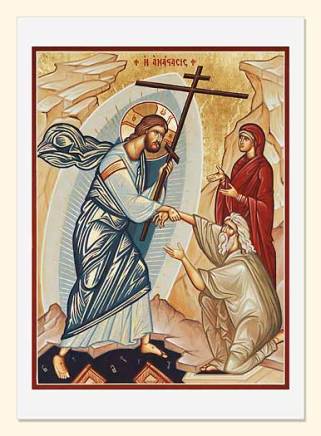
These truths are hard to grasp, even for the intellect, and Fr. Stephen helps me quite a bit at that level. But to live in the reality of our freedom, to acquire and absorb and give this kind of liberating love — it’s something impossible, were it not for the fact and the power of the Resurrection. Lent is a good time to pray about this, yes?

I’m looking forward to seeing all of my children at once this weekend, and the thought of them and their tender, breakable and forgiving hearts gives me great comfort; they are a testimony to the kindness of God. And His kindness certainly pertains to the article I was referencing, the whole of which you can read here.

Why do we eat?

SOME REMARKS ON FASTING by Fr. Stephen Freeman:

…. I have seen greater good accomplished in souls through their failure in the fasting season than in the souls of those who “fasted well.” Publicans enter the kingdom of God before Pharisees pretty much every time.

Why do we fast? Perhaps the more germane question is “why do we eat?” Christ quoted Scripture to the evil one and said, “Man does not live by bread alone but by every word that proceeds from the mouth of God.” We eat as though our life depended on it and it does not. We fast because our life depends on the word of God.

I worked for a couple of years as a hospice chaplain. During that time, daily sitting at the side of the beds of dying patients—I learned a little about how we die. It is a medical fact that many people become “anorexic” before death—that is —they cease to want food. Many times family and even doctors become concerned and force food on a patient who will not survive. Interestingly, it was found that patients who became anorexic had less pain than those who having become anorexic were forced to take food. (None of this is about the psychological anorexia that afflicts many of our youth. That is a tragedy)

It is as though at death our bodies have a wisdom we have lacked for most of our lives. It knows that what it needs is not food—but something deeper. The soul seeks and hungers for the living God. The body and its pain become a distraction. And thus in God’s mercy the distraction is reduced…Why do we fast? We fast so that we may live like a dying man, and in dying we can be born to eternal life.

Read the whole article here.

Adam wept.

And we’ve got to get ourselves back to the Garden…     Joni Mitchell (1969)

expulsion Adam & Eve - Decani Monastery

“And it is prayer that leads us back to Paradise. It is said that when a priest stands before the closed gates of the altar at the beginning of Vespers, he represents Adam weeping before the closed gates of Paradise. I think of that image often as I stand quietly waiting for the Reader to end the prayers of the ninth hour. For as I stand before those holy gates, all humanity stands in me. We all stand before the closed gates of paradise. Many times I find the gates closed even to the Paradise of the heart. My thoughts swirl with a thousand distractions and the gates of hell threaten my undoing.

“But it is good to stand still and to bow the head and to weep with Adam. For the doors that are shut will be opened. The gates that are closed will be lifted up. In the wonder of the Divine Liturgy the fruit of the Tree of Life will be brought forth with the invitation, ‘In the fear of God and with faith, draw near!’”

I’m posting this because today is the Sunday of Forgiveness, the day before Orthodox Lent begins, when we remember how Adam and Eve were expelled from Paradise.  Read more of this article by Fr. Stephen

(Fresco above is in Decani Monastery in Kosovo.)

Giddiness

I have described myself as “giddy” when I am euphoric or joyful, but the sense of the word in the following poem is more along the lines of dizzy or flighty. The poet muses about his giddy state of mind and how he needs God to save him from it.

We Orthodox are often exhorted concerning this problem of the mind’s whirlwind, and the way to calm it, as in this post: Be Still and Know That I Am God, in which we read: “This constellation of desires and feelings is a constant swirl within the mind. Since it consists of desires and feelings, it is extremely ineffective in guarding against outside desires and feelings. We are deeply vulnerable.”

The human condition has not changed much since George Herbert wrote the poem in the 1600’s. Herbert (1593-1633) was a Welsh-born English poet, orator and Anglican priest. Another more famous poet and priest, John Donne, became Hebert’s godfather when his own father died.

What has changed more is the English language, and besides the word giddy I found in this poem one that had been completely unknown to me: snudge. Merriam-Webster speculates that it is an alteration of snug, and basically means to snuggle or nestle.

But there may be more subtle and unpleasant connotations, having to do with antisocial attitudes or behavior. Crooked Talk: Five Hundred Years of the Language of Crime quotes a 1676 use of the word related to robbery: “[He] gives it to his snudge, who snudges away with it to his [fence] who buyes it.” By the time Robert Nares included it in his Glossary in 1822 he said it meant “a miser, curmudgeon, a sneaking fellow.”

Obviously I am attracted to this word snudge, describing something I am prone to doing, which might be perfectly wholesome — or not. I won’t try to determine which, because that effort sounds like too much temptation for my giddy mind.

GIDDINESS

Oh, what a thing is man! how far from power,
From settled peace and rest!
He is some twenty sev’ral men at least
Each sev’ral hour.

One while he counts of heav’n, as of his treasure:
But then a thought creeps in,
And calls him coward, who for fear of sin
Will lose a pleasure.

Now he will fight it out, and to the wars;
Now eat his bread in peace,
And snudge in quiet: now he scorns increase;
Now all day spares.

He builds a house, which quickly down must go,
As if a whirlwind blew
And crusht the building; and it’s partly true,
His mind is so.

O what a sight were Man, if his attires
Did alter with his mind;
And like a Dolphin’s skin, his clothes combin’d
With his desires!

Surely if each one saw another’s heart,
There would be no commerce,
No sale or bargain pass: all would disperse,
And live apart.

Lord, mend or rather make us: one creation
Will not suffice our turn:
Except thou make us daily, we shall spurn
Our own Salvation.

-George Herbert