The picture below is of a cemetery that I have visited a few times in the last two years. This week I was here for the burial of Nina, about whom I told you not long ago, when she was still going strong.

Nina said recently, and smiling, I’m sure, that she didn’t really want to celebrate another birthday on this earth; and though she wasn’t sick or in pain, her heart did stop one day, just before she would have turned 104.
When I heard that she had died I was still in the mountains, and it made me sad to think I would not be able to pray at her funeral – so I was pleasantly surprised to learn that it would not take place until later. It’s not traditional to wait that long, but perhaps the birth of one of her great-great-grandchildren, who was present at the service and two weeks old, had something to do with the delay.
It was to love and honor Nina that I made the effort to get to church that morning, and not because I knew her or her family very well. I wasn’t feeling energetic or “spiritual” and you might even say I was in a bad mood. So I was completely surprised at how personally and deeply I was affected.
Her casket was in the center of the church. We were all gathered around singing, and the priests and deacons were censing Nina and the church, because something fundamental and important and holy was going on. Yes, they were censing Nina. Father addressed the common but mistak en idea that people often express about the dead, saying, for example, “That’s not my mother!” as though the material aspect of the self was unessential. “Well, who is it, then?” he asked.
Father Stephen in a recent blog told about a Protestant church in his town that forbids the presence of the body at funerals. He writes, “Biology is easily the most fundamental aspect of our human existence. We do not ‘have’ bodies – we ‘are’ bodies.”
I’m so thankful that in my church we do not whisk away the body, but instead acknowledge it as the most “fundamental aspect” of the person and the way that we have known them their whole life. We sang a hymn about “the last kiss,” and we had the opportunity to kiss and venerate Nina’s holy body, with which she worshiped God and loved so many people during her many years on the earth.
I did think a lot about my husband that day, and I wept, because I still feel the raw places where he was torn away from me; but because it has been over a year since his own falling asleep, I was less distracted by my own grief and able to pay closer attention to the service than I could at the two funerals I attended last spring and summer. I noticed Christ with us at Nina’s funeral, and the palpable love of the Holy Trinity, which we reflected in and from our own bodies, still more or less intact.
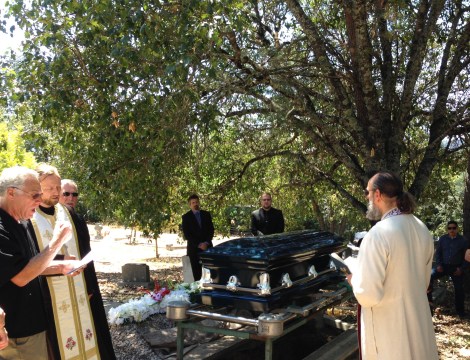
The liturgy of the funeral service is rich and deep. It is a commending of the believer to God, praying, “Grant rest in blessed repose, O Lord, to the soul of your servant,” many times, solemnly and lovingly, with Psalms and many readings from the Gospels and other scriptures, such as this passage from John, in which Jesus tells His disciples,
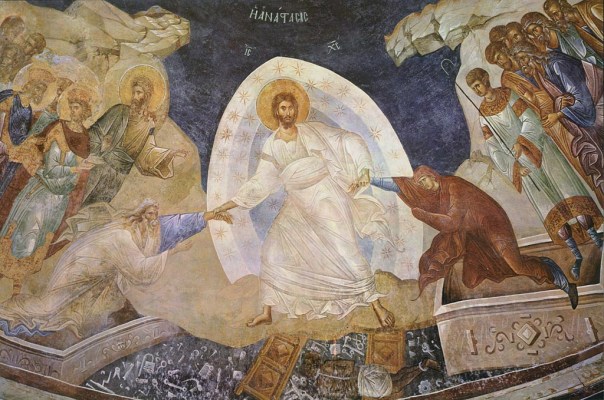
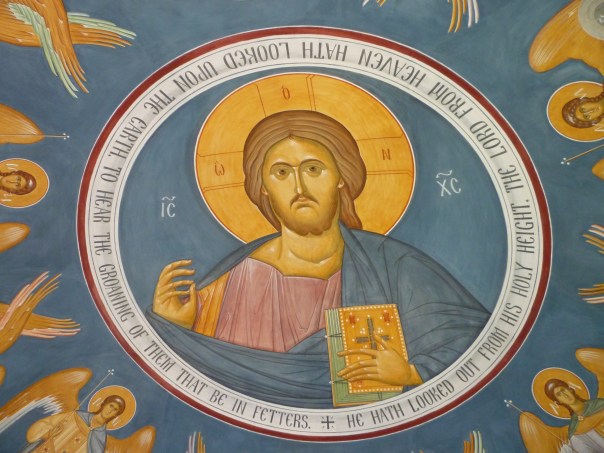
Verily, verily I say unto you, he that heareth My Word and believeth in Him that sent Me, hath everlasting life and shall not come into condemnation, but is passed from death unto life…. the hour is coming and now is, when the dead shall hear the voice of the Son of God; and they that hear shall live. For as the Father hath life in Himself, so hath He given to the Son to have life in Himself, and hath given Him authority to execute judgment also, because He is the Son of Man.
Marvel not at this; for the hour is coming in which all that are in the graves shall hear His voice and shall come forth….

Hearing words like this, I couldn’t dwell too long on the horrible unnaturalness of death, and the sorrow of a soul being torn from its body. Again, I am helped by the way that Fr. Stephen explains our perspective:
In the traditional theology of the Eastern Church, this world and the “next,” are not two worlds. We use the language of place (heaven and earth) for lack of language not for accuracy. There is more to the created order than we see (“all things visible and invisible”). But that which is not seen is not inherently separate from that which is. Sacrament (mystery in the East) is a way of describing the relationship between what is seen and what is unseen. Everything is sacrament, icon and symbol.
In such a setting, death is a change, but not an end. That which we see, the body, remains important and worthy of honor. A funeral, the service of remembrance, is a sacramental gathering in the presence of God. The body is honored, even venerated. The life of remembrance, eternal remembrance, begins.
I hadn’t planned to go to the cemetery for the burial, for various reasons, but I didn’t want to leave this event that seemed to have a stately and grace-filled momentum – I wanted that grace!
So I drove over with a couple of other women, and stood with the family and fellow parishioners, including that brand-new baby, while we committed our dear friend to the earth – for a time. The epistle we had just heard echoed in my mind,
(I Thessalonians 4) 13 But I would not have you to be ignorant, brethren, concerning those who are asleep, that ye sorrow not, even as others who have no hope.
14 For if we believe that Jesus died and rose again, even so will God bring with Him those also who sleep in Jesus.
15 For this we say unto you by the Word of the Lord: that we who are alive and remain unto the coming of the Lord, shall not precede those who are asleep.
16 For the Lord Himself shall descend from Heaven with a shout, with the voice of the archangel and with the trumpet of God; and the dead in Christ shall rise first;
17 then we who are alive and remain shall be caught up together with them in the clouds to meet the Lord in the air. And so shall we ever be with the Lord.
If you would like to read more about the Orthodox funeral service, there is a good article on this site. It’s all very encouraging!
With the saints give rest, O Christ, to the soul of Thy servant where sickness and sorrow
are no more, neither sighing, but life everlasting.