In his essay, “Does Goodness Require the Possibility of Evil?”, Father Stephen Freeman compares the Christian understanding of evil, choices, and being with that of Carl Jung, Star Trek, and Depth Psychology. He says that our modern way of elevating choice above all else leads us in the wrong direction:
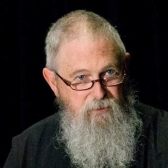 “Before looking at the nature of good and evil, it is worth seeing the problem involved when choice is inserted into the conversation. What happens in that approach is that we are no longer speaking about the nature of good and evil, indeed, both are relativized in importance. Everything quickly revolves back to the nature of choosing, and makes the actions of our will the center of the good. Thus, there is no true good or evil, only good choices and evil choices. It is a narcissistic ontology – a system of thought in which we ourselves become the center of attention.”
The writer reminds us that only God is good, and that the goodness that we know in our lives is a gift from Him. So where is evil in all  this? And how to sort out the choices that we have made? How many of our ignorant or hasty choices turned out for “evil”? Fr. Stephen recalls the example of Joseph in the Old Testament, who was the victim of his brothers’ evil choices.
“We cannot see the consequences of our actions (beyond the most immediate circumstances) nor can we control the myriad of other events that will interact with any choice we might make. We are simply insufficient of ourselves to create good through our choices.”
Getting from our narcissism and confused choices to receiving goodness has to do with movement:
“The course of our existence is a movement. That movement is impelled towards the good through our desire for God (sometimes manifest simply as a longing for beauty, truth, and goodness).”
To get a fuller picture than I can convey in these little clips, read the whole article: here.
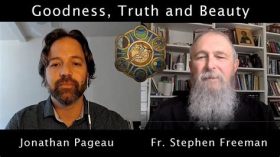
I just noticed that Father Stephen discussed “Goodness, Truth and Beauty” with Jonathan Pageau a couple of years ago: here.
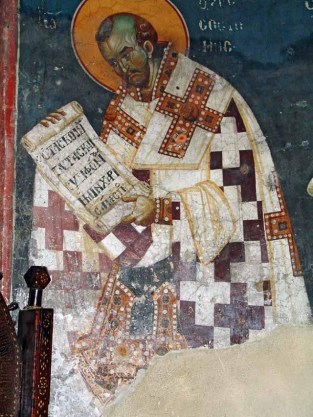 I can think of no Church Father who spoke more forcefully or critically about the moral failings of his time than St. John Chrysostom. He did not hesitate to call out the Emperor, or problems within the larger Church. Eventually, his words brought about his exile. Banished to the very edge of the empire, he died in isolation. Writing to the Deaconness Olympia, his closest friend and confidant, he expressed the very heart of Orthodoxy in troubled times:
 “I have stood near the cave of St. Jerome in Bethlehem, and seen the recently excavated graves of the Holy Innocents. There are a mass of infant burials, clearly made in haste, with evidence of violence, all dating to the first century. It is not a Biblical myth but a crime scene as gruesome as any that we could imagine. This is the Wisdom of Man.


