Tag Archives: Fr. Stephen Freeman

Healing in all directions.

“There is never a pain as deep as that inflicted by someone who is supposed to love you. Such injuries echo through the years and the generations. The face that stares back at us in the mirror is easily a fractal of someone whose actions power our own insanity. We can hate a parent, only to be haunted by their constant presence in us.”

The first part of Father Stephen Freeman’s post for today, “Every Generation,” is about that dark side of our human connectedness. But the reality of it works positively, also, as we all know, if not from our own families, then from others who might seem to have received a better legacy.

The older I get, the more time I spend considering all of the people who have gone before who have contributed to my physical and/or spiritual well-being. The Orthodox Church trains us in this perspective by bringing us very close to the saints throughout time whose names we do know, and closer to this earthly home, we often remember in our thankful prayers the “founders of this holy temple.”

No doubt the prayers of my Sunday School teachers and other adults protected me as I grew up; the teachers and friends, my parents and grandparents and great-grandparents, aunts and uncles gave me so much, in particular behaviors and actions that must remain in large degree a mystery to us who can only see the outward.

In many cases I’m sure that their gift to their descendants was to struggle… and fail; but having struggled, their defeat was not as much of a failure as it would have been. God only knows how they tried, how hard it was just to keep going day after day. If their minds were ignorant of the significance of their lives to the whole of humanity, they were nevertheless contributing:

“If we inherit a burden within our life, so our salvation, our struggles with that burden, involve not only ourselves but those who have gone before as well as those who come after. We struggle as the ‘Whole Adam’ (in the phrase of St. Silouan).

“There is an Athonite saying: ‘A monk heals his family for seven generations.’ When I first heard this, my thought was, ‘In which direction?’ The answer, I think, is every direction. We are always healing the family tree as we embrace the path of salvation, monk or layman. Our lives are just that connected.”

What does all that have to do with Christ’s mother? In her prophecy Mary said, “All generations shall call me blessed.” There is a lot packed into that statement. As Father Stephen writes:

“In her person we see all generations gathered together. Her ‘be it unto me according to your word’ resounds in the heart of every believer, uniting them to her heart whose flesh unites us to God.”

Read the whole article. I didn’t quote quite all of it! When I started to write this post it was still the Feast of the Dormition of Mary, which is a fitting day to think about these things. Now we have passed liturgically to the next day, but that’s okay, because every day is good to remember family and be thankful.

Born into everyone’s business.

Encounters with strangers often leave me feeling deeply connected at the fundamental level of our common humanity. People you don’t know, who may be needy themselves, or may help you in an emergency, or with whom you share a crisis, are often easier to feel close to than your dearest friend or your cousin you’ve loved since you were children. That is because you have nothing but your humanity to connect with. No offenses given or received have been stuffed into your baggage regarding that person.

Like the Indian woman I once sat next to, so very close to, on a plane from Mumbai to Frankfurt. She actually had been seated behind me when we first boarded, but before we were told to fasten our safety belts the man next to me, I guessed he was her son, traded places with her, perhaps so she could sit by a woman. I don’t know, but she and I liked each other, we could tell by our smiles, though we said not a word to each other during eight hours, not knowing the words.

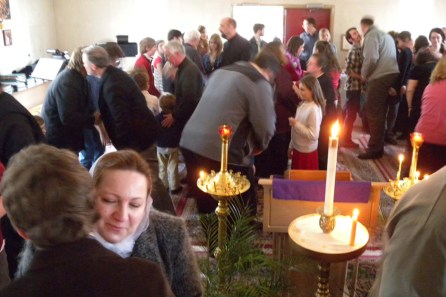
Today in the Orthodox Church we enter Great Lent with the Vespers of Forgiveness, when we also connect with many people we hardly know, on the ground of our fallen humanity. We admit with a bow and a kiss that we have sinned against them, whether we’ve ever spoken to them or have even seen them before. We exchange the words, “Please forgive me!” with each person in the service in turn, and each of us responds, “God forgives!”

Why? Because, as Elder Sophrony said, “Every sin, manifest or secret, committed by each one of us, affects the rest of the universe.”

I’m sure many of us find it difficult to comprehend, but going through this exercise every year will help us learn the truth in our hearts. Father Stephen Freeman helps, too, in passages like this:

The universe as an event of communion, a reality in which we literally participate, is quite foreign to the modern mind. The fiction of our radical individualism is an invention designed to promote the most irresponsible account of human freedom possible. It tells us that our lives “are our own,” and that we can act without consequences for anyone other than ourselves. “It is none of your business!” is the heart-cry of modernity. But this is simply not true.

We are born into everyone’s business and everyone’s business sets the stage and the very parameters of our existence. The language we speak, the thoughts we think, everything in our lives comes to us already burdened with the history and experience of the world around us. The saints treat this reality in the strongest possible sense. “My brother is my life,” St. Silouan says. By this, he does not mean simply that he cares strongly about his brother. He means it in its most literal sense. Not only is my own life not my own, but the life of the other is, in fact, my true life, or my true life certainly has no existence or reality apart from the life of the other.

Read the rest of the article: Why We Forgive

And if you are keeping Lent, I pray that through your efforts and God’s grace you and we all will grow in understanding of this life that we share. God bless you!

Seoul, Korea

*pictures found online

Die before you die.

The day after I wrote about feeling my mortality, I was prompted to think more on the subject, first by Father Stephen Freeman, in an article about hospitals vs. hospice, and the importance of visiting the sick. When he was chaplain on a hospice team:

“It was the first time I ever saw a doctor listening carefully to nurses and chaplains. There was nothing ‘active’ that could be done other than providing comfort and support. The team stood in awe before the reality of dying, inevitably sharing the knowledge that what a patient was facing would be our own lot in time.”

For several years I’ve had more of that awareness myself, that every moment I go on living it is only because of God’s will and sustaining power. This understanding was only heightened when I was weak and sick, and not distracted by all the “active” things of my typical days, and could be in awe of the fact of existence.

This morning, I have a further reminder of death, and the scripture that tells us, “Precious in the eyes of the Lord is the death of His saints.” A woman about my age fell asleep in death this week and I will be helping to prepare her body for burial in just a couple of hours. We will pray and anoint her with oil and commend her to Christ, before she is moved to the church for her funeral. It is always a holy thing to join with a sister at this stage in her “journey to the kingdom.”

In the short movie linked below, the musings of a 97-year-old philosopher as he calmly and “philosophically” considers his own death show a sensibility much more deeply human and nuanced than what he wrote in his book on the subject when he was younger. Though he feels that he lost half of himself when his wife of 70 years died, at the same time he doesn’t want to die; he has just started noticing the beauty of trees the way he never did before. The intellectual history of his own mind tells him that “there is no point” to life, so it doesn’t make sense to him, he calls it foolish, that he should mind saying good-bye. But he does mind.

Maybe it was the death of his wife that shook up his life so that now he calls death “the one thing central to my existence.” And he doesn’t have it figured out. Though now he likely knows more than he did then, because he has actually crossed that river; the movie was made by his grandson in his memory. There is a short article with a little more information at The Atlantic.

Father Stephen:

“The monastic tradition of the Church has the notion that we should always keep death before our eyes. In a culture where sickness and death are hidden from view, such a notion can seem morbid and wrongly formulated. St. Paul said of himself, ‘I die daily’ (1Cor. 15:31).

“More completely, he said, ‘I am crucified with Christ, nevertheless I live. Yet not I, but Christ lives in me. And the life that I now live, I live by the faith of the Son of God, who loved me and gave Himself for me’ (Gal. 2:20).

“These are not morbid notions, but remembrances of the truth. If you lived on the edge of a cliff, only disaster could come from forgetting that fact. We remember the truth of our existence (including its end) so that our life might be shaped by the conscious remembrance of the name of God. When we pray, ‘Lord, Jesus Christ, have mercy on me,’ we proclaim the futility and emptiness of our self-existence, while more profoundly proclaiming the goodness and kindness of God in Christ who, in us, tramples down death by death.

“There is a monastic saying in Orthodoxy: ‘If you die before you die, then you won’t have to die when you die.'”

Jacinto and the Bishop

When they are traveling around the American Southwest visiting the many and remote parishes in their huge diocese, the French priests in Willa Cather’s Death Comes for the Archbishop often have an Indian companion along. At night they camp on the desert sand. This passage is excerpted from the tale of one such journey:

Kneeling on either side of the embers they repeated their prayer together and then rolled up in their blankets. The Bishop went to sleep thinking with satisfaction that he was beginning to have some sort of human companionship with his Indian boy. One called the Indians “boys,” perhaps because there was something youthful and elastic in their bodies. Certainly about their behavior there was nothing boyish in the American sense, or even in the European sense.

Jacinto was never, by any chance, naïf; he was never taken by surprise. One felt that his training, whatever it had been, had prepared him to meet any situation which might confront him. He was as much at home in the Bishop’s study as in his own pueblo — and he was never too much at home anywhere. Father Latour felt he had gone a good way toward gaining his guide’s friendship, though he did not know how.

The truth was, Jacinto liked the Bishop’s way of meeting people; thought he had the right tone with Padre Jesus, and that he had good manners with the Indians. In his experience, white people, when they addressed Indians, always put on a false face. There were many kinds of false faces; Father Vaillant’s, for example, was kindly but too vehement. The Bishop put on none at all. He stood straight and turned to the Governor of Laguna, and his face underwent no change. Jacinto thought this remarkable.

-Willa Cather

Maybe the Bishop and Jacinto share some qualities of character, and that’s why they appreciate one another. One aspect of Bishop Latour’s character that I see is his humility. In fact, perhaps there is a double meaning in the book’s title: not just the usual meaning of the ending of his earthly life, which we read about in the last pages, but also the little deaths that come to him day by day, not adding up but subtracting bit by bit from the possibility of earthly glory that might have been his, if he had given his fine mind and life to a different life back in France. Instead of fame and accomplishment, he sees defeat on many levels. But he accepts that.

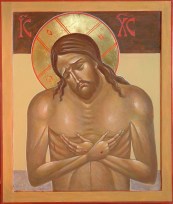
Fr. Stephen Freeman recently wrote in “The Despised God” about the humility of God. He says, “The ‘glory’ of God is not the glory of wondrous success, shining fame and an incomparable reputation. Instead, we are told that we behold the glory of God ‘in the face of Jesus Christ.’… The crucifixion of Christ for Paul is more than an event that accomplishes salvation – it is an event that reveals Him in His fullness.”

“For many, such meekness in Christ is treated as something of a disguise, or a temporary work for the purpose of salvation. They all too quickly turn away from this understanding to assert that ‘He will come again in glory to judge the living and the dead!’ But there is nothing to indicate that the definition of glory is somehow being altered for the sake of the Second Coming. As for the imagery of the Revelation of St. John, it should be read through the Cross rather than used as a corrective for the Cross.

“… the friends of God are foolish, weak, base and despised. That is the narrow way. Interestingly, it is a way that is the most open for all to walk. We need not be wise, strong, and well-thought-of. It turns the world upside-down and our lives along with it.

“Right now the world is desperate for a few fools.”

-Fr. Stephen Freeman