Tag Archives: glory

What the mandorla reveals.

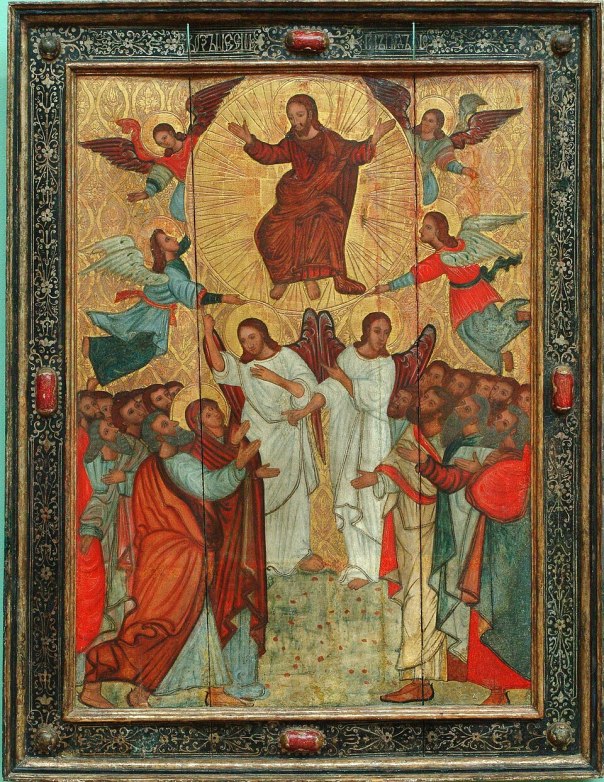
This year we Orthodox celebrate the Ascension of Christ on May 21st, which is, as always, 40 days  after the feast of the Resurrection of Christ. It’s been a while since I published this article about the feast and about the significance of the mandorla, so I’m offering it again:
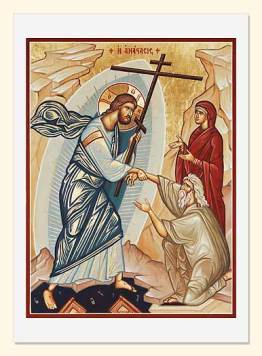
christ forgiving resurrection 2Until a recent vocabulary expansion, I knew little Italian beyond pizza and zucchini. Now I know mandorla, which means almond. In the language of iconography, it means a background shape, often an almond shape but not always, which conveys meaning having nothing to do with the nut.

In this article “Within a Mandorla” Fr. Stephen Freeman explains:

Revealed in the context of a mandorla is that which we know by the revelation of Scripture but which might not have been witnessed by the human eye – or – if witnessed – somehow transcended the normal bounds of vision.

“Mark says that [Christ] was “carried up into heaven and seated at the right hand of God.” This last formula is a creedal confession – but not an eyewitness description. That Christ was taken up and that He is seated at the right hand of the Father is the faith and dogma of the Church. But the Church knows this in a mystical manner and not in the manner of a newspaper reporter.”
And from Icon Reader:

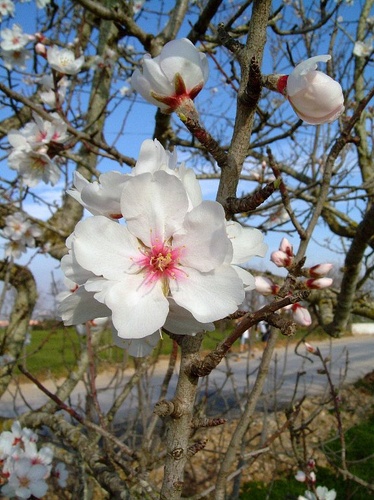
“Sometimes a star – but the usual elliptical shape gives it the name mandorla, which is Italian for the nut. The almond tree is the first plant to flower in Greece, sometimes as early as mid-January, and as such is a symbol of new life and fertility. Ancient Greek myths also link almonds, and the almond-shape, with new life; yet preceding all these in time, and succeeding them in importance, is the story of Aaron’s rod, which blossomed forth not only flowers, but almonds (Numbers 17:8)”

The mandorla can represent light that was actually seen by those present at an event, but it often also symbolizes the majesty and glory that is beyond our earthly vision or ability to put into words.

From Wikipedia: “These mandorla will often be painted in several concentric patterns of color which grow darker as they come close to the center. This is in keeping with the church’s use of apophatic theology, as described by Dionysius the Areopagite and others. As holiness increases, there is no way to depict its brightness except by darkness.”

The story of what the disciples of Jesus saw with their own eyes is told in the first chapter of the Book of Acts:

“So when they had come together, they asked him, ‘Lord, is this the time when you will restore the kingdom to Israel?’ He replied, ‘It is not for you to know the times or periods that the Father has set by his own authority.  But you will receive power when the Holy Spirit has come upon you; and you will be my witnesses in Jerusalem, in all Judea and Samaria, and to the ends of the earth.’ When he had said this, as they were watching, he was lifted up, and a cloud took him out of their sight.  While he was going and they were gazing up toward heaven, suddenly two men in white robes stood by them.  They said, ‘Men of Galilee, why do you stand looking up toward heaven? This Jesus, who has been taken up from you into heaven, will come in the same way as you saw him go into heaven.’”
The Lord has ascended into heaven
that He might send the Comforter to the world.
The heavens prepared His throne, and the clouds His mount.
Angels marvel to see a Man high above them.
The Father receives Him Whom He holds, co-eternal, in His bosom.
The Holy Spirit commands all His Angels:
“Lift up your gates, ye princes!
All ye nations, clap your hands:
for Christ has gone up to where He was before!”

-Hymn for the feast
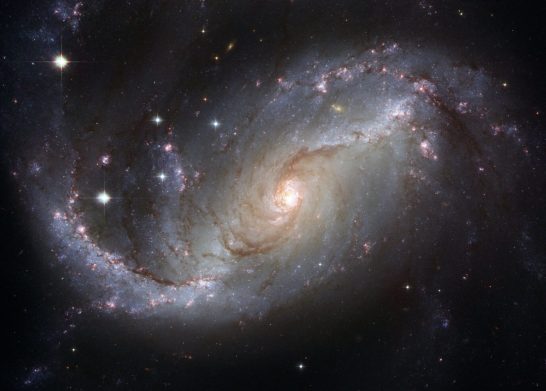
Life pouring in, every moment.

 “…the very name ‘Space’ seemed a blasphemous libel for this empyrean ocean of radiance in which they swam. He could not call it ‘dead’; he felt life pouring into him from it every moment.”

I’m sure I don’t know all the reasons, but my mind has often been overfull, or numb, or empty — or all three?? — of late, while as a whole embodied person I have been awfully busy, so much so that I also haven’t had time to be about the typical documentarist, analytical or musing business. I do feel that I am changing, which is to be expected, and is normal…  As I get older I often think, Who knows when I will wake up one morning without the strength to do ___ ? I better take my opportunity now!

So many of those opportunities keep coming my way, one after the other, cascading through the weeks. I am very thankful. In between, when I stagger into the house and drink my tea, read a few blogs and fall into bed, I feel incapable of putting thoughts together in writing here. Which is okay, because, as the writer of Ecclesiastes says,

“What has been is what will be,
and what has been done is what will be done,
and there is nothing new under the sun.”

Even the things that are new to us as individuals are not new to humanity, and whatever I might think and write about has been said before. Maybe I myself even said it before! That is the case with the quote at top, which was part of a post I “wrote,” or assembled, to put it more accurately, several years ago. I was surprised and pleased to come across it today,  when WordPress was giving me fits and caused me to stay longer at my computer, when I ought to have been out shopping for Thanksgiving menu items. The old blog post helps me think about things I’ve been reading recently.

One of the opportunities I had this month was to participate in a newly formed local book group that was reading Walker Percy’s Lost in the Cosmos. I had been wanting to read something by Percy for at least twenty years; two or three books by him had come and gone from my shelves without being read. So I tackled the Cosmos book and joined the group, in large part to meet the other readers who were interested in such a book.

Walker Percy

I didn’t love the book, I think mostly because I have watched so little TV in my adult life, and was not familiar with the many references to shows and personalities; I missed the allusions by which I would have accessed the humor. In preparation for our group discussion I read a review of Lost in the Cosmos by Alan Jacobs, who claims that Carl Sagan is the main (unmentioned) character in the book, and that Percy is writing partly in response to the 1981 PBS series “Cosmos” (by Carl Sagan), which opens with Sagan’s narration, “The Cosmos is all that is or ever was or ever will be.” Jacobs gives us his take: “‘Cosmos’ was not about science, but about allowing us to observe a scientist with an attractive personality as a substitute for thinking scientifically.”

The middle section of Lost in the Cosmos is a lesson in semiotics, and it was my favorite part, once I put my mind to it. I have wanted to learn about this field of study which someone has described as “an investigation into how meaning is created and how meaning is communicated.” So that was another opportunity not to pass up.
If you remember watching “Cosmos,” or are interested in how modern man has lost himself, and what it all has to do with semiotics and television, you might want to read that review by Jacobs, or even read Lost in the Cosmos. A few people in our discussion group said that they like Walker Percy’s novels better than this ironic “self-help book”: The Moviegoer, for example. I hope I will get around to reading one of them.

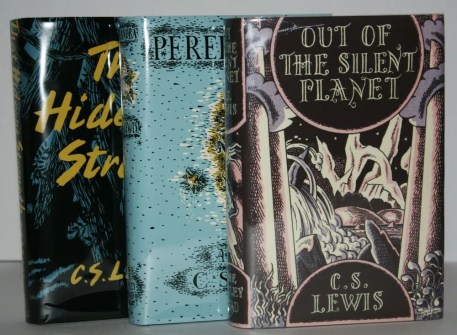
The article that prompted my post of eight years ago, “Space is the womb of life,” was by Michael Baruzzini, in Touchstone magazine, titled “Lost in Space.” I had forgotten that Carl Sagan had ever been referenced on my blog, but in that article Baruzzini compares Carl Sagan’s view of “space” to that of C.S. Lewis’s character Ransom in the Space Trilogy (the “he” in the quote at top).

Baruzzini traces the development of modern man’s concept of the heavens to the point where Sagan could authoritatively tell us, “Our planet is a lonely speck in the great enveloping cosmic dark.” He then shares some of what fills the heavens, revealed by modern scientific instruments — such as the “glowing background of radiation left over from the early moments of the universe,” and the invisible particles that show up in the aurora borealis.

One thing Sagan evidently gets right is how we are made of stardust! My readers are likely more aware of these discoveries than I am; as I said, I have watched little TV, and read few scientific articles or books. Still, I find it easy to get lost in browsing Hubble photos. More from the Touchstone article:

“[A]ll of the particles that make up our bodies and the familiar world around us are the products of reactions deep within stars. The same reactions that turn simple protons into the rocks and waters of planets also form the complex elements in living things, starting with the indispensable element carbon, which makes up the backbone of all organic molecules.”

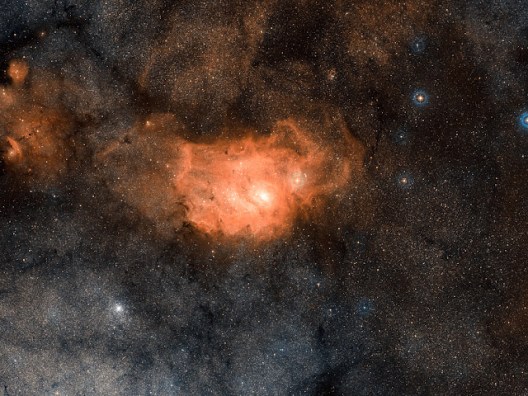
A caption on the above photo reads: “This image from the Digitized Sky Survey shows the area around the Lagoon Nebula, otherwise known as Messier 8. This nebula is filled with intense winds from hot stars, churning funnels of gas, and energetic star formation, all embedded within an intricate haze of gas and pitch-dark dust.” The empyrean ocean! How did Lewis know?

Surely his understanding grew out of the richness of his Christian world view, which informed his knowledge of philosophy, theology and literature — something like Baruzzini describes:

“From the readiness with which medieval Christianity accepted the nested order of the Aristotelian universe, to the progressive cosmic orders of Dante’s Divine Comedy, and even to J. R. R. Tolkien’s Middle-earth creation myth, which speaks of the habitation of man as nestled far within the ‘Deeps of Time,’ the idea of a universe of meaningful immensity and density has been amenable to the Christian mind. Man finds himself not lost in the cold, but placed precisely in a life-giving realm, not too unlike a developing infant folded deep in the tissues of his mother, or a vibrant reef enveloped in the nourishing flows and currents of the ocean.”

Flaming Star Nebula

The “meaningful immensity and density” is not only a quality of the material world: the earthly and heavenly things we can see, whether with the naked eye or modern instruments, are reflections of spiritual realities. The heavens declare the glory of God to a degree, but they speak of a personal God who wants to reveal His glory in the realm of the human spirit. Let us fall down and worship.

Shame that is glory and grace.

“Extreme Humility”

More than two years ago I began to engage with Timothy Patitsas’s book The Ethics of Beauty. It’s an inconvenient book because of its unwieldiness, and I didn’t get very far into it until this summer, when I determined to read it on a regular basis, with its weight resting on my kitchen table and I hefting only a cup of tea.

Just in time for my trip earlier this month and the necessary sitting on airplanes, I discovered that the book is now on Kindle, Hallelujah! By the time I returned home I had made my way through 31% of its 729 pages, to page 224, in the middle of the chapter titled “Shame and Sacrifice.” I will start sharing my gleanings on that theme.

Father Stephen Freeman has written many times on his blog about shame, and until now I hadn’t read about it elsewhere. I particularly appreciated his explaining the toxic shame that cripples so many people in the modern world. In the last couple of years he’s written about healthy shame, too, as in the article “Can Shame Ever Be Healthy?” He credits the author John Bradshaw and his book Healing the Shame That Binds Us for clarifying the difference between the two, in an era when many people don’t want to acknowledge such a thing as the healthy version. But they are ignoring the science, according to Fr. Stephen:

“We are hard-wired for a response (one of the nine identified neuro-biological affects) that is accurately described as ‘shame.’ It is not a product of culture. It is universal, timeless, and biological. It can be compared to other effects such as the ‘surprise-startle’ effect, or the ‘distress-anguish’ effect, or the ‘interest-excitement’ effect. The ‘mechanism’ of the shame experience, whether toxic or healthy, is the same, differing only in its intensity and the issues that surround and embed themselves as complex, emotional triggers.”

Patitsas likewise sees the tendency of modern therapy to disbelieve in healthy shame, because:

“…it is so busy promoting self-regard and, ultimately, self-love, that it can’t possibly also teach us to look to the source of healthy shame outside ourselves. To replace the wrong kind of shame in us with the pure quality of shame, soul therapy must bring us face to face both with God and with other human beings who’ve seen what we’ve seen and yet have done better than us – that would be, in one person, Jesus Christ. Or, if you like, God and the saints…. Healthy shame is a fruit of deep organic processes; it is the glory upon the face of Moses when he descends from Mt. Sinai.”

It is interesting to put the insights of these two paragraphs together and begin to understand that to deal with our neurobiology and psyche, trying to create self-esteem without any reference to our Creator and Savior is a dead end, an unworthy goal. Yes, the inner man is essential, but the true self is only revealed by the Kingdom of God within, after “deep organic processes.”
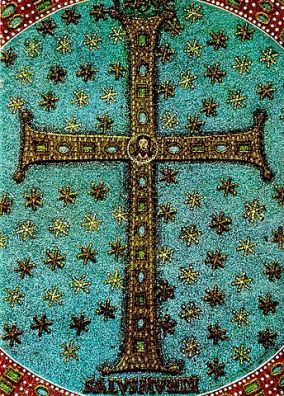
To replace toxic or unhealthy shame with healthy shame, Patitsas continues,

“…we must also see Christ crucified, or else we will never overcome our false ideas about what is and isn’t shameful. Without seeing ‘the King of Glory’ hanging from the cross, a person will never be able to understand those times when accepting to be shamed by others is a necessary part of receiving God’s glory.”

Fr. Stephen points out a scriptural reference to shame that lines up with this, from Sirach 4:21:

“For there is a shame that leads to sin, and there is a shame that is glory and grace.”

May the Lord strengthen us in the latter direction!

Expect kissing and fruit.

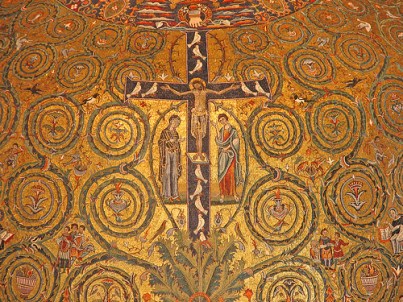
The poetry of this Psalm enlivens my spirit with its many action verbs that evoke the overflowing love and energies of God as we humans experience Him, being turned, quickened, gladdened; hearing our Father speak peace and living in His Kingdom where righteousness and peace kiss, truth springs up, and fruit naturally grows on the trees.
O God, Thou wilt turn and quicken us,
and Thy people shall be glad in Thee.

Show us, O Lord, Thy mercy,
and Thy salvation do Thou give unto us.

I will hear what the Lord God will speak in me;
for He will speak peace to His people and to His saints
and to them that turn their heart unto Him.

Surely nigh unto them that fear Him is His salvation,
that glory may dwell in our land.

Mercy and truth are met together,
righteousness and peace have kissed each other.

Truth is sprung up out of the earth,
and righteousness hath looked down from heaven.

Yea, for the Lord will give goodness,
and our land shall yield her fruit.

Righteousness shall go before Him
and shall set His footsteps in the way.

-From Psalm 84