Tag Archives: Ascension

What the mandorla reveals.

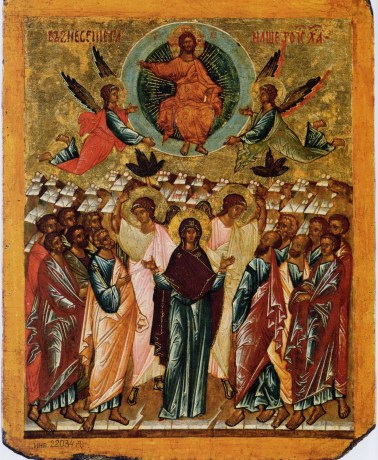
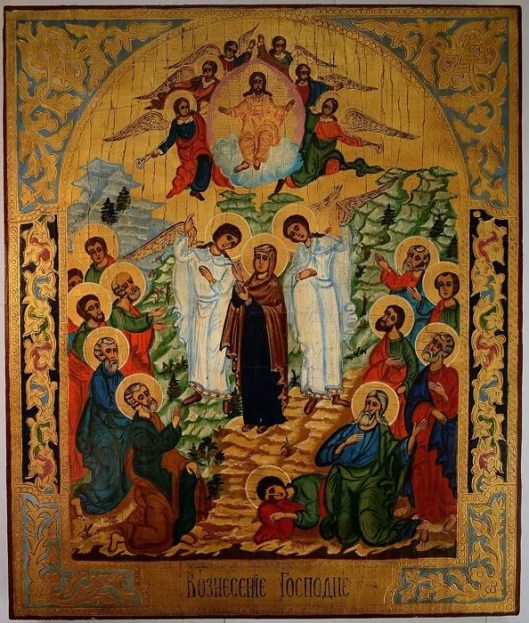
This year we Orthodox celebrate the Ascension of Christ on May 21st, which is, as always, 40 days  after the feast of the Resurrection of Christ. It’s been a while since I published this article about the feast and about the significance of the mandorla, so I’m offering it again:
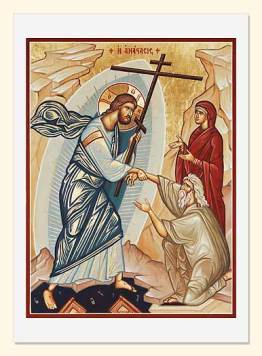
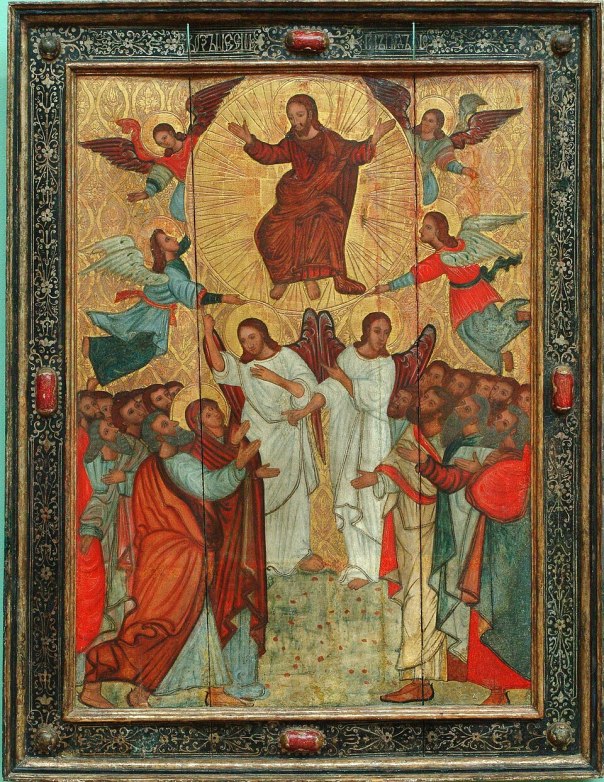
christ forgiving resurrection 2Until a recent vocabulary expansion, I knew little Italian beyond pizza and zucchini. Now I know mandorla, which means almond. In the language of iconography, it means a background shape, often an almond shape but not always, which conveys meaning having nothing to do with the nut.

In this article “Within a Mandorla” Fr. Stephen Freeman explains:

Revealed in the context of a mandorla is that which we know by the revelation of Scripture but which might not have been witnessed by the human eye – or – if witnessed – somehow transcended the normal bounds of vision.

“Mark says that [Christ] was “carried up into heaven and seated at the right hand of God.” This last formula is a creedal confession – but not an eyewitness description. That Christ was taken up and that He is seated at the right hand of the Father is the faith and dogma of the Church. But the Church knows this in a mystical manner and not in the manner of a newspaper reporter.”
And from Icon Reader:

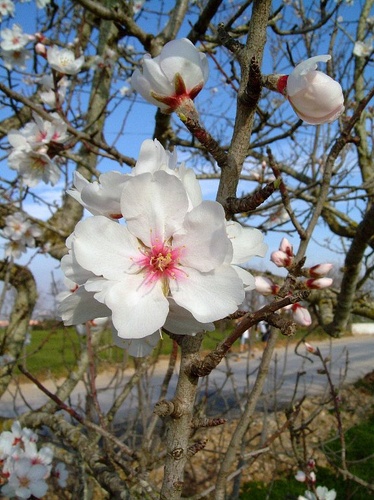
“Sometimes a star – but the usual elliptical shape gives it the name mandorla, which is Italian for the nut. The almond tree is the first plant to flower in Greece, sometimes as early as mid-January, and as such is a symbol of new life and fertility. Ancient Greek myths also link almonds, and the almond-shape, with new life; yet preceding all these in time, and succeeding them in importance, is the story of Aaron’s rod, which blossomed forth not only flowers, but almonds (Numbers 17:8)”

The mandorla can represent light that was actually seen by those present at an event, but it often also symbolizes the majesty and glory that is beyond our earthly vision or ability to put into words.

From Wikipedia: “These mandorla will often be painted in several concentric patterns of color which grow darker as they come close to the center. This is in keeping with the church’s use of apophatic theology, as described by Dionysius the Areopagite and others. As holiness increases, there is no way to depict its brightness except by darkness.”

The story of what the disciples of Jesus saw with their own eyes is told in the first chapter of the Book of Acts:

“So when they had come together, they asked him, ‘Lord, is this the time when you will restore the kingdom to Israel?’ He replied, ‘It is not for you to know the times or periods that the Father has set by his own authority.  But you will receive power when the Holy Spirit has come upon you; and you will be my witnesses in Jerusalem, in all Judea and Samaria, and to the ends of the earth.’ When he had said this, as they were watching, he was lifted up, and a cloud took him out of their sight.  While he was going and they were gazing up toward heaven, suddenly two men in white robes stood by them.  They said, ‘Men of Galilee, why do you stand looking up toward heaven? This Jesus, who has been taken up from you into heaven, will come in the same way as you saw him go into heaven.’”
The Lord has ascended into heaven
that He might send the Comforter to the world.
The heavens prepared His throne, and the clouds His mount.
Angels marvel to see a Man high above them.
The Father receives Him Whom He holds, co-eternal, in His bosom.
The Holy Spirit commands all His Angels:
“Lift up your gates, ye princes!
All ye nations, clap your hands:
for Christ has gone up to where He was before!”

-Hymn for the feast

Ascension, looking toward Pentecost….

Today was Ascension Day for the Eastern Orthodox. During his homily our pastor drew our attention to the fresco we could see behind him, of Christ ascending, with the disciples looking up at him, 40 days after his resurrection. He said that in our temple that event is depicted above the altar as a reminder that in the Divine Liturgy we also ascend to Heaven. The icon shows what St. Luke tells in the first chapter of the Book of Acts:

“The first account I composed, Theophilus, about all that Jesus began to do and teach, until the day when He was taken up, after He had by the Holy Spirit given orders to the apostles whom He had chosen. To these He also presented Himself alive, after His suffering, by many convincing proofs, appearing to them over a period of forty days, and speaking of the things concerning the kingdom of God.

“And gathering them together, He commanded them not to leave Jerusalem, but to wait for what the Father had promised, “Which,” He said, “you heard of from Me; for John baptized with water, but you shall be baptized with the Holy Spirit not many days from now.”

“And so when they had come together, they were asking Him, saying, ‘Lord, is it at this time You are restoring the kingdom to Israel?’ He said to them, ‘It is not for you to know times or epochs which the Father has fixed by His own authority; but you shall receive power when the Holy Spirit has come upon you; and you shall be My witnesses both in Jerusalem, and in all Judea and Samaria, and even to the remotest part of the earth.’

“And after He had said these things, He was lifted up while they were looking on, and a cloud received Him out of their sight. And as they were gazing intently into the sky while He was departing, behold, two men in white clothing stood beside them; and they also said, ‘Men of Galilee, why do you stand looking into the sky? This Jesus, who has been taken up from you into heaven, will come in just the same way as you have watched Him go into heaven.'”

St. Paul mentions our own situation when he writes to the Ephesians :

“God raised us up with Christ and seated us with him
in the heavenly realms in Christ Jesus.”

In our daily prayers, we no longer start with the Paschal Troparion, “Christ is risen from the dead, trampling down death by death, and upon those in the tombs bestowing life,” but replace that line with the Troparion of Ascension:

Thou hast ascended in glory, O Christ our God,
and gladdened Thy disciples with the promise of the Holy Spirit.
And they were assured by the blessing
that Thou art the Son of God, and Redeemer of the World.

In only ten days we will come to Pentecost, and return to the usual beginning, “O Heavenly King, the Comforter, the Spirit of Truth….” But for now, we are with the disciples, waiting for the Spirit, Whom Christ said would “come upon” them.

They were looking intently up into the sky as he was going, when suddenly two men dressed in white stood beside them.Men of Galilee,’ they said, ‘why do you stand here looking into the sky? This same Jesus, who has been taken from you into heaven, will come back in the same way you have seen him go into heaven.’

Albrecht Dürer

Then the apostles returned to Jerusalem from the hill called the Mount of Olives, a Sabbath day’s walk from the city. When they arrived, they went upstairs to the room where they were staying. Those present were Peter, John, James and Andrew; Philip and Thomas, Bartholomew and Matthew; James son of Alphaeus and Simon the Zealot, and Judas son of James. They all joined together constantly in prayer, along with the women and Mary the mother of Jesus, and with his brothers.”

In anticipation of Pentecost, I might revisit the history of that feast in the Old Testament, and in the Book of Jubilees, which Richard Rohlin and Jonathan Pageau discuss in two podcasts, which are also about the giving of the Law on Mount Sinai, and about the Tower of Babel. What — are all these connected? Yes.

Pentecost is traditionally considered an inversion of the curse of Babel. I heard some of these thoughts at the Symbolic World Summit I attended earlier this year, but it is a lot to stretch my mind toward. To consider how “the confusion of tongues is resolved,” explained by a philologist like Rohlin — I have to say, it reveals God’s glory, and His wonderful plan through the ages.

Here are the two podcasts, if you want to check them out:
The Tower of Babel with Richard Rohlin
and
The Tower of Babel Part 2 with Richard Rohlin

The Tower of Babel, by Peter Brueghel the Younger

Our hearts soar at Ascension.

A HYMN

A hymn of glory let us sing;
New songs throughout the world shall ring;
By a new way none ever trod
Christ mounteth to the throne of God.

The apostles on the mountain stand, —
The mystic mount, in Holy Land;
They with the virgin mother, see
Jesus ascend in majesty.

The angels say to the eleven:
“Why stand ye gazing into heaven?
This is the Saviour, this is He!
Jesus hath triumphed gloriously!”

They said the Lord should come again,
As these beheld him rising then,
Calm soaring through the radiant sky.
Mounting its dazzling summits high.

May our affections thither tend,
And thither constantly ascend,
Where, seated on the Father’s throne,
Thee reigning in the heavens we own!

Be thou our present joy. Oh Lord!
Who wilt be ever our reward;
And, as the countless ages flee.
May all our glory be in Thee!

-Bede (c. 672/3 – 735)
Translated by Elizabeth Charles

Novgorod, 15th century.

The increase of Pascha.

From our parish bulletin:

From the eve of the Ascension of the Lord (an event which we confess when we recite the Creed) until the following Friday, we sing this hymn:

Thou hast ascended in glory, O Christ our God,
and gladdened Thy Disciples with the promise of the Holy Spirit.
And they were assured by the blessing
that Thou art the Son of God and Redeemer of the world.

The Feast is always on a Thursday—Forty Days after the Resurrection (described in Acts 1). We are such materialists that it’s hard for us to conceive or understand this event. The Ascension is the vindication of the crucified, buried and risen Lord Jesus, the initiation of His reign— inauguration day—over all creation, and His power made present in us.

“Lo, I am with you, even to the end of the ages. Amen,” says the Lord as He ascends—that is, as He comes into His glory and sits upon the Throne at the Right Hand of the Father. He is with us—we are with Him too— because now, the One Who Is God AND man is in Heaven.

As St. Leo the Great, the Pope of Rome (+461) taught: “With all due solemnity we are commemorating that day on which our poor human nature was carried up, in Christ, above all the hosts of Heaven, above all the ranks of angels, beyond the highest Heavenly powers to the very throne of God the Father.”

This is simultaneously our ascension and our glorification, since we are united to Christ through holy Baptism as members of His Body. Therefore, St. Paul can further write: “For you have died, and your life is hidden with Christ in God.” (Col. 3:3) Out of our physical sight, we now “see” the glorified Christ through the eyes of faith.

St. Leo further explains how important this spiritual insight is: “For such is the power of great minds, such the light of truly believing souls, that they put unhesitating faith in what is not seen with the bodily eyes; they fix their desires on what is beyond sight. Such fidelity could never be born in our hearts, nor could anyone be justified by faith, if our salvation lay only in what is visible.”

The Feast of the Ascension is not a decline from the glory of Pascha. It is, rather, the increase of Pascha, and a movement upward toward the Kingdom of Heaven for those who are in Christ. It is the joyful revelation of our destiny in Christ.