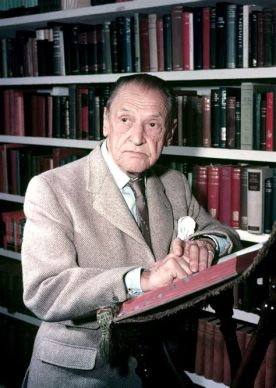
“Some people read for instruction, which is praiseworthy, and some for pleasure, which is innocent, but not a few read from habit, and I suppose that this is neither innocent nor praiseworthy. Of that lamentable company am I. Conversation after a time bores me, games tire me and my own thoughts, which we are told are the unfailing resource of a sensible man, have a tendency to run dry. Then I fly to my book as the opium-smoker to his pipe. I would sooner read the catalogue of the Army and Navy Stores or Bradshaw’s Guide than nothing at all, and indeed I have spent many delightful hours over both these works. At one time I never went out without a second-hand bookseller’s list in my pocket. I know no reading more fruity.
“Of course to read in this way is as reprehensible as doping, and I never cease to wonder at the impertinence of great readers who, because they are such, look down on the illiterate. From the standpoint of what eternity is it better to have read a thousand books than to have ploughed a million furrows? Let us admit that reading with us is just a drug that we cannot do without—who of this band does not know the restlessness that attacks him when he has been severed from reading too long, the apprehension and irritability, and the sigh of relief which the sight of a printed page extracts from him?—and so let us be no more vainglorious than the poor slaves of the hypodermic needle or the pint-pot.
“And like the dope-fiend who cannot move from place to place without taking with him a plentiful supply of his deadly balm I never venture far without a sufficiency of reading matter.”
-W. Somerset Maugham (1874-1965), “The Book-Bag,” Collected Short Stories, Vol. IV
Only a few pages into Anthony Doerr’s Four Seasons in Rome, and I was enthralled; I began to want very much to make my own visit to that most historic and colorful city. But a chapter in, I realized that Doerr had brought me with him, and that my vicarious travels were so much more exciting and satisfying than anything I could accomplish in real life — all without the huge expense and strain of international travel.
“Energy pours off the traffic, off the sidewalks; it feels as if we are pumping through the interior of a living cell, mitochondria careering around, charged ions bouncing off membranes, everything arranging and rearranging. Here is a pair of stone lions with crossed paws; here is a Gypsy sleeping on a square of cardboard. Down the white throat of a street a church floats atop stairs.”
Stone Pines, aka Umbrella Pines, of Rome (internet)
Doerr’s year in Rome was certainly stressful, but he was young and strong, and was able to take his adventures, which any of us might know in the present moment as anxieties,dilemmas,pain and suffering, and turn them into prose that conveys not just a complainy travelogue, but his own engagement with the sensory overload of living in Rome, combined with being a new father. Fatherhood alone is such a transformative experience, it would give such a writer plenty of material for a book, but to have twins, and then to take them at six months of age to live in Rome, where you don’t even know the language, is exciting to the point of crazy.
“What did Columbus write in his log as he set out from Spain? ‘Above all, it is fitting that I forget about sleeping and devote much attention to navigation in order to accomplish this.’ Henry wakes again at two. Owen is up at three. Each time, rising out of a half sleep, it takes a full minute to remember what I have forgotten: I am a father; we have moved to Italy. All night I carry one crying baby or the other onto the terrace. The air is warm and sweet. Stars burn here and there. In the distance little strands of glitter climb the hills.”
Last year I read Doerr’s 2014 novel All the Light We Cannot See. All I did was run my eyes along the words and lines, and the author did all the magic of transporting me to another place and time, to rooms in Germany and houses in France, to the beach and along streets and into human hearts beating with fear and hope. I couldn’t help but love them, we were that close – and it was the writer who had brought us together.
It seems that he was already working on All the Light ten years earlier, while in Rome on a literature fellowship at the American Academy. It was a good thing he didn’t have to show anyone a progress report, because Rome and twins were all-consuming. He did write a lot of journal entries, which eventually became this delightful book.
During the Doerr Family’s year in Rome the twins didn’t let their parents sleep much. They also were very sick for weeks, and then Doerr’s wife Shauna ended up in the hospital. Pope John Paul II died, and a new pope was elected. The seasons changed, the husband and wife went on outings to Umbria, and the babies learned to walk. They watched the pines out the window:
“Mediterranean pines, stone pines, parasol pines, and umbrella pines—all the same thing: Pinus pinea. Regal trees, astounding trees, trees both unruly and composed at once, like princes who sleep stock-still but dream swarming dreams.”
In another place I read that Anthony Doerr likes to quote Victor Shklovsky, who wrote 100 years ago: “Art exists that one may recover the sensation of life; it exists to make one feel things, to make the stone stony. The purpose of art is to impart the sensation of things as they are perceived and not as they are known.”
And this is what Doerr tries to do – but first he must shake himself out of the habit of not seeing, this habit that he explains is quite necessary:
“Without habit, the beauty of the world would overwhelm us. We’d pass out every time we saw—actually saw—a flower. Imagine if we only got to see a cumulonimbus cloud or Cassiopeia or a snowfall once a century: there’d be pandemonium in the streets. People would lie by the thousands in the fields on their backs…..
“’Habitualization,’ a Russian army-commissar-turned-literary-critic named Viktor Shklovsky wrote in 1917, ‘devours works, clothes, furniture, one’s wife, and the fear of war.’ What he argued is that, over time, we stop perceiving familiar things—words, friends, apartments—as they truly are.”
If I did go to Rome, I’m sure I would be shaken out of my everyday way of seeing things. This has happened to me many times, being in a new place without The Usual surroundings and schedule and people in my life. Even the air smells different, and seems to wake up the brain. Reading Doerr makes me want to take off the blinders more often and really be attentive to what is bombarding my senses.
It could be scary, I know – or exhausting, as he warns:
“The gaze widens and drifts; the eye is insatiable. The brain drowns.”
“The Big Fountain” near the Doerrs’ apartment. Completed 1690.
So Anthony Doerr is very good at what he does, but he is more than a skilled observer and wordsmith; as he imparts to the reader what he receives from the world, his own warmth and humanity come with the package. He is a grateful and caring man who reveals his humble likableness in this very personal account. As he tells you what he sees, he can’t help but tell you who he is. When he looks at his little son:
“…his entire four-pound body motionless except his eyelids, it seemed he understood everything I was working so hard to understand: his mother’s love, his brother’s ceaseless crying; he was already forgiving me for my shortcomings as a father; he was the distillation of a dozen generations, my grandpa’s grandpa’s grandpa, all stripped into a single flame and stowed still-burning inside the thin slip of his ribs.”
When it is time for the Doerrs to return to their Idaho home, Anthony tries to put the experience of leaving Rome into words:
“I know nothing. I lived in Rome four seasons. I never made it through the gates between myself and the Italians. I cannot claim to have become, in even the smallest manner, Roman. And yet I can’t stop myself: a pen, a notebook, the urge to circumscribe experience. Roma, they say, non basta una vita. One life is not enough.”
I was grateful to visit Rome by means of this book, but of course, it was enough for me. I don’t have a bucket list of books or places to see or experiences to have, because if I ever start to think like that, I am reminded of the example of our Lord’s earthly life that was on the surface quite confined — He didn’t go to Rome, either — but was the expression of the best human life ever lived.
I could also be content not reading another book for the rest of my life, but I did just order Doerr’s collection of short stories, The Shell Collector, and in that way hope to see more wide views through his brain-drowning gaze.
Four in the afternoon is a more pleasant time to take a walk in this season. It’s hard to stop whatever project I’ve gained some momentum on, but I was craving the outing…
…and that means I have established a good habit, which I consider a miracle.
It had been a few days since I had been on the creek path, enough time for more colors to appear, or to fade. The fennel has faded, even while its seeds are ripening.
While I was admiring the turning leaves, I spied a ladybug who had the same impulse as I, to catch the warm rays on its back.
Each one of these quotes contains some truth about our humanity and this way we have of creating strong predispositions in ourselves. If we have any good habits, of course we don’t worry about them being too strong, or try to fight against them. But most of the thoughts I’ve collected seem only to apply to the habits we feel are “bad,” or at least not promoting our goals. From what I’ve seen, the majority of us fallen humans are all too prone to lay aside what appear to be the bonds of good character in what is known as The Moment of Weakness. Don’t trust in these habits! Pray and seek God, and live.
Habits are at first cobwebs, then cables. – Spanish proverb
Every grown-up man consists wholly of habits, although he is often unaware of it and even denies having any habits at all. – Georges Gurdjieff
The strength of a man’s virtue should not be measured by his special exertions, but by his habitual acts. – Blaise Pascal
The chains of habit are too weak to be felt until they are too strong to be broken.
– Samuel Johnson
It is no mean contest to overcome one’s bad habits, for custom, strengthened by enduring a long time, takes on the force of [second] nature.
– St. Basil the Great
Man is not imprisoned by habit. Great changes in him can be wrought by crisis – once that crisis can be recognized and understood. – Norman Cousins
 lion furrows? Let us admit that reading with us is just a drug that we cannot do without—who of this band does not know the restlessness that attacks him when he has been severed from reading too long, the apprehension and irritability, and the sigh of relief which the sight of a printed page extracts from him?—and so let us be no more vainglorious than the poor slaves of the hypodermic needle or the pint-pot.
 It seems that he was already working on All the Light ten years earlier, while in Rome on a literature fellowship at the American Academy. It was a good thing he didn’t have to show anyone a progress report, because Rome and twins were all-consuming. He did write a lot of journal entries, which eventually became this delightful book.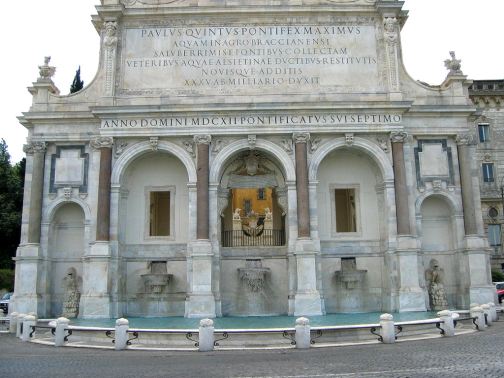


 Gladsome Lights