Today was most wonderful, as it was a fully At Home Day, after a long period of being away every day, always for good things, of course. It could be called a catch-up day, as I’ve had the time to concentrate on tasks that have been getting shoved aside and neglected for too long. Cooking and tidying up took quite a bit of time; because I’ve been cooking more lately, I end up washing dishes more often, but that’s okay, because I enjoy cleaning up the kitchen if I can really give it proper attention. I watered a wilting/dying house plant, and while I ate my lunch I watched the birds outside on the patio, as they finished up the last of the suet feeder.
 I took some papaya peelings and Brussels sprouts trimmings out to add to the worm bucket. And it occurred to me, since worm farming is called vermiculture or vermicomposting, etc., maybe I could call my worms “vermi’s” — what do you think? It sounds cuter than worms. This is what my worms typically look like when I take off the lid of their 5-gallon bucket. I’m always relieved if they are looking alive. When the weather drops to freezing, they are unhappy, and disappear into the center of their habitat to huddle together.
It’s been raining steadily all day — until now, when just before the sun went down, it came out and made everything sparkle — and I knew last night that I would want to have a fire in the stove so that I wouldn’t be distracted by being cold, on this day of opportunity. So I brought quite a few logs into the garage in advance of the rain, before I left for a General Unction service at a sister parish.

At this Orthodox service we pray and sing, and hear seven epistle readings and seven Gospel readings by, ideally, seven priests. Last night we only had one bishop and four priests, which meant that when we got to the anointings “for the healing of soul and body,” we had just five of those. Surely they were more than adequate to convey this special grace during Lent. One of the epistle readings included this passage from the book of James:
 Is anyone among you suffering? Let him pray. Is anyone cheerful? Let him sing psalms. Is anyone among you sick? Let him call for the elders of the church, and let them pray over him, anointing him with oil in the name of the Lord. And the prayer of faith will save the sick, and the Lord will raise him up. And if he has committed sins, he will be forgiven.
(I didn’t take pictures at the service, but I found online these images that are typical.)
Since I opened my sleepy eyes I’ve been blissful knowing that I didn’t have to watch the clock, or change my clothes and get in the car to go anywhere. Much of my morning could be contemplative. Though my supply is very low, there were plenty of logs still, to keep the fire going and the house cozy. It seemed the most blessed day. Once, for a brief moment, a thought came to mind, comparing my life to the “old times” of a few years or decades ago — but I regained my focus pretty fast.
After dinner I was reading in a church calendar that has quotes for every day. This one from  St. Luke the Blessed Surgeon was just on point:
It is not right to speak of the former years and to bless them and to curse our own age. We must know that in every age and in every place, people who actually seek their salvation find it.
-St. Luke of Simferopol and Crimea
St. Luke might well have reason to bless his former life, that is: before his wife died leaving their four children motherless, before Lenin came to power, and before his three imprisonments and torture. He had his priorities right, as you can see by reading his life here.
It’s likely that sometime in the future I will fall into longing backward for days like today; I hope the example of St. Luke will help me to cut it short and be fully present in whatever kind of days lie ahead. But for today, his exhortation made me glad that I had been able to be here and now, and that the here was at home.

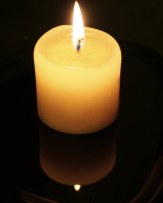 No man, when he hath lighted a candle, putteth it in a secret place, neither under a bushel, but on a candlestick, that they which come in may see the light. The light of the body is the eye: therefore when thine eye is single, thy whole body also is full of light; but when thine eye is evil, thy body also is full of darkness. Take heed therefore that the light which is in thee be not darkness. If thy whole body therefore be full of light, having no part dark, the whole shall be full of light, as when the bright shining of a candle doth give thee light.
 But though spiritual sight must be part of what Christ is talking about, twice He uses the words, “whole body full of light.” Pause and think on that! What can it even mean? We can theorize about it, but Christ, Who called Himself “The light of the world,” is not an idea or a theory or a spiritual practice. He will have to teach us what this means by experience. Our yearly Lenten effort is our effort to return again and again to that lifelong process. And He has many ways of opening our eyes and bringing us to Himself, customized to each person’s unique situation.
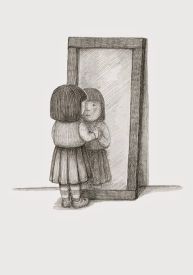
 is losing some of his youthful goodness. If our lives are like mirrors that are meant to reflect the glory of our Creator, his mirror is not doing that very well; it has gotten dirty by slow degrees and not even his parents understand why their son does not bring them joy as he used to.
 “It was indeed a lovely being, and Curdie thought how happy it must
  after an indefinable time out of time, which may be less than a minute, our boy comes through the storm with clarity, and proceeds with his repentance.
 I attended a Holy Unction service with my goddaughter last night. Before the service proper our priest read an article on
  Gladsome Lights