“I ask this much” was the title of a post I wrote ten years ago, not long after my husband died. My thoughts then were inspired by the poem below, which I recently revisited. Yesterday I began to notice afresh the near constancy of my murmuring and complaining; today I was encouraged by the testimony of my former self, who wrote back then,
And every day, I feel a great Love surrounding me, like the pleasant air that holds me and gives me oxygen even while I am having those pity parties. Or like the sun whose heat is keeping me alive and giving me energy.
Let us be up and doing! And let’s start by asking the great Maker of the sun and of us, for His light, and strength, and joy. Our asking will be the beginning of the receiving.
PRAYER at SUNRISE
O mighty, powerful, dark-dispelling sun, Now thou art risen, and thy day begun. How shrink the shrouding mists before thy face, As up thou spring’st to thy diurnal race! How darkness chases darkness to the west, As shades of light on light rise radiant from thy crest! For thee, great source of strength, emblem of might, In hours of darkest gloom there is no night. Thou shinest on though clouds hide thee from sight, And through each break thou sendest down thy light.
O greater Maker of this Thy great sun, Give me the strength this one day’s race to run, Fill me with light, fill me with sun-like strength, Fill me with joy to rob the day its length. Light from within, light that will outward shine, Strength to make strong some weaker heart than mine, Joy to make glad each soul that feels its touch; Great Father of the sun, I ask this much.
According to liturgical time, Bright Monday is already past, and we are entering Bright Tuesday of this blessed week. I’m afraid I’m not readjusted to plain time yet, or to the way much of the world has merely switched from the weekend to weekday, or from Easter to common days. The superabundance of life and joy that descends on us at Pascha is too much for a few hours or even a few days to contain. So when I saw a call coming in on my phone from my doctor, my first thought was, Why would anyone be calling me today?? I didn’t pick up.
After Palm Sunday this year I was home for the next few days of Holy Week, but from Thursday evening until Sunday evening I went to church every day. Normally I can’t manage that with my limited mental and physical resources, but Holy Week is not Normal, and it didn’t feel right to be home when so much was happening elsewhere. I wish I didn’t have to miss any of the multitude of grace-filled services, each with its unique flavor, and particular gifts that are given only once a year to those present to imbibe and absorb them. Through all the senses and by means of our minds, as we hear the deep theology of our salvation, we are mystically brought into the presence of Christ — as He talks at length to His disciples in the upper room, prays in Gethsemane, is betrayed, mocked, and nailed to the cross.
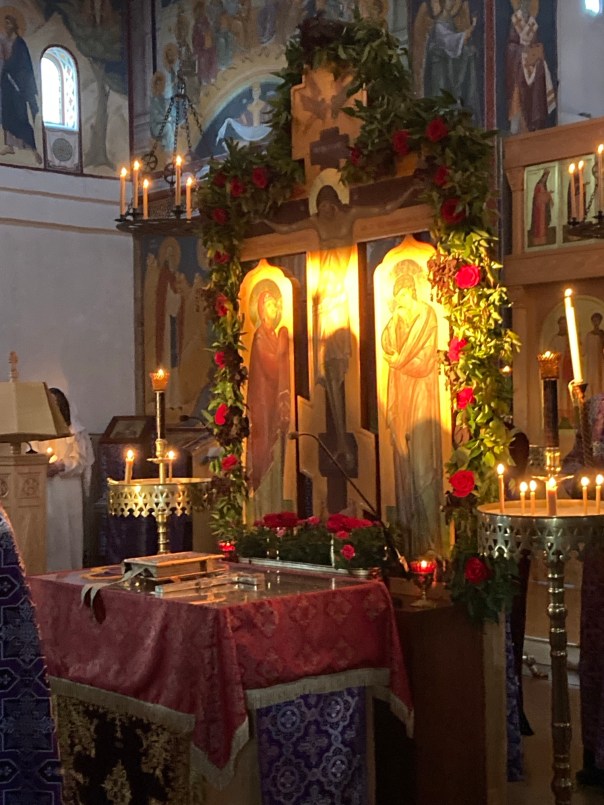
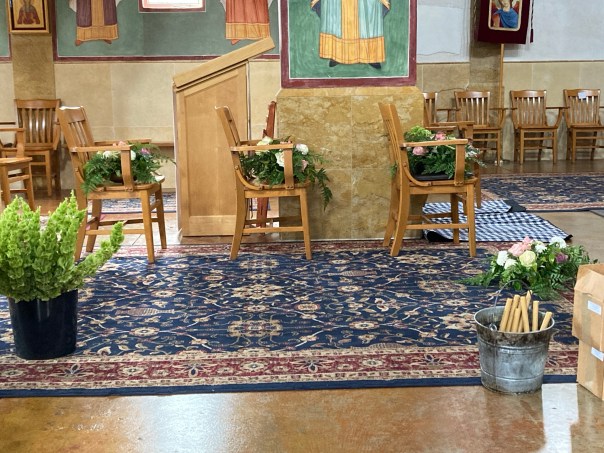
At the Holy Saturday services we sing about the Harrowing of Hell. Both of the pictures above are from Matins of Holy Saturday, which is Friday evening. On Saturday, after the Vesperal Liturgy midday, many people are bustling about the church tidying up and decorating in preparation for the Paschal service.
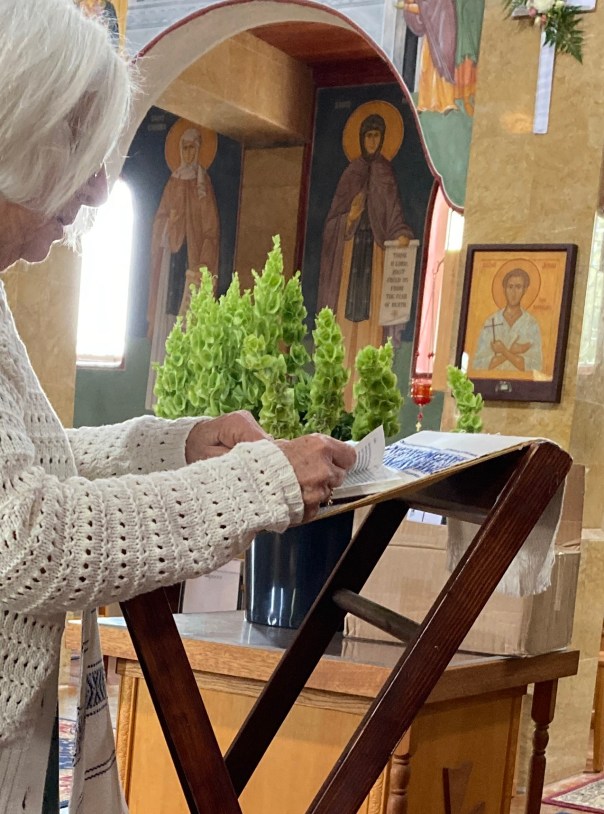
At the same time other parishioners take turns reading the Acts of the Apostles beginning from the end of Saturday’s Liturgy all the way until the beginning of the service at 11:30 p.m.
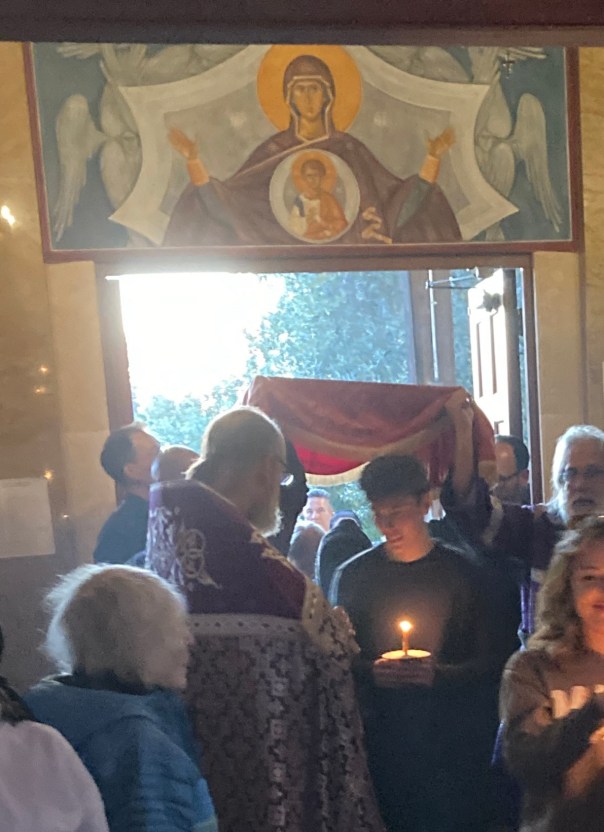
By the time we get to Saturday night we are prepared to exult finally, at midnight, to shout, “Christ is risen!” and, “Indeed He is risen!” and with all our being to sing until we are hoarse the many glorious hymns of Paschal Matins, about Christ’s conquering of death. As the gates of Hell have been broken down, so are the gates and doors of the church open throughout Bright Week.
Many, if not most people in my parish make traditional rich breads and Pascha Cheese (a mildly sweet loaf made of cream cheese and others) to eat at the feast, but I have never done this. One new friend, when she heard that I hadn’t baked anything for my household, was mildly horrified, but also very pleased that she had good reason to give me one of the four braided breads that she’d baked Saturday morning, in the style of her homeland of Moldova. So I went home with this cheese-filled pastry, which I’ve been enjoying very much.
As to the spiritual feast, truly, we need all the time until Pentecost to even partially digest the reality of it. I expect to be in Greece for the feast of Pentecost, which will be different! But for the next few weeks we live in the radiance of “Christ is risen!” May the light of the Resurrection shine on your whole week, and make it Bright.
I use “we” in the title to show solidarity with my beloved garden. Several times a year, a complaint is lodged against Gardener Gretchen for failing to live up to her vision. I guess it’s just the reality of Life Right Now. Tomorrow will be a big gardening day, a day of improvement, but today is when I had a few minutes to stroll about taking stock, taking pictures. All the plants are calling me to come out and admire them, and to notice how they thrive; they don’t want me to feel bad about how much I ignore them.
Lithodora with nigella and weeds.
Lithodora is one of my favorites. This week I’m going to pull out all the Love-in-a-Mist sprouts that are growing through and around it and under the fruit trees. In the front I already did as Gardener Dan advised me: I “edited” (thinned) the nigella, which he says will help them produce larger blooms. I think I reduced the number of plants in that bed from roughly 1,000 to 100.
Let me get the rather sad picture below out of the way now, the planter boxes where I typically grow squash and tomatoes. I’m at a loss as to what to do there, as my travels will take me away at just the wrong time for summer vegetables. Maybe the earth will have to lie fallow until August, when I can plant winter greens.
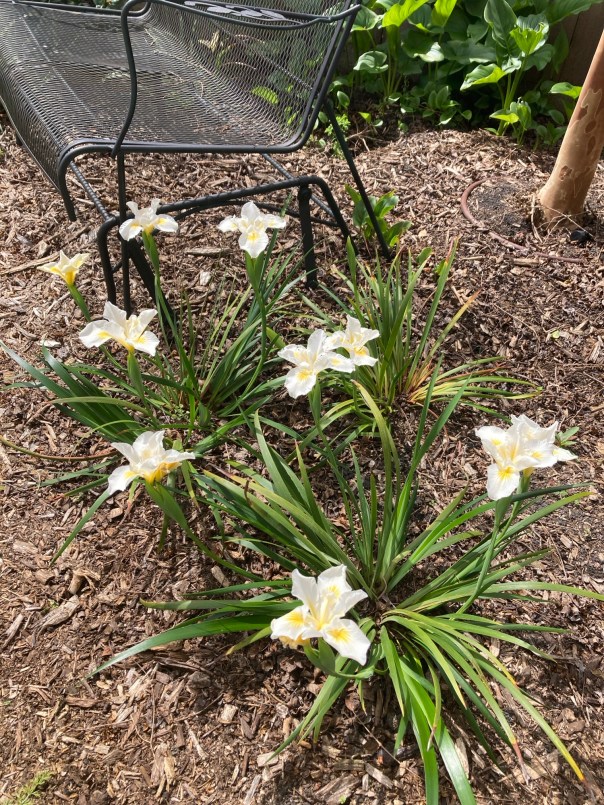
The native Pacific Coast Iris is now blooming in my very own garden (below). I am completely thrilled. This plant is so popular on the West Coast — not just near the ocean but up into the mountains — that it has its own fan club, the Society for Pacific Coast Native Iris.
In native plant nurseries one can find many colors and species of this type, Iris subsect. Californicae, which is in the same family as the Siberian irises. The Flora of North America site says, “Series Californicae presents some of the most complex taxonomic problems in all of our American irises.” In the wild a specimen can be difficult to identify as to which of the three main groups it is in because of “their willingness to cross pollinate whenever their ranges overlap.”
Pacific Coast Iris
When I was offered a choice by Dan, I knew I wanted the white. But maybe I will find a place to plant other colors in the future. One plant site explained, “If the tall bearded iris is the queen of the garden, the natives are the pixies.” My queens are nearby, in the front garden, rising up tall and elegant, with the pale yellow California poppies (and lots of weeds) for contrast.
Back by the lemon tree, I had a sort of iris dumping ground for a few years, where I planted whatever extra corms came my way, usually gifted by iris sellers who threw a few odd ones into the shipment. The colors or the quantities didn’t fit in with the others, so I saved them in that corner, where they never did well. Last fall I put them in a double row behind a plum tree, where they are surprisingly starting to bloom. Yes, I saw that milk thistle — I just need gloves before I will tackle it!
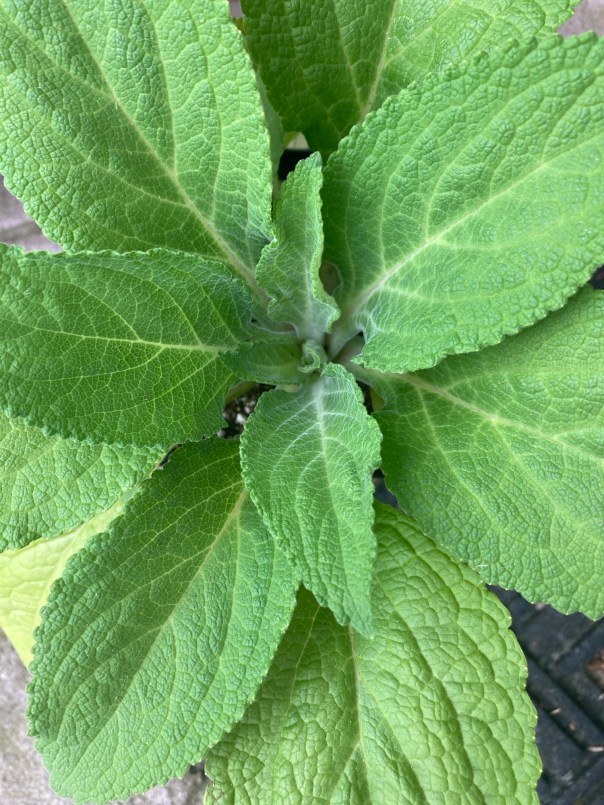
This spring, I bought exactly one plant on my own, without any idea of where I might install it. I will wander tomorrow and find a setting for a foxglove plant.
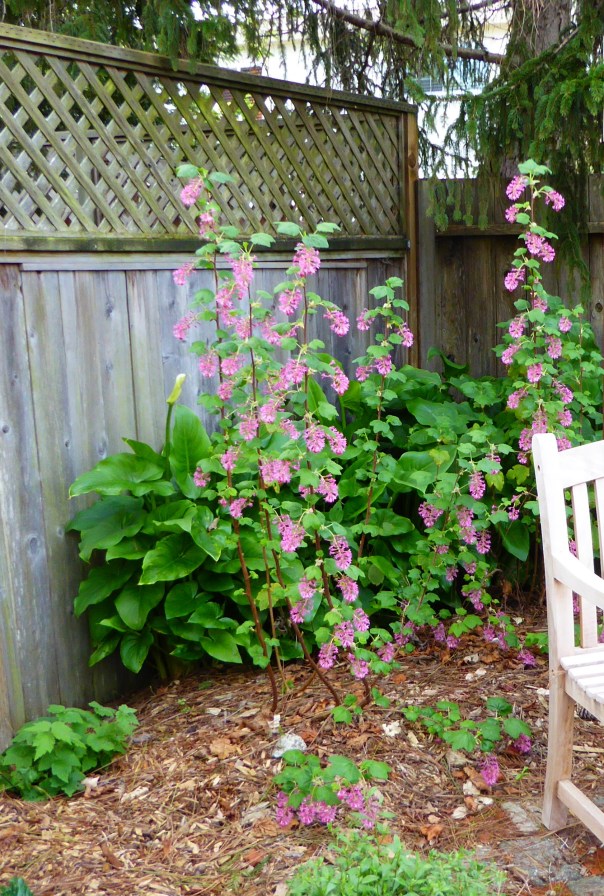
For a few years, back when my garden was newly landscaped, I had three native currant bushes (ribes) with their showy flowers and intoxicating scented leaves.
Ribes, March 2017
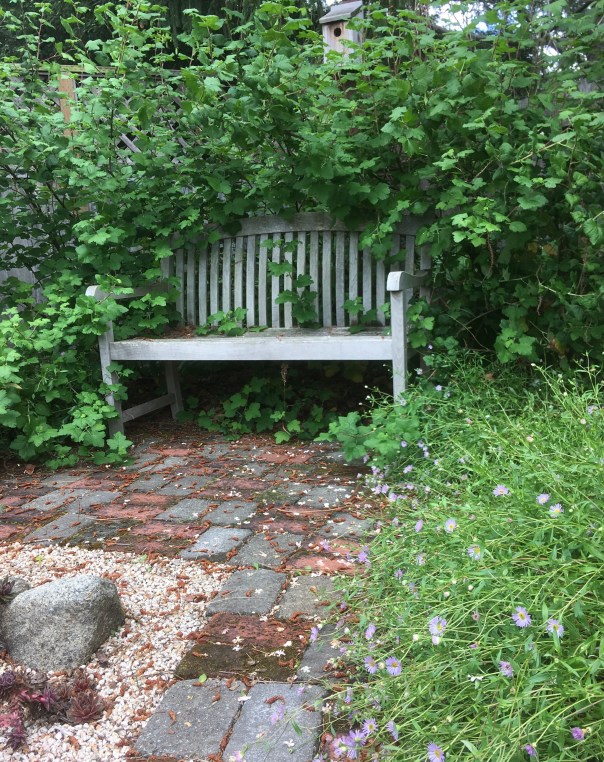
They grew so large that they engulfed the bench in front of them, making it impossible to sit there:
Ribes, May 2019
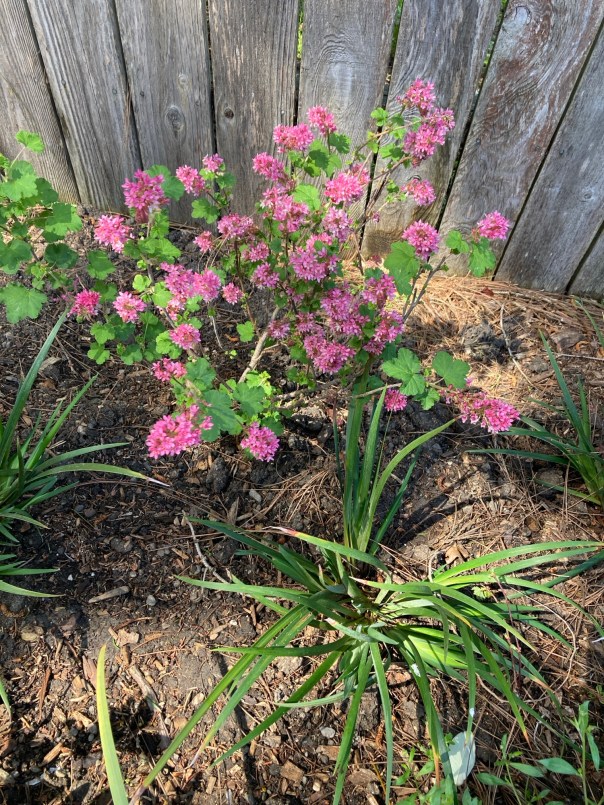
After I pruned them, they bloomed again …. and then one by one they died. No one could figure out why. Now we are trying some new ones, which don’t look like the same plant exactly, but they are blooming very prettily right now:
Last fall I made it to the hardware store after most of the bulbs were already bought up. All they had of muscari were these “special” ones below. I bought a big bag, and then regretted it, thinking they might turn out to be just weird. So instead of planting them near the front door, I put them in various places in the back garden, where they are blooming late… and I do think they are odd.
Revived survivors from last year.
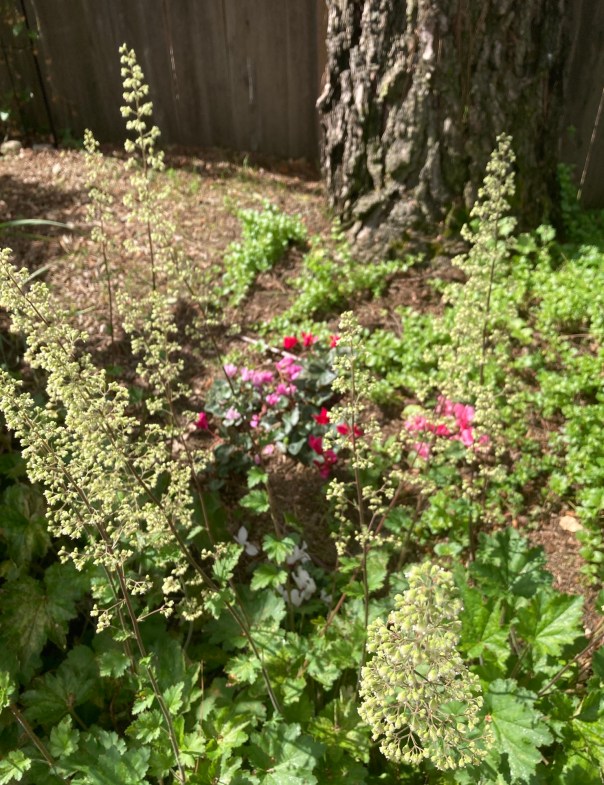
The heuchera are covered with their bells already, and you can see my little cyclamen plantation behind. The soil is very shallow because of tree roots, but they come back year after year; recently I added two more to their family.
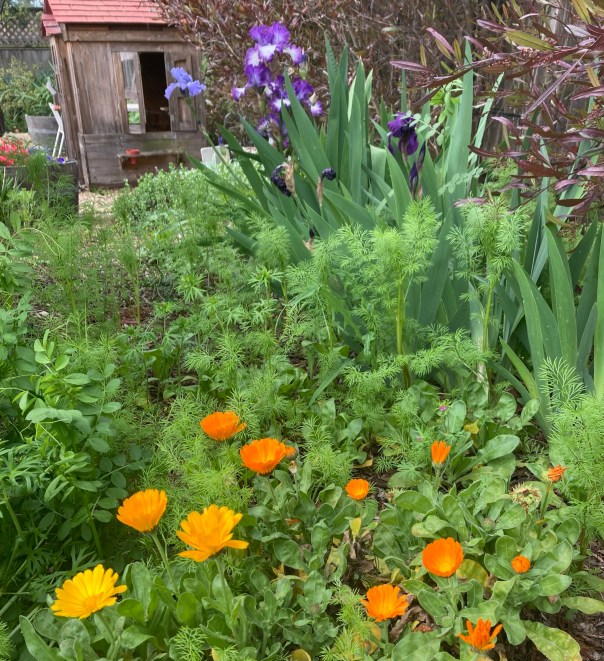
I will close with a cheery calendula group. They are brighter than ever because of all the rain they got, and will never look this good again until next winter or spring, if they get a good winter watering. It’s just too dry in my garden for them to thrive, but they are like many of us that way, right? Rarely are all the conditions optimal for our looking and feeling our best. The calendulas are surrounded by tall, pushy, more drought-tolerant “tares” that don’t seem to bother them at all. I hope to follow their example and cultivate more hardiness, and cheeriness too. Or — merriment.
Because this morning I was reading a Psalm not in my usual translation, and it went like this:
And let the righteous be glad; Let them greatly rejoice before God; Let them be glad with merriment.
On this day we remember St. Tikhon of Zadonsk, a man born into a poor Russian family in 1724. He excelled in school, and after attending seminary became a teacher, and then a monk. After being elevated to the bishopric, at one time he had over 800 churches under his care; the story of his life is well told: here.
It was a huge job, and he accomplished a great deal, but his health began to suffer to the point that he wasn’t able to carry out his duties. He was transferred to a monastery in Zadonsk, and in solitude and relative rest continued to write. Bodily afflictions didn’t cease, but changed, and he became plagued with insomnia and depression, as this article “Victor over Melancholy” explains:
“It was a time of desperate and total battle with his thoughts, of overcoming the spirit of melancholy, despair, and despondency, and of a reassessment of his life circumstances; in the end, his soul acquired the priceless experience of overcoming, and with that the boldness to comfort the despairing….”
Being in seclusion was in some ways harder than overseeing hundreds of parishes, and the saint considered a petition to go back to his former overly-busy life. But eventually he gave up trying to change his situation, and gave himself to ministering to the many needs of the people in the community:
“In the small house where he lived, he organized a type of hospital for those who contracted any kind of illness on the way to work or on pilgrimage. He also offered spiritual alms, tearfully praying for the needs and illnesses of those closely and not so closely known by him.”
His writings were widely read by this time; in one of his compilations of “spiritual treasures” he exhorts us:
“We see in the world that people are weeping… They are born with weeping, live with weeping, and die with weeping. People weep because they live in the world—a place of weeping, the vale of tears… And you weep, Christian!… Weep, while time yet remains, while tears are yet beneficial. Weep, and you will not weep eternally. Weep, and be comforted.” Source
The first Orthodox monastery established in the United States is dedicated to St. Tikhon of Zadonsk: St. Tikhon’s Monastery in Pennsylvania was founded in 1905 concurrently with an orphans’ home, and the current campus is shared with St. Tikhon’s Seminary and Bookstore as well.
Annual Memorial Day Pilgrimage to St. Tikhon’s Monastery, May 2024
Before falling asleep in death, at the age of 59, St. Tikhon was delivered of his melancholy. But in the years previous, during which his writings were proving beneficial to so many, it’s clear from them that his spiritual struggles were already bearing fruit. His example is inspiring, and his words confirm it:
“A manifest sign of love for God is a heartfelt gladness in God, for we rejoice in what we love. Likewise love of God cannot exist without joy, and whenever a man feels the sweetness of the love of God within his heart, he rejoices in God. For so sweet a virtue as love cannot be felt without joy. As honey sweetens our throat when we taste of it, so the love of God makes our heart glad when we taste and see that the Lord is good (LXX-Ps. 33:9 [KJV-Ps. 34:8]). –“On Love for God”
Saint Tikhon was glorified on Sunday August 13, 1861.









 On this day we remember St. Tikhon of Zadonsk, a man born into a poor Russian family in 1724. He excelled in school, and after attending seminary became a teacher, and then a monk. After being elevated to the bishopric, at one time he had over 800 churches under his care; the story of his life is well told:


 Gladsome Lights