“Take your needle, my child, and work at your pattern — it will come out a rose by and by. Life is like that…one stitch at a time, taken patiently.”
~ Oliver Wendell Holmes
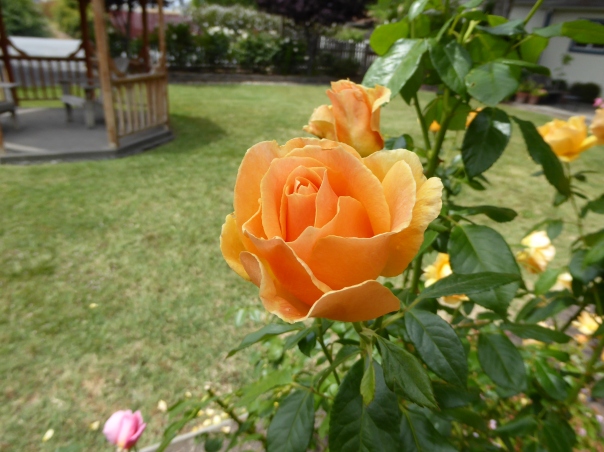 rose at church
“Take your needle, my child, and work at your pattern — it will come out a rose by and by. Life is like that…one stitch at a time, taken patiently.”
~ Oliver Wendell Holmes
rose at church
“When I lay prostrate in despair, Thou hast raised me to keep the morning watch.” That is a line from morning prayers in our prayer book, the first clause of which used to seem a little over-dramatic. No more. I’ve been realizing that it is my default setting, to wake up with a sort of dread, wondering how I will meet the needs of the day, Little Me?
Step by step, that’s how. First, get out of bed, because nothing will get better, nothing will be accomplished if I don’t take that first step. Although lately it seems the first step has been moved back to a moment before, with a confession to myself, “You, GJ, are lying prostrate in despair, but God is about to raise you up to keep the morning watch.” — Then comes the stepping out on to the floor.
Maybe this poem, in spite of its mention of spiritual patience, is not really about any of this, but the “every morning” heartens me.
LANDSCAPE
by Mary Oliver
Isn’t it plain the sheets of moss, except that
they have no tongues, could lecture
all day if they wanted about
spiritual patience? Isn’t it clear
the black oaks along the path are standing
as though they were the most fragile of flowers?
Every morning I walk like this around
the pond, thinking: if the doors of my heart
ever close, I am as good as dead.
Every morning, so far, I’m alive. And now
the crows break off from the rest of the darkness
and burst up into the sky—as though
all night they had thought of what they would like
their lives to be, and imagined
their strong, thick wings.

This Lord’s Day we were remembering the paralytic, who sat by the pool waiting for a chance to get into the water at those times when an angel stirred it, so that he might be healed. After 38 years, Jesus came by and healed him.
Father John in his homily highlighted one aspect of the Gospel story: how we are like that man in our seeming paralysis when it comes to overcoming our sins. Priests often hear in confession the lament of the Christian who continues to battle the same weaknesses and failings year after year, feeling that he makes little progress.
I think a lot about the truism that habits are like a second nature to us. As we read in Jeremiah 13:23: “Can the Ethiopian change his skin or the leopard its spots? Neither can you do good who are accustomed to doing evil.”
It sounds very little like one chipper exhortation you might have read: “It’s never too late to be what you might have been.” Well, yes, why not just start today? When I read that on Tuesday, I remembered the paralytic, and I thought on my own unchanged bad habits. After his 38 years, wasn’t it in fact too late for many things? (The assumption is that one might have been greater; the reverse is probably more true, that it’s never too late to start a downward spiral.)
For myself, let’s see…how many years have I been cultivating certain of my bad habits? More than that, I’m afraid. But it’s a simple thing: “The only thing that stands between me and greatness is me.” (Woody Allen)
 |
| George Eliot |
George Eliot is credited with having made that bold assertion, “It’s never to late to be what you might have been.” She was the subject of a New Yorker article from February of this year, “Middlemarch and Me,” by Rebecca Mead, who questions the validity of the quote and whether it even reflects the true outlook of the author Mary Ann Evans.
Mead has been a lifelong lover of Eliot’s books, Middlemarch in particular, and she points out some hints that the author leaves in her novels, as well as forthright confessions from her journals, to show that her general attitude was wiser and more modest.
In Middlemarch, we read of the main character, “Dorothea herself had no dreams of being praised above other women, feeling that there was always something better which she might have done, if she had only been better and known better.”
Mead writes: “Middlemarch is not about blooming late, or unexpectedly coming into one’s own after the unproductive flush of youth. Middlemarch suggests that it is always too late to be what you might have been — but it also shows that, virtually without exception, the unrealized life is worth living. The book that Virginia Woolf characterized as ‘one of the few English novels written for grown-up people’ is also a book about how to be a grownup person — about how to bear one’s share of sorrow, failure, and loss, as well as to enjoy moments of hard-won happiness.”
Let’s look back at the Paralytic by the Sheep’s Gate Pool. He must have had some way to propel himself, perhaps one limb that was functional, so that he could sit there for much of his life hoping to get down to the water first. He certainly had patience — and perseverance, to keep trying.
Father John said that even if we feel we have nothing more than a big toe’s worth of strength against our sins, we must keep struggling. Because we never know when Jesus will come to us. When he came to the cripple by the pool, He Himself was the source of the healing, and the man was delivered from his afflictions and was able to walk and carry his bed. For most of us, we will not receive the equivalent healing until we are resurrected in the coming Kingdom.
In the meantime, we will have failures. Maybe we will even think we are failures. It is very discouraging when one realizes what Samuel Johnson found: “The chains of habit are generally too small to be felt until they are too strong to be broken.” On another aspect of this human experience, Dorothea said in Middlemarch about her husband’s intellectual labors: “Failure after long perseverance is much grander than never to have a striving good enough to be called a failure.”
The most helpful sort of activity to persevere in, if one wants to be on the path to God, is prayer. “A long perseverance” of this sort would never be disappointing. The very moments of prayer have the potential to be Heaven itself, in the presence of the God Who is Love.
“In patience you possess your souls,” we read in Luke 21, and Mark Twain elaborates: “Habit is habit, and not to be flung out of the window by any man, but coaxed downstairs a step at a time.”
Whether we are being too easy on ourselves is the question. If we are being lazy, of course, that is one of the sins we are trying to overcome. And pride in thinking we are equal to any task, we can be anything we put our minds to — that also must be set aside.
Mary Ann Evans put it this way in her journal: “The difficulty is, to decide how far resolution should set in the direction of activity rather than in the acceptance of a more negative state.”
But I like best the way St. Seraphim of Sarov speaks about this, and will close with his gentle words: “One should be lenient towards the weaknesses and imperfections of one’s own soul and endure one’s own shortcomings as we tolerate the shortcomings of our neighbours, and at the same time not become lazy but impel oneself to work on one’s improvement incessantly.”
When Joanne at Seasonal Hearth was in the Netherlands she and her family rode bicycles a lot, and they took so many pictures of bicycles of all sorts everywhere, it adds up to give a feeling for the country where the population of bikes is greater than that of people.
On this blog about Words, I learned that I possess philoprogenitiveness, and it has been one of the greatest stories of my life! I don’t always read these posts, but they come daily…Now that I’ve been so encouraged by this one, I might check in more often. If I had known the word amphibology it would have come in handy when I was grousing about grammar recently.
Some people can drink milk their whole lives seemingly without any problem (though my husband’s chiropractor thinks it’s the worst thing for anyone) while others can’t digest it. Via Touchstone I ran into this article about population migrations and where the gene for lactose tolerance came from. I’d like to read more about it.
My favorite prize from recent web wandering is a daily posting of poems from the George Hail Library in Rhode Island, each one accompanied by a picture and brief introductory notes. It’s more reliable than the online poem-a-day I used to read, and the blog host has some pleasing parameters for the sort of poetry she likes to share. Here is a recent one that I love. If you click on the title you can see the photo and comments as well:
THE PATIENCE OF ORDINARY THINGS
It is a kind of love, is it not?
How the cup holds the tea,
How the chair stands sturdy and foursquare,
How the floor receives the bottoms of shoes
Or toes. How soles of feet know
Where they’re supposed to be.
I’ve been thinking about the patience
Of ordinary things, how clothes
Wait respectfully in closets
And soap dries quietly in the dish,
And towels drink the wet
From the skin of the back.
And the lovely repetition of stairs.
And what is more generous than a window?
~ Pat Schneider, American poet and writer
 Gladsome Lights