Tag Archives: Pentecost

Give us hearts of flesh!

…I will take you out of the nations; I will gather you from all the countries and bring you back into your own land.  I will sprinkle clean water on you, and you will be clean; I will cleanse you from all your impurities and from all your idols. I will give you a new heart and put a new spirit in you; I will remove from you your heart of stone and give you a heart of flesh.  And I will put my Spirit in you….  -Ezekiel 36

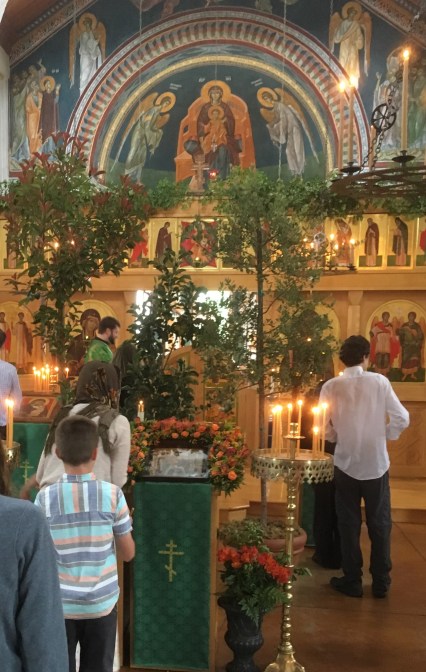
It was a day for rejoicing in my parish, as three men were baptized, and another became a catechumen. Many of us stood scattered over the large patio and lawns outside the church, and roughly in the center of our gathering was the baptismal font that had been newly refurbished. Up the steps of the sunken font they emerged in turn to receive chrismation with that divinely scented oil, the seal of the gift of the Holy Spirit. The rest of us prayed with them and a few sang into our masks, glad with the newly illumined souls that their period of waiting and preparing has been fulfilled. One of the men had been a catechumen for two years, through many delays and interruptions.

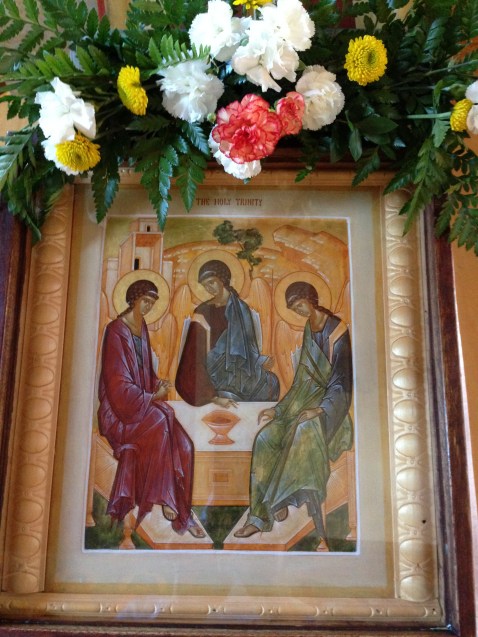
It’s Holy Trinity Day, the Feast of Pentecost, the Descent of the Holy Spirit.

We commemorate the day when the Holy Spirit fell on the apostles and they finally experienced what Christ had promised, when He said that He must “go away,” but He would send the Comforter. But Pentecost is not so much a historic event as it is a present reality.

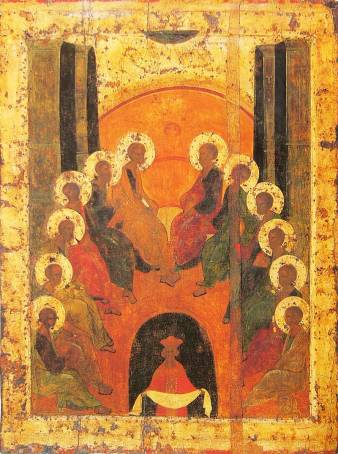
The icon called “Descent of the Holy Spirit” is full of theology. I prepared a small lesson on it for my church school class today and learned about things I’d never paid attention to before. This example shows an empty seat in the center of the semicircle of the apostles, which is for Christ, the invisible Head of the Church, Who is present always through the Holy Spirit.

But some of the Pentecost icons have Christ’s mother Mary, the Theotokos, in that spot; it’s not because we consider her the head of the church. If she is there, it is as another member of Christ’s body, and the supreme earthly example for the rest of us of how a person filled with the Holy Spirit ought to live; in that case her place is called the Teacher’s Seat. The Apostle Paul is in the icon and he was not even present.

The twelve apostles in the icon represent the whole Church throughout time. They sit not in a closed circle but in a semicircle whose openness invites us to be part of that Body. We each experience the descent of the Holy Spirit at our baptism, in the Eucharist, and through all the ministries of the Church, which is why we begin every prayer and every work with, “O Heavenly King, the Comforter, the Spirit of Truth, come and abide in us… ”

…and we might add, do give us those hearts of flesh!
Now you are light in the Lord.

The Monday after Pentecost Sunday, we Orthodox celebrate Holy Spirit Day.

When He came down and confused the tongues,
the Most High divided the nations;

but when He distributed the tongues of fire,
He called all people to unity.

Therefore, with one voice, we glorify the most-Holy Spirit.

(Hymn of the Feast)

For you were once darkness, but now you are light in the Lord. Walk as children of light (for the fruit of the Spirit is in all goodness, righteousness, and truth), finding out what is acceptable to the Lord.  And have no fellowship with the unfruitful works of darkness, but rather expose them. For it is shameful even to speak of those things which are done by them in secret. But all things that are exposed are made manifest by the light, for whatever makes manifest is light. Therefore He says:

“Awake, you who sleep,
Arise from the dead,
And Christ will give you light.”

(From the epistle for the day, Ephesians 5)

The earth herself awakens.

Anglican priest Fr. Malcolm Guite has written a cycle of sonnets for the church year, several of which I have posted in the past. You can read and listen to this one for Pentecost on his site. I like the theme of the four elements which he weaves into his poem. From the blog:

“Throughout the cycle, and more widely, I have been reflecting on the traditional ‘four elements’ of earth, air, water and fire. I have been considering how each of them expresses and embodies different aspects of the Gospel and of God’s goodness, as though the four elements were, in their own way, another four evangelists.

“In that context I was very struck by the way Scripture expresses the presence of the Holy Spirit through the three most dynamic of the four elements, the air, ( a mighty rushing wind, but also the breath of the spirit) water, (the waters of baptism, the river of life, the fountain springing up to eternal life promised by Jesus) and of course fire, the tongues of flame at Pentecost. Three out of four ain’t bad, but I was wondering, where is the fourth? Where is earth? And then I realised that we ourselves are earth, the ‘Adam’ made of the red clay, and we become living beings, fully alive, when the Holy Spirit, clothed in the three other elements comes upon us and becomes a part of who we are.”

PENTECOST

Today we feel the wind beneath our wings
Today  the hidden fountain flows and plays
Today the church draws breath at last and sings
As every flame becomes a Tongue of praise.
This is the feast of fire, air, and water
Poured out and breathed and kindled into earth.
The earth herself awakens to her maker
And is translated out of death to birth.
The right words come today in their right order
And every word spells freedom and release
Today the gospel crosses every border
All tongues are loosened by the Prince of Peace
Today the lost are found in His translation.
Whose mother-tongue is Love, in  every nation.

-Malcolm Guite

The most fragrant dispensation.

Since Pascha I have been reading The Eucharist by Father Alexander Schmemann. It is so much more than I expected; I don’t know what I did expect — maybe with such a simple title I imagined something “dry and scholarly”? We can count on Fr. Alexander to be scholarly, but we can also count on his words to be infused by the Holy Spirit and to convey his own obvious joy in the Holy Spirit.
My priest was graced to hear these words as seminary lectures; the author died before he could finish the English edition of his book, but use was made of the original Russian and the French translation in the publishing of the edition I am reading, in 1987.  It’s another of those many lasting gifts that Fr. Alexander has given us.

Much in the section on “The Sacrament of the Kingdom” is especially fitting for the celebration of Pentecost this week, so I share from the riches I’m receiving:

…Through his coming on the “last and great day of Pentecost” the Holy Spirit transforms this last day into the first day of the new creation and manifests the Church as the gift and presence of this first and “eighth” day.

Thus, everything in the Church is by the Holy Spirit, everything is in the Holy Spirit and everything is partaking of the Holy Spirit. It is by the Holy Spirit because with the descent of the Spirit the Church is revealed as the transformation of the end into the beginning, of the old life into the new. “The Holy Spirit grants all things; he is the source of prophecy, he fulfills the priesthood, he gathers the entire church assembly” (hymn of Pentecost). Everything in the Church is in the Holy Spirit, who raises us up to the heavenly sanctuary, to the throne of God. “We have seen the true light, we have received the heavenly Spirit” (another hymn of Pentecost).

Finally, the Church is entirely oriented toward the Holy Spirit, “the treasury of blessings and giver of life.” The entire life of the Church is a thirst for acquisition of the Holy Spirit and for participation in him, and in him of the fullness of grace. Just as the life and spiritual struggle of each believer consists, in the words of St. Seraphim of Sarov, in the acquisition of the Holy Spirit, so also the life of the Church is that same acquisition, that same eternally satisfied but never completely quenched thirst for the Holy Spirit.

I can imagine that there are writings about the Holy Spirit that are “dry,” if the writer is not skilled, or has not experienced life in Christ. But the Holy Spirit himself cannot be dry — he is sent to water our souls with divine life. At the close of this section Father Alexander gives us a prayer from the compline canon of the Feast of the Holy Spirit:

“Come to us, O Holy Spirit, and make us partakers of your holiness,
and of the light that knows no evening, and of the divine life,
and of the most fragrant dispensation….”