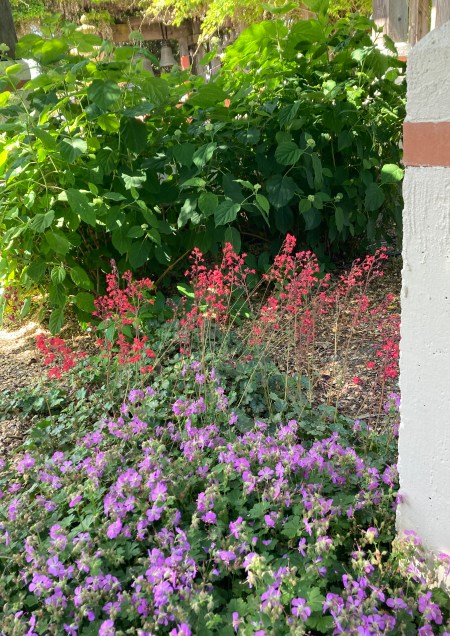
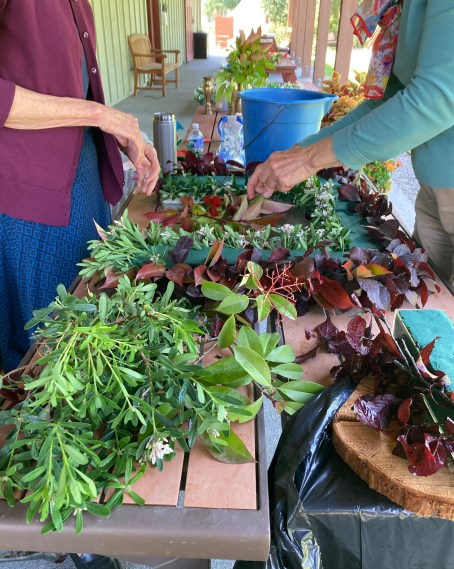
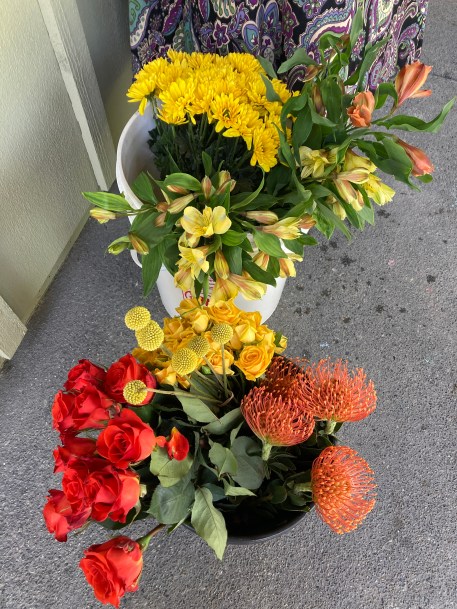
When I arrived on the church property this morning on St. Justin’s day, I saw three trees in pots sitting by the front porch, waiting to go in and become part of the decoration for Pentecost Sunday. I walked around and took pictures of the landscape with its ever changing color display. Throughout the morning people were coming and going, for the service and for other activities connected to the upcoming feast. A crew was cooking in the kitchen, and out on the patio women arranged flowers.
Four of us were in the temple ironing green altar cloths and replacing the white ones that have been the theme since Pascha, almost fifty days ago. A few of the icons are so heavy, it takes two of us to lift the big box frame from its stand, while the third set of hands slides off the white satin hanging and arranges the fresh green cloth as straight as possible; then the saint’s image is laid down to rest again.
Before any of that, the Liturgy in honor of St. Justin was served in our little church; one of our group who bears the name of Justin was directing the minimal choir. It may be that I never before attended a Divine Liturgy for St. Justin, though I have mentioned him on my blog. In any case, I didn’t remember the hymns of the feast, which draw attention to his title as Philosopher, and his ability to defend the faith in words, and to witness to it by his death. I was moved by their poetry.
You emptied the cup of the wisdom of the Greeks,
but you thirsted again,
until you came to the well where you found
water springing unto eternal life.
And having drunk deeply,
you also drank from the cup
which Christ gave to His disciples.
Therefore, O Justin,
we praise you as a Philosopher
and Martyr of Christ.
O Justin, teacher of divine knowledge,
you shone with the radiance of true philosophy.
You were wisely armed against the Enemy.
Confessing the truth, you contested with the Martyrs,
with them, O Justin, always entreat Christ to save our souls.
On this page, you can read the life of the saint: St. Justin the Philosopher.
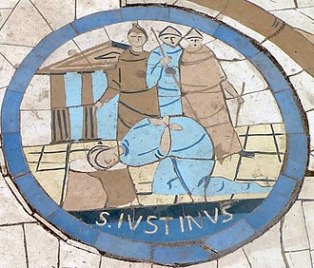 He lived in the second century, and wrote his second Apology, addressed to the Roman Senate, in 161, soon after Marcus Aurelius became emperor. He had been able to persuade the previous emperor, Antoninus Pius, to stop persecuting Christians, at least for a time. The Cynic philosopher Crescentius, who reportedly always lost debates against Justin, had a part in his death, as out of envy he denounced him to the Roman court, after which Justin and six friends were imprisoned, tried and beheaded. The following is considered to be the court record of the trial (Wikipedia):
The Prefect Rusticus says: Approach and sacrifice, all of you, to the gods. Justin says: No one in his right mind gives up piety for impiety. The Prefect Rusticus says: If you do not obey, you will be tortured without mercy. Justin replies: That is our desire, to be tortured for Our Lord, Jesus Christ, and so to be saved, for that will give us salvation and firm confidence at the more terrible universal tribunal of Our Lord and Saviour. And all the martyrs said: Do as you wish, for we are Christians, and we do not  sacrifice to idols. The Prefect Rusticus read the sentence: Those who do not wish to sacrifice to the gods and to obey the emperor will be scourged and beheaded according to the laws. The holy martyrs glorifying God betook themselves to the customary place, where they were beheaded and consummated their martyrdom confessing their Saviour.
I admire this saint’s search for the truth, and am glad that it didn’t take his whole life to try out, in turn, the Stoics, the Peripatetics, the Pythagoreans and the Platonists, until he at last found Christ. Even more inspiring is his resolve, once he knew the Truth — the way he clung firmly to Christ who is the true Logos, the Word of God. I want to follow St. Justin’s example in drinking deeply of True Philosophy.
As a breath from Paradise,
the dew descending upon Hermon,
Christ the Power and the Peace and Wisdom of God the Father,
came upon your thirsting spirit, O Martyr Justin,
making you a Fount of Knowledge for all the faithful,
when with true valor you endured death as a Martyr,
to live forever in Christ.

 When we say that God is spirit, we say simply that he is not matter as we know it, that he is something quite different. In that sense it is a negative description that belongs already without the word, to that form of theology which is negative theology, apophatic theology, a theology of paradoxes, a theology that uses words to point toward the ineffable — that which can neither be described nor put into words and yet which must be indicated somehow in speech.
 After Myriah had gone home, she wrote to thank me, and to apologize for what she thought was her own “noise” as she “tried to make sense of everything.” She said, “I came home and planned to curl up and read the Bible.” But family demands prevented her. I realized that I had robbed her of what should have been a respite from confusion, talking as I had as though raging and clanging could be truly rational. Probably we should have spent some part of our two-day visit reading the Gospel together. (The garden did rescue us several times.)

