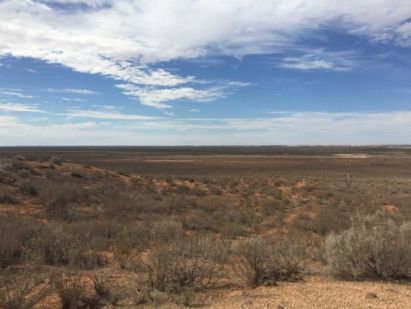
When in 1930 Jill Ker Conway’s father began homesteading a “block” of 18,000 acres in New South Wales, Australia, the change in lifestyle was jarring for his wife.
When my father left in the morning to work on the fences, or on one of the three bores [wells] that watered the sheep and cattle, my mother heard no human voice save the two children. There was no contact with another human being and the silence was so profound it pressed upon the eardrums. My father, being a westerner, born into that profound peace and silence, felt the need for it like an addiction to a powerful drug. Here, pressed into the earth by the weight of that enormous sky, there is real peace. To those who know it, the annihilation of the self, subsumed into the vast emptiness of nature, is akin to a religious experience. We children grew up to know it and seek it as our father before us. What was social and sensory deprivation for the stranger was the earth and sky that made us what we were. For my mother, the emptiness was disorienting, and the loneliness and silence a daily torment of existential dread.
At about 5,000 feet up into the mountains I usually turn off the radio or story, open all the car windows, and breathe deeply of the pine and cedar scents that are so exhilarating. They make me think, “Why oh why have I stayed away so long? How will I bear to go back down to the air of the flatlands?”
Wallflower
But this summer — it didn’t happen that way. At about 3,000 feet I got lost, or at least confused, by taking a couple of wrong turns. When I realized my mistake, it took me a half hour to get back on track. At 4,000 feet, even though it was still 86°, I opened the windows under tall pines, but all I noticed was my shirt hanging in the backseat, as a sleeve started flapping in the rear view mirror.
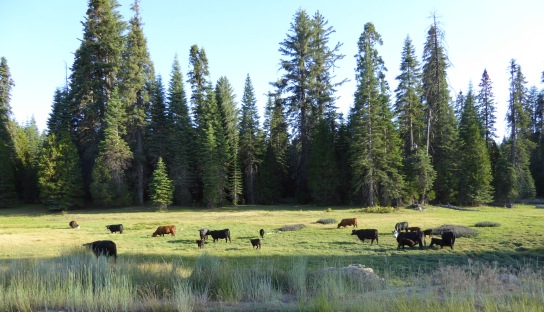
And I watched the thermometer drop 20 degrees in 20 minutes, as I climbed into the forest. I saw the elderberry bushes in bloom, those tall and friendly plants I’d learned about two years ago, and more than one upland meadow with black cattle grazing. Maybe it wasn’t late in the day for summertime, but I’d forgotten how the sun would go down early, because the trees are so tall, and the valleys deep. I discovered that my jaw was sore – evidently I’d been clenching it, so there must have been some anxiety about the time underneath my excitement over all the irresistible photo opportunities.
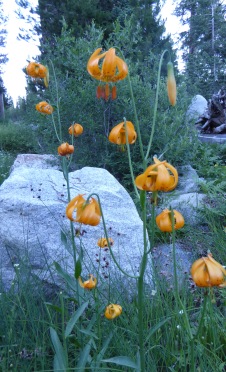
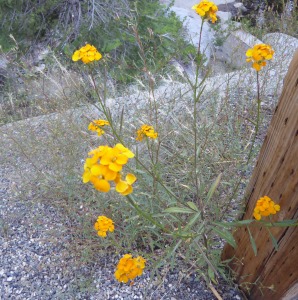
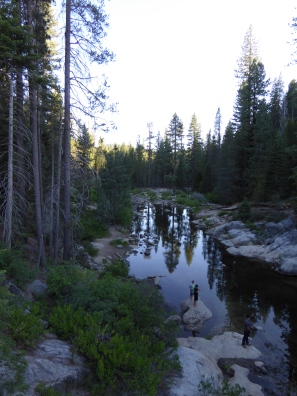
Where the road crosses a bridge over a creek I stopped to catch the fishermen in the twilight, and found an orange wallflower, that lacking a wall, made do with a post.
Leopard Lily
The thermometer dropped another twenty degrees in the last hour of my drive, as I got higher and higher and still obeyed the call of the wildflowers to stop and take their pictures — because after all, they might be gone the next time I passed their way! Their glory is short-lived, except for the Pearly Everlasting that seems to hang on and on making a white border by the roadside.
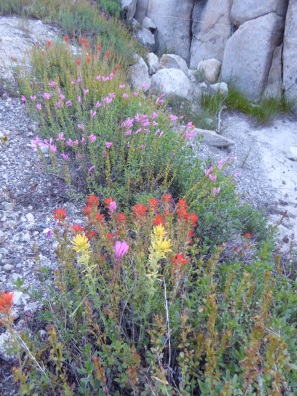
Leopard lilies bloomed in the wetter areas, but the penstemon and paintbrush grew right out of the granite gravel next to the pavement, where they also get the maximum of sun exposure.
paintbrush & penstemon
And then, after a journey of eight and a half hours (it “normally” takes me six) during which the temperature ranged from 102° to 57°, I arrived at the door of our beloved cabin! I had by this time forgotten the advice of one of my friends, when I told her about my anxiety: “Breathe deeply when you get in the mountains.” I’m sure when I was sitting at home in the morning and read that message I must have thought, “Well, that comes naturally!”
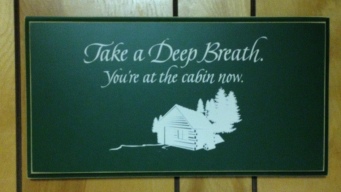
When I unlocked the door and walked in, I noticed a new sign on the wall:
I obeyed that word, too, but I was only thinking of how I needed the conscious inhalation to help me relax. It wasn’t until I was lying in bed an hour later that it dawned on me I hadn’t smelled the trees. Was it the drought that was making them hold every droplet of moisture in their needles? Was I to spend several days in their company and never get that mountain perfume? Two years ago when I last was last here, smoke from a huge forest fire in Yosemite was filling my senses with the scent of burning trees.
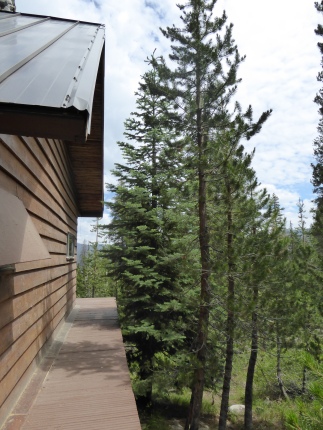
view from deck
It was the bone-penetrating, soul-healing quiet of the mountains that most affected me during this visit. I was completely solitary for my first evening and morning, and that turned out to be enough time for an intense healing session.
I sat on the deck reading in the morning. Two birds twittered a call-and-response from one Lodgepole pine to another. Up there the sun is baking, and the altitude takes your breath away – or more precisely, takes the oxygen from your breath – and everything combines and causes a heavy sleepiness to fall on you…. Before noon I had to lie on my bed to take a nap. But in the cool of the bedroom I revived and didn’t sleep. I read more in George MacDonald’s Phantastes, the book that C.S. Lewis said “baptized his imagination.”
The protagonist of the story, who is exploring Fairyland, encounters a lovely and deep blue pool: “Led by an irresistible desire, I undressed, and plunged into the water. It clothed me as with a new sense and its object both in one. The waters lay so close to me, they seemed to enter and revive my heart.”
When in my imagination I experienced that Living Water with the swimmer in the story, it was as if the silence of the mountain morning were the pool of God’s healing presence for me at that moment. Then I knew another reality I had read about a few pages before in that book, “Tears are the only cure for weeping.”
One doesn’t like to imagine breathing water, and I hadn’t yet managed to detect that comforting mountain aroma in the air that I drank hungrily, but stillness and peace were in plentiful supply, and were oxygen for my spirit. That sort of peace is so unfamiliar, it is at the same time both soothing and thrilling.
I was soon to have more good company, both human and atmospheric, and I will tell more about that next time.
I ran across this article, part of a series on education by Anthony Esolen. In the course of describing how the modern world wars against our children’s souls in ways our ancestors didn’t experience, he touches on the topics of play, and why we don’t want to be stimulated, and silence.
I think of the Lord speaking to us, in His silence that communicates so much: “Be still, and know that I am God.” And that is how I know that these issues are crucial. Some excerpts:
It is noise, rather, that is the absence, both of the significant word and of the fullness of being that silence allows us to hear. …how petty and dreary a thing it is to be stimulated. The stimulus is the prick or spur you dig into the side of an animal. Imagine the horse, slow moving creature when he is content, with his large sad eyes. If we are to make use of him, we must apply the spur. It is essentially a pornographic world, where everyone lies naked on a bed of nettles, and every new thing is dead before it is born. Silence is so great a blessing to us because we cannot use it. All things truly creative, which partake of the spirit of play, send their roots deep down into silence.
My last post remembering Saint Herman prompted Pom Pom to ask me if I had read The Music of Silence, book she had just received in the mail. I haven’t read such a book, so I googled it and immediately have several tangents to run along now. I don’t know if she meant this memoir of Andrea Bocelli, or this one about singing the Hours or services of the church through the day in Gregorian Chant.
One reviewer wrote of the latter book:
“Nothing is as ordinary, or as sacred, as time. Far from being an infinitesimally small unit of measurement or a means of separating one event from another, time provides the means by which the still, small, silent voice of God may be heard.”
Silence….hmmm….I know so little of it.
When I read about music, silence, solitude, it can be an inspiration and a reminder, but my readings and thinkings are typically like so many rabbit trails, to use a term that hints at the fun of scurrying from one author or thought to another. A rabbit is doing what he was made to do, and glorifies God by it. I was made to live by the Holy Spirit in communion with my Creator.
So I need to STOP on the trail and pray–and maybe even get off the trail sometimes! It wasn’t books and ideas that made it possible for Father Herman to sing with the angels. It was prayer. The kind of prayer St Isaac of Syria is talking about when he says:
“The wisdom of the Holy Spirit is much greater than the wisdom of the entire world. Within the wisdom of the Holy Spirit, silence prevails; the wisdom of the world, however, goes astray into idle talk.”
My mind is given to talking idly with itself. So much of my remembering of my Savior is like the awareness I might have of an earthly friend when she is in the room with me, but I am not paying close attention. I might hear her talking without really listening, I might even speak with her–but not make eye contact.
Don’t we all have this weakness in our human condition, worsened by modern life, that we can’t settle our minds down firmly even when in prayer? Abba Dorotheus of Gaza says:
“Just as it is easier to sin in thought than in deed, correspondingly, it is more difficult to struggle with thoughts than with deeds.”
But C.S. Lewis encourages us:
“Virtue–even attempted virtue [I hope this includes attempted prayer]–brings light; indulgence brings fog.”
So I will keep struggling in prayer, to push past the distractions, to listen for the Silence that is God’s music.
It’s not the wonderful blog posts and the writers of them that are my problem. Nor my own writing, because just the discipline of organizing the chaos at least gets me on the road to taking every thought captive to Christ, though my readers might legitimately question how often I get to my destination. With God’s help, I know His presence and see His working in the world by the goings-on of the blogosphere and the piles of books throughout my house. Glory to God for all things! Lord, have mercy!
One more rabbit trail, leading quickly to the spot where all those paths ought eventually to end up, was brought to my attention this month, a poem by George Herbert:
Christmas
The shepherds sing; and shall I silent be? My God, no hymn for Thee? My soul’s a shepherd too; a flock it feeds Of thoughts, and words, and deeds. The pasture is Thy word: the streams, Thy grace, Enriching all the place. Shepherd and flock shall sing, and all my powers Outsing the daylight hours. Then will we chide the sun for letting night Take up his place and right: We sing one common Lord; wherefore he should Himself the candle hold.
I will go searching, till I find a sun Shall stay, till we have done; A willing shiner, that shall shine as gladly, As frost-nipped suns look sadly. Then will we sing, and shine all our own day, And one another pay: His beams shall cheer my breast, and both so twine, Till ev’n His beams sing, and my music shine.