…the air is the sphere of the devil, and the enemy of our race, who, having fallen from heaven, endeavors with the other evil spirits who shared in his disobedience both to keep souls from the truth and to hinder the progress of those who are trying to follow it. The apostle refers to this when he says, “According to the prince of the power of the air, of the spirit that now worketh in the sons of disobedience.” But the Lord came to overthrow the devil and to purify the air and to make “a way” for us up to heaven, as the apostle says, “through the veil, that is to say, His flesh.” This had to be done through death, and by what other kind of death could it be done, save by a death in the air, that is, on the cross? Here, again, you see how right and natural it was that the Lord should suffer thus; for being thus “lifted up,” He cleansed the air from all the evil influences of the enemy. “I beheld Satan as lightning falling,” He says; and thus he re-opened the road to heaven, saying again, “Lift up your gates, O ye princes, and be ye lift up, ye everlasting doors.”
Here Athanasius himself writes of a phenomenon I don’t know anything about, “what happens when great king enters a large city.” But the example from ancient times, in On the Incarnation, is so eloquently given that its light shines right through any culture barrier and reveals a truth of the Incarnation in a new and bright aspect.
You know how it is when some great king enters a large city and dwells in one of its houses; because of his dwelling in that single house, the whole city is honored, and enemies and robbers cease to molest it. Even so is it with the King of all; He has come into our country and dwelt in one body amidst the many, and in consequence the designs of the enemy against mankind have been foiled, and the corruption of death, which formerly held them in its power, has simply ceased to be. For the human race would have perished utterly had not the Lord and Saviour of all, the Son of God, come among us and put an end to death.
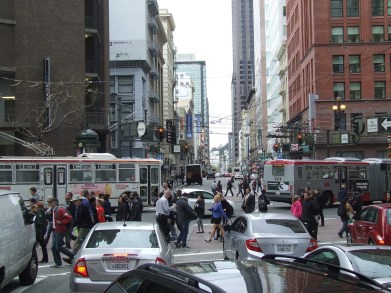
A young woman we know is trying to love people in San Francisco for the sake of Christ. In a recent prayer letter she wrote:
The hardest part of doing ministry in San Francisco is the cost of living factor. My rent is $1975 for my two bedroom apartment, which many in the city will tell you is a good deal. Because of the high cost of living most pastors and missionaries don’t live here. The problem is that you can’t relate to the people and become effective at reaching the city for Christ if you don’t really live among them.
San Francisco downtown
People think that if they just have some fancy strategy they will see people come to Christ. These programs become like the welfare system; people just learn how to work the system, and there are so many that the homeless get to pick what they want at different meals.
They get used to sitting and allowing the word of God to come in one ear and out the other…rarely do you see any lives change. The old fashioned way of living among the people is gone from many Christians’ concept of what a missionary does. The majority of pastors live outside the city because it is cheaper. They then drive into the city where they have a reserved parking place and never spend time out in the community.
But this woman meets people on the bus and the playground, and they get to know and trust her as their lives interweave with hers. The words of her letter came back to me as I was reading On the Incarnation by St. Athanasius:
The Saviour of us all, the Word of God, in His great love took to Himself a body and moved as Man among men, meeting their senses, so to speak, half way. He became Himself an object for the senses, so that those who were seeking God in sensible things might apprehend the Father through the works which He, the Word of God, did in the body. Human and human-minded as men were, therefore, to whichever side they looked in the sensible world they found themselves taught the truth….For this reason was He both born and manifested as Man, for this he died and rose, in order that, eclipsing by His works all other human deeds, He might recall men from all the paths of error to Know the Father. As He says Himself, “I came to seek and to save that which was lost.”
I must have read C.S. Lewis’s introduction to St. Athanasius’s On the Incarnation twice before in an attempt on the whole book, without getting much beyond it, but on this third try I have kept going. It seemed a fitting little paperback to read during Advent.
In the introduction we have an instance of Lewis’s exhorting us to read more of the Old Books, like this one from the 4th century, though we are timid: “The student is half afraid to meet one of the great philosophers face to face. He feels himself inadequate and thinks he will not understand him. But if he only knew, the great man, just because of his greatness, is much more intelligible than his modern commentator.”
And Lewis also writes here about devotional vs. doctrinal works, On the Incarnation being one of the latter, that he finds the doctrinal books often “more helpful in devotion” than the expressly devotional ones. I can relate to his description of people who “find that the heart sings unbidden while they are working their way through a tough bit of theology with a pipe in their teeth and a pencil in their hand.”
Actually I don’t know about the pipe in the teeth, but I always have a pencil in my hand as I lie in bed with my book of theology or literature or whatever. And I marked some passages from St. Athanasius to share in this season when we focus on God With Us.
You must understand why it is that the Word of the Father, so great and so high, has been made manifest in bodily form. He has not assumed a body as proper to his own nature, far from it, for as the Word He is without body. He has been manifested in a human body for this reason only, out of the love and goodness of His Father, for the salvation of us men. We will begin, then, with the creation of the world and with God its Maker, for the first fact that you must grasp is this: the renewal of creation has been wrought by the Self-same Word Who made it in the beginning. There is thus no inconsistency between creation and salvation; for the One Father has employed the same Agent for both works, effecting the salvation of the world through the same Word Who made it in the beginning.
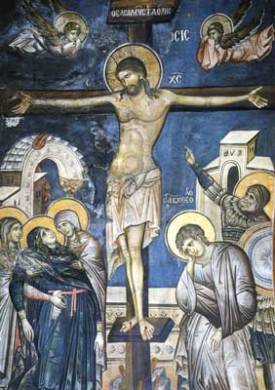 …the air is the sphere of the devil, and the enemy of our race, who, having fallen from heaven, endeavors with the other evil spirits who shared in his disobedience both to keep souls from the truth and to hinder the progress of those who are trying to follow it. The apostle refers to this when he says, “According to the prince of the power of the air, of the spirit that now worketh in the sons of disobedience.” But the Lord came to overthrow the devil and to purify the air and to make “a way” for us up to heaven, as the apostle says, “through the veil, that is to say, His flesh.” This had to be done through death, and by what other kind of death could it be done, save by a death in the air, that is, on the cross? Here, again, you see how right and natural it was that the Lord should suffer thus; for being thus “lifted up,” He cleansed the air from all the evil influences of the enemy. “I beheld Satan as lightning falling,” He says; and thus he re-opened the road to heaven, saying again, “Lift up your gates, O ye princes, and be ye lift up, ye everlasting doors.”
 Gladsome Lights