Tag Archives: St. John Chrysostom

The paltriness of the good and the bad.

Father Stephen:

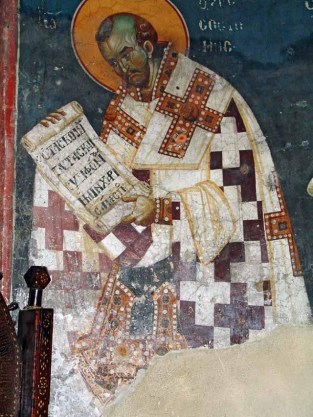
I can think of no Church Father who spoke more forcefully or critically about the moral failings of his time than St. John Chrysostom. He did not hesitate to call out the Emperor, or problems within the larger Church. Eventually, his words brought about his exile. Banished to the very edge of the empire, he died in isolation. Writing to the Deaconness Olympia, his closest friend and confidant, he expressed the very heart of Orthodoxy in troubled times:

“Therefore, do not be cast down, I beseech you. For there is only one thing, Olympia, to fear, only one real temptation, and that is sin. This is the refrain that I keep chanting to you ceaselessly. For everything else is ultimately a fable – whether you speak of plots, or enmities, or deceptions, or slanders, or abuses, or accusations, or confiscations, or banishments, or sharpened swords, or high seas, or war engulfing the entire world. Whichever of these you point to, they are transitory and perishable, and they only affect mortal bodies; they cannot in any way injure the watchful soul. This is why, wishing to express the paltriness of both the good and the bad things of this present life, the blessed Paul stated the matter in one phrase, saying, ‘For the things that are seen are transient’ (2 Cor. 4:18).”

From Letter 7, Saint John Chrysostom’s Letters to Saint Olympia.

From Fr. Stephen Freeman’s recent post: Into the Heart of the Capitol

O Hell, where is thy victory?

Hell was embittered when it met Thee below face to face.
It was embittered because it was set at naught.
It was embittered for it was mocked.
It was embittered for it was slain.
It was embittered for it was cast down.
It was embittered for it was fettered.
It received a body and encountered God.
It received earth and came face to face with heaven.
It received what is seen,
and fell because of what is unseen.
O death, where is thy sting?
O Hell, where is thy victory?
Christ is risen and thou art cast down.
Christ has risen and the demons have fallen.
Christ is risen and life is made free.”

Christ is risen! Indeed, He is risen!

Text from the Paschal homily of St. John Chrysostom

Hovering over the meadow.

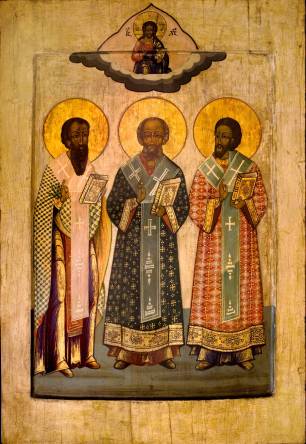
Our Orthodox commemoration of the Three Holy Hierarchs and Ecumenical Teachers was instituted as a result of 11th-century debates about which of them was the greatest. They themselves had to intervene by means of a vision given to St. John Bishop of Euchaita, who chose January 30 for their feast.

These three gifts to the Church are Basil the Great (330-379), Gregory the Theologian (329-389), and John Chrysostom (347-407). Each has his own feast day, but they are held in such esteem that it isn’t too much for us to remember them again together, they who in the words of a hymn, “have enlightened the world with the rays of their divine doctrines. They are sweetly-flowing rivers of wisdom filling all creation with springs of heavenly knowledge.”

A hymn of Matins on their feast day echoes a theme that runs through hagiography generally; it is the sweetness of true theology and and God’s Word imparted to us.

Like bees hovering over the meadow of scriptures,
You embraced the wonderful pollen of their flowers.
Together you have produced for all the faithful
The honey of your teachings for their complete delight.
Therefore as we each enjoy this,
We cry out with gladness:
Blessed ones, even after death,
Be advocates for us who praise you!

The Feast of Angels

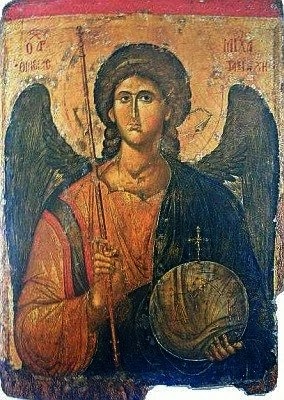
Being raised in Protestant churches, I learned little about angels. Since coming to Orthodoxy, I’ve been introduced to a large body of teaching, and some practices that help me learn experientially, too. Some lessons come through the feasts such as on November 8th (beginning with Vespers tonight, actually), when we celebrate the Feast of The Synaxis of the Chief of the Heavenly Hosts, Archangel Michael and the Other Heavenly Bodiless Powers.

I read that the commemoration was established at the beginning of the fourth century at the Council of Laodicea. It was set to be celebrated in what was at that time the ninth month of the year, because there are nine ranks of angels.

This very rich article also tells a lot about angels according to our tradition. One teaching that gets me thinking about the mysteries of God’s Kingdom is about the angels’ bodies. But aren’t they body-less, as the name of the feast calls them? On that topic and others, here are some excerpts from the blog post, passing on to us the teachings of several church fathers:

St. John of Damascus says they are creatures limited in space and time; they have their own specific external appearance. Compared to humans, they are bodiless due to the human’s “heavy body,” but compared to God they have a body. “We speak about the angels as bodiless and immaterial compared to us, but in fact everything is heavy and material compared to God, to Whom nobody can be compared, because only the Divine is non-material and bodiless.”

St. John Chrysostom says that “… every one of us has his angel;” and St. Basil the Great adds, “Beside every believer in God sits his angel, so repent.” Finally, the angel of prayer is the angel who helps us to pray. St. Clement of Alexandria says, “Even when a person prays alone, he is accompanied by angels.” Tertullian commands the Christian not to sit when he prays in respect for the angel of prayer standing beside him.

That last sentence is the kind of nugget of truth that I can hope to remember, and let it influence my everyday life. Some will say, Why not just remember that God Himself sits with you, so repent? etc. What I have concluded after debating about these things many years ago is that if God has chosen to use angels in His salvation work, why should we ignore or reject them? Why don’t we just say, Thank you, Lord! and show our appreciation by our acts?

In our parish we have many who are named for the Archangel Michael; we’ll have Divine Liturgy tomorrow morning and give thanks for the work of angels in our lives. I’d like to muse longer over more quotes from this article but I better return to my housework if I want to make it to church in the morning.