Leaving my home, traveling alone among strangers; being with my dear family and so soon saying good-bye and leaving their welcoming home; returning to my homey spaces; leaving home again (as I am doing today) and becoming absent from my house and garden… A lot of this kind of drama has been mine, this month. I will write more soon about this week’s travels. I have to say, though, that none of my leavetaking has felt as painful as a scorpion!
LEAVETAKING
On the morning they left we said goodbye filled with sadness for the absence to come.
Inside the palanquins on the camels’ backs I saw their faces beautiful as moons behind veils of golden cloth.
Beneath the veils tears crept like scorpions over the fragrant roses of their cheeks.
These scorpions do not harm the cheek they mark. They save their sting for the heart of the sorrowful lover.
-Ibn Jakh (1000 – 1050) Spain Translated by Emilio Garcia Gomez & Cola Franzen
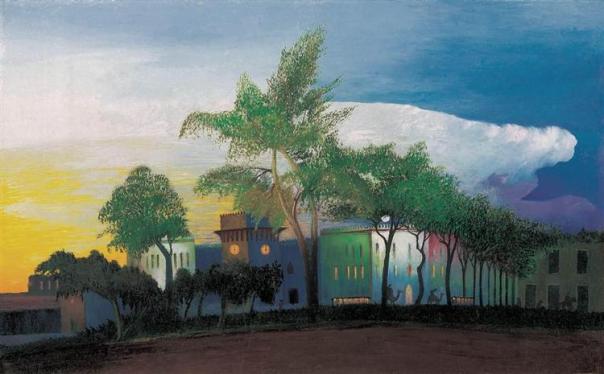
Tivadar Kosztka, Csontvary Fortress With Arabs Riding Camels
Thou tellest my wanderings: put thou my tears into thy bottle: are they not in thy book?
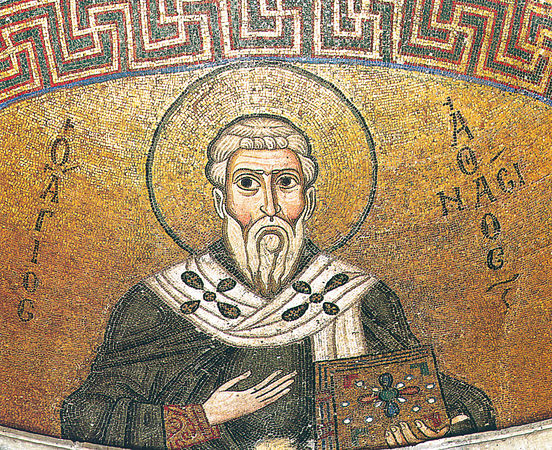
The more one researches current events, historical accounts, and the tangled web of cultures and civilizations going back to the foundation of the world, the more likely is a fall into worry and even despair. We fear especially for children who have to grow up in a violent era, as many have done. That’s why I take courage from the life of St. Athanasius, and pray that my children, grandchildren, godchildren, and all of us, might learn deep in our souls what he knew. The following is an excerpt from a post I wrote several years ago in a time of sorrow. I have shared the quote from his treatise more recently than that, but I hope you might agree with me that it’s worth rereading:
I learned in the short account of the life of Athanasius at the beginning of his On the Incarnation, that the last and worst persecution of Christians ended in Egypt in 311 A.D., when Athanasius was about fourteen. From the age of five he had lived with the constant threat of death, and with the ever-present reality of persecution of his friends and family. The behavior of the ungodly is irrational and inhuman, and tends to cause great pain and suffering, often unto death, not only of the innocent but also of the most Christ-like. As an adult the scenes and events of his childhood seem to be fresh in his mind when he writes:
“A very strong proof of this destruction of death and its conquest by the cross is supplied by the present fact, namely this. All the disciples of Christ despise death; they take the offensive against it and instead of fearing it, by the sign of the cross and by faith in Christ trample on it as on something dead. Before the divine sojourn of the Saviour, even the holiest of men were afraid of death, and mourned the dead as those who perish. But now that the Saviour has raised his body, death is no longer terrible, but all those who believe in Christ tread it underfoot as nothing, knowing full well that when they die they do not perish, but live indeed, and become incorruptible through the resurrection. But that devil who of old wickedly exulted in death, now that the pains of death are loosed, he alone it is who remains truly dead.”
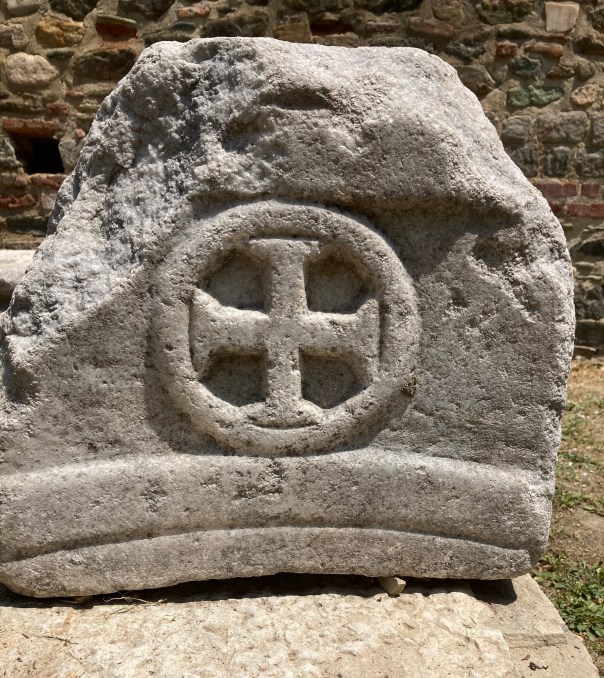
Thessaloniki – Rubble at Church of the Acheiropoietos
September rain falls on the house.
In the failing light, the old grandmother
sits in the kitchen with the child
beside the Little Marvel Stove,
reading the jokes from the almanac,
laughing and talking to hide her tears.
She thinks that her equinoctial tears
and the rain that beats on the roof of the house
were both foretold by the almanac,
but only known to a grandmother.
The iron kettle sings on the stove.
She cuts some bread and says to the child,
It’s time for tea now; but the child
is watching the teakettle’s small hard tears
dance like mad on the hot black stove,
the way the rain must dance on the house.
Tidying up, the old grandmother
hangs up the clever almanac
on its string. Birdlike, the almanac
hovers half open above the child,
hovers above the old grandmother
and her teacup full of dark brown tears.
She shivers and says she thinks the house
feels chilly, and puts more wood in the stove.
It was to be, says the Marvel Stove.
I know what I know, says the almanac.
With crayons the child draws a rigid house
and a winding pathway. Then the child
puts in a man with buttons like tears
and shows it proudly to the grandmother.
But secretly, while the grandmother
busies herself about the stove,
the little moons fall down like tears
from between the pages of the almanac
into the flower bed the child
has carefully placed in the front of the house.
Time to plant tears, says the almanac.
The grandmother sings to the marvelous stove
and the child draws another inscrutable house.
There are many kinds of tears, and it is important to discriminate between them.
So writes Bishop Kallistos Ware in The Inner Kingdom, in a chapter on “The Orthodox Experience of Repentance.” He has much to say about tears, which requires seven paragraphs, and I include this one sentence as a means of introducing the fact that in the Orthodox understanding, tears are a great and even necessary gift. Being reminded, I read the chapter’s closing paragraphs with a new perspective:
St. John Climacus
Filled with grief yet at the same time filled with joy, repentance expresses the creative tension found at all times in the Christian life on this earth, and described with such vividness by St. Paul: “…always carrying in our body the death of Jesus, so that the life of Jesus may also be manifested in our body…dying, and behold we live…sorrowful, yet always rejoicing” (2 Cor 4:10; 6:9-10).
As a life of continual repentance, our Christian discipleship is a sharing at one and the same time in Gethsemane and the Transfiguration, in the Cross and the Resurrection. St John Climacus sums the matter up by saying, “If you put on blessed and grace-filled mourning as a wedding robe, you will know the spiritual laughter of the soul.”
 and civilizations going back to the foundation of the world, the more likely is a fall into worry and even despair. We fear especially for children who have to grow up in a violent era, as many have done. That’s why I take courage from the life of St. Athanasius, and pray that my children, grandchildren, godchildren, and all of us, might learn deep in our souls what he knew. The following is an excerpt from a post I wrote several years ago in a time of sorrow. I have shared the quote from his treatise more recently than that, but I hope you might agree with me that it’s worth rereading:


 Gladsome Lights