The Sunday of Orthodoxy

I don’t think many of us will be reading blogs on Christmas morning, so I offer this meditation a little early, from a Christmas homily of very long ago, found here.
It was fitting that the Giver of all holiness should enter this world by a pure and holy birth. For He it is that of old formed Adam from the virgin earth, and from Adam without help of woman formed woman. For as without woman Adam produced woman, so did the Virgin without man this day bring forth a man. For it is a man, saith the Lord, and who shall know him [Jer. 17:9]. For since the race of women owed to men a debt, as from Adam without woman woman came, therefore without man the Virgin this day brought forth, and on behalf of Eve repaid the debt to man.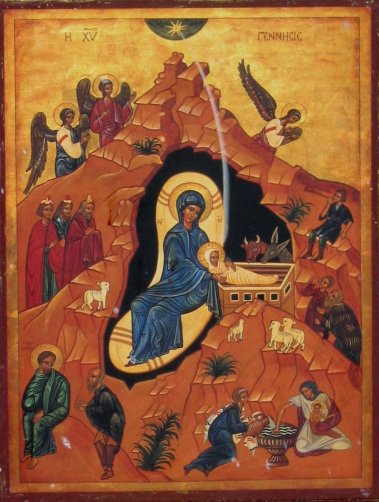
That Adam might not take pride, that he without woman had engendered woman, a Woman without man has begotten man; so that by the similarity of the mystery is proved the similarity in nature. For as before the Almighty took a rib from Adam, and by that Adam was not made less; so in the Virgin He formed a living temple, and the holy virginity remained unchanged. Sound and unharmed Adam remained even after the deprivation of a rib; unstained the Virgin though a Child was born of her.
+ St. John Chrysostom, “Homily on Christmas Morning”
Do you wonder where Joseph is? Orthodox icons don’t show him in the typical western setting of the birth of Christ. You can find out about any unfamiliar elements of this picture from Iconreader in his post about the Nativity icon.
We are waiting for Christmas, for the Incarnation of Christ, not that I think that is what Wyeth is referring to in the quote below; for nature’s Spring we have to wait months more.
But Christ is our “Dayspring from on high,” as Zacharias foretold when prophesying about his son John the Forerunner who had just been born:
And thou, child, shalt be called the prophet of the Highest: for thou shalt go before the face of the Lord to prepare his ways; to give knowledge of salvation unto his people by the remission of their sins, through the tender mercy of our God; whereby the dayspring from on high hath visited us, to give light to them that sit in darkness and in the shadow of death, to guide our feet into the way of peace. (Luke 1)
I’m feasting on that thought today, how every morning Christ wants to be our souls’ Warmth and Light, like the life-giving sun of spring and summer, no matter what the weather outside.
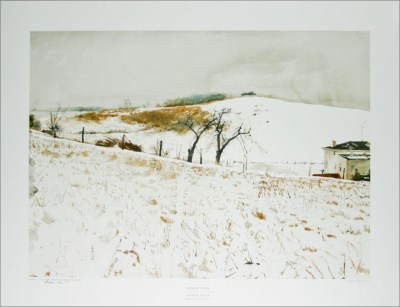
I prefer winter and fall, when you feel the bone structure of the landscape –
the loneliness of it, the dead feeling of winter.
Something waits beneath it, the whole story doesn’t show.
–Andrew Wyeth
Once or twice a week I go to the gym and walk on the treadmill for an hour or so, and I read, either The New Yorker or Touchstone magazine. Worlds apart in perspective and subject matter, those two periodicals, but both having some content of interest to me, treated in enough depth to keep my attention away from the tedious treading.
I always keep a ball-point pen next to my water bottle on the little shelf of the machine, so that even while I hang on with one hand as I hike, all out of breath, my other hand is free to stab at the page trying to make marks that will help me find my way back later. It’s always my intention to return when I am in a more contemplative mood, to the words or sentences that piqued my interest because they remind me of something else in my life and philosophy. I love how everything is connected to everything else, even when I don’t have time to figure out exactly how, or to articulate it in my own words.
In the last few years that sort of time and ability seem especially lacking, yet I keep on reading and underlining and thinking at only an introductory level about one article at a time. Then I stash that magazine in my basket by the computer and the next time I start in on a fresh one. This kind of behavior has been going on for a long time, so I have a great store of “material,” as we writers call it, with new resources constantly arriving.
I’m going to try to post more frequently and without much comment — without much real writing! — snippets from my readings, so that I don’t completely lose the benefit of the riches I’m enjoying every week. Maybe one or another of my readers will find a topic of interest now and then, but even if you don’t, copying some excerpts will give me more satisfaction than the usual procrastinations.
 One article I read this month was from the September/October 2014 Issue of Touchstone, an introduction to metaphysics by Graeme Hunter titled “The Light of Everyman.” Hunter starts out by writing, “The hardest things to talk about are simple ones. My topic is the simplest thing of all: reality.”
He proceeds to explain how metaphysics is important because it “sees only the realities to which all people and all cultures have equal access,” and he also explores the question of how we can know that reality is intelligible to us. Some philosophers have concluded that in fact it is not intelligible, which leads them to nihilism; and some don’t want to go all the way there, and they end up making the whole issue more complicated than it has to be, even nonsensical.
Hunter proposes a solution to the question, which is the part that I wanted to share, as he explores the line from scripture that we know in English as, “In the beginning was the Word”:
“‘En arche en ho Logos’ are the first five words of John. No translation can do them justice. The word Logos is one of the most polysemous words in the Greek dictionary. Its meanings include ‘word,’ ‘speech,’ ‘argument,’ ‘theory,’ ‘account,’ ‘blueprint,’ the laying out of things and gathering them up. But underlying its many meanings is the simple idea we have just been talking about: the idea of intelligibility.”
“The intelligibility of things cannot be proven, as we have seen [earlier in the article]. And we have also seen that the natural sciences give us no right to assume it. But what if, as John proclaims, the intelligibility of things has been revealed, not just in the form of a divine pronouncement written in a holy book, but in the form of God made man, and dwelling among us, full of grace and truth? God as Intelligibility. The Maker who knows the world ; the Knower who makes it; making and knowing as one thing; Maker and Knower taking human form.”
The Icon of Extreme Humility seems a good one to contemplate as we are talking about the Son of God who “humbled himself, taking the form of a man…”
 Gladsome Lights