Tag Archives: thinking

Sorting lentils and words and….

A Woman Cleaning Lentils

A lentil, a lentil, a lentil, a stone.
A green one, a black one, a green one, a black. A stone.
A lentil, a lentil, a stone, a lentil, a lentil, a word.
Suddenly a word. A lentil.
A lentil, a word, a word next to another word. A sentence.
A word, a word, a word, a nonsense speech.
Then an old song.
Then an old dream.
A life, another life, a hard life. A lentil. A life.
An easy life. A hard life, Why easy? Why hard?
Lives next to each other. A life. A word. A lentil.
A green one, a black one, a green one, a black one, pain.
A green song, a green lentil, a black one, a stone.
A lentil, a stone, a stone, a lentil.

— Zahrad

I found this provocative poem on this blog post, and have been keeping it in the back of my mind until today when I read a comment by Celeste on this blog post, about her own need to “re-sort.”

The household and garden chores that I pile up around me every day, the practical love for husband and children and grandchildren, the worship of God in His Church such as I enjoyed this morning, the good books and blogs I read, the writing I am compelled to do — they all seem to be represented and connected for me in the images of these lines.

Here I am, once again in the middle of trying-not-to-be-frantic trip preparations, but God gave me an extra hour this afternoon, which meant I could eat some leftover frittata and read a comment on a blog, and look what happened! More sorting of thoughts and realities, with the unspoken urge to order my affections aright and find His peace and strength for the next few hours and days.

Suddenly a word.
A life.

Animal, Vegetable, Weed

When my husband saw the sizable box of books I had packed for this trip to my daughter’s house, he wondered why I would need so many. My answer, “Because my brain is so tired right now, I can’t imagine wanting to read any of them, so I can’t know what my appetite will be when it returns, and I want to be prepared.”

I came prepared for the journey, too, with The Message Bible on CD, My Antonia, Miles Gone By, and the latest Mars Hill Audio Journal on CD’s to choose from. I started out with the Mars Hill disk, because it’s usually very relaxing for me to stretch my brain, gentle as the exercise is when one is only eavesdropping on other people’s conversations.

This edition had a lot of discussions on the topic of beauty, the host said in the introduction, and in a small panic, I hit the button to eject. No, I wasn’t up for that–it sounded too difficult to even follow along with. What would be easier? How about, Tell Me a Story, and one I am already familiar with. My Antonia was a good choice, as it turned out, very soul-nourishing in the story and the lovely writing. And it was Beauty–not discussed, but the reality.

The last few days I’ve been living in the reality of beauty and a lot of other things that people, including me, like to theorize and philosophize about. I haven’t picked up any of those books that I thought I might read or think about or write thoughtful reviews of. I’ve been chasing around a ten-month-old who is a major explorer of his world, and maybe it is in two ways keeping me in the Grammar phase of my stunted version of classical education. You know, where you learn the facts and language and data that you will work with later.

It’s always a blessing to have little children around who are discovering everything for the first time, as it makes me notice the details of my surroundings freshly. Today I gave this guy, whom I will nickname Scout, a piece of used waxed paper that wasn’t really dirty, and after he fiddled with it a minute or two it tore in two. He had been looking at one piece of paper, and suddenly there were two pieces, and he was obviously surprised to see the smaller piece move in his hand far away from the original.

Babies aren’t wondering philosophers. They are scientists without even a theory, in the research stage, gathering information. I’ve been able to do some of that kind of mental work this week, as in learning the names of oak trees. I also took a picture in the forest of a bush with pink flowers, and when I went looking for oaks in the shrub and tree guide there was a picture of it, and I have now memorized it–well, at least for this week–Douglas spiraea.

Douglas spiraea

When Scout was exploring the back yard he came upon a weed (spurge) that I knew I should know the name of, so I looked it up in Weeds of the West, a marvelous tome that I am very pleased is now in Pippin’s collection. It’s a book several of us in the family had our eye on for a long time before someone actually took the plunge to invest in such an unappealing title.

I looked quickly through the whole book yesterday, and learned quite a few facts that have no relevance to any philosophical book review I might write, but they were so pleasing to me! My objective was to make a list of all the weeds that I already knew by sight, which surprised me by how long it was. A whole series of Weeds blogposts could be written on the links to childhood memories and events.

Then I was surprised to find in the weed book a flower that is also always in the mountain wildflower guides I’ve been consulting for years, Corn Lily or False Hellebore. It was about then I suspect I was moving into the Logic Stage, making connections and comparing one word with another, drawing conclusions using my data.

This plant is deadly and noxious, for a fact (Here’s a historical bit about that from Wikipedia: “The plant was used by some [Native American] tribes to elect a new leader. All the candidates would eat the root, and the last to start vomiting would become the new leader.”), but some of the things I thought I knew about it aren’t true, and in the middle of writing this blog I am realizing that I still don’t have the facts straight enough to tell any more about it.

About other weeds, I learned that what I thought was Black Mustard was actually Radish; these are cousins someone got mixed up and taught me wrong. Nutsedge is a cute name for an ugly weed in my own garden. I’ll be content to study the most broad Grammar of Plants for the rest of my stay here on earth.

Which brings me to the second reason hanging out with children keeps me at their level: time. When I am scurrying about during naptimes to do little pieces of chores, just keeping up with the physical bare necessities, my mind is flitting about and not in the mood for a certain kind of thinking, which I hesitate to call “higher.”

I don’t seem to be able to settle in, under deadlines, and tackle a question of theology or philosophy in such a way that I can write about it. I’m using all my mental resources doing philosophy and theology on a fundamental level that is more in keeping with my stage in life, when my body demands more sleep, and my brain loses thoughts instead of holding them. When I wake up from a nap, or when Scout goes down for a nap, the names of the flowers are still there in the nature guide, the trees and clouds are still handy for contemplating right outside the door.

Play–what Scout does–is when you do things with no immediate goal in mind. I can’t have an agenda or a syllabus when I am minding Scout while he experiments. So I try to look around and pay attention at least as well as he is doing. I’m glad I’ve arrived at a place in life where the order and complexity of the universe are certainties to me, and every flower and rock is a gift from the Creator with the potential to draw me to Himself. It might even be an advantage to have a tired brain when enjoying that kind of Beauty.

Cairo Trilogy – Intro

Cairo Trilogy covers

The most fun I had in high school was learning French. But writing a paper on existentialism for my English class, inspired by the books my French teacher had lent me, was the most fascinating work I did. Looking back, I can see that my love for philosophy was born then. Recently an old school friend told me how jealous she was when the teacher raved over my paper. I didn’t save it, but I can’t believe it was very good; Mrs. Sanders probably just wasn’t used to such a heady topic even being introduced in our farm town.

In my paper I compared Kierkegaard and Sartre. I was a Christian believer at the time and relieved to find that there was an existentialist philosopher who named the name of Christ. When I got to college I found that Francis Schaeffer thought Kierkegaard misunderstood The Faith if he believed it required a “leap of faith.” At the time I wasn’t comfortable with the world of philosophy and wouldn’t have said I loved it. I was trying to love Christ in a fairly pietistic way and didn’t have a clue as to how to engage Christianly with the humanities. I did enjoy hearing from and reading various theologians and didn’t realize the divergence among them until after I was married.

When I became a wife and mother I began to focus on reading children’s books, and teaching children practical aspects of the faith. In the 1980’s two girlfriends separately and in different ways made me realize the importance of the historicity of Christianity; soon I was sitting up in bed every night reading Chalcedon magazine and happily listening in on The Great Conversation that humans are always having. The many writers for the publication saw the whole of history and philosophy and were not afraid of it; they had confidence that God in Christ had it all wrapped up, even if they didn’t.

Reading this point of view was amazingly encouraging and relaxing. It seemed to really help me go to sleep at night, to leave all the details of running a household and family outside the door and try to stretch my mind to understand why the French Revolution happened, how Romantics skew the Gospel, or why Chalcedonian Christology is pertinent today. It was comforting to drift off like the child who doesn’t know what his parents are talking about, but who feels safe in her bed. God is omnipotent and omniscient, and I will never be, so I rest in Him.

Somewhere I read that people who enjoy thinking are not always the best thinkers. Maybe that means not the most efficient, or logical. I don’t often have anything to show for all the eavesdropping I’ve done, listening to the Good Thinkers. In the world of philosophy I resemble my own Baby Girl when she was old enough to talk, but not old enough to grasp what the other six of us were discussing at the dinner table. She wanted so much to be in on the lively talk, and would look from one to the other of her family, and when she heard a phrase that she could link to something she knew about, she would quickly interject a comment that was rarely on topic.

Three years ago I became a child in the Orthodox Church, and now I am even more ignorant, as what I know has shrunk in proportion to the vastness and connectedness of God’s World as it is perceived by our theologians and lived by the saints. Categories and schemes I had gradually come up with aren’t as helpful as they promised to be, and in my imagination I am catching a phrase of conversation, or a glimpse of Life, of how everything is summed up in Christ; God in Trinity is simple and whole. I have been learning that God didn’t mean for us to suffer all these separations or distinctions between soul and body, between mind and heart, and between thought and action.

While I was beginning to find Christ in His Church I was also learning that ideas can’t be separated from people. No one can be labeled solely by what philosophy he espouses this week. A philosophy does not have an existence in itself but is humans thinking in a certain way. The Kaiser Permanente billboards that have a cyclist telling us, “I am not my bad knee,” and a chubby woman saying, “I am not my weight problem,” help us understand that people are complicated. Kierkegaard no doubt would like to defend himself on a billboard saying, “I am not existentialist philosophy.”

When I began reading The Cairo Trilogy by Naguib Mahfouz I was immediately captivated by his writing, and I suspected that I was going to find it multi-layered with meaning. I read about Mahfouz a bit online to give myself a head start. He was a philosopher, and some have referred to “existential themes” in his works, so I have been reading with an eye to letting him tell me what existentialism is. All I could remember from my sketchy term paper was the buzz-word “authentic,” and one word doesn’t make for a definition. My paper on the topic couldn’t have been very good because I didn’t have much intellectual preparation for tackling it. Kierkegaard himself wrote volumes of philosophy that pretty much started that branch of The Conversation, and generated many more books by people discussing and debating his ideas.

A definition of philosophy that sticks in my mind is “people seeking to know how to live the good life.” Mahfouz’s writing is full of such common humans, some of whom think harder about it, or have more success. I am reminded of the saying, “Be kind, for everyone you meet is fighting a great battle.” The characters I have met in The Cairo Trilogy are enriching the world of my imagination as I get to know their various personalities and see how they respond to the challenges of their culture and the political situation they have to deal with. None of them would put himself in a neat box with a label on it, and that’s why it takes three novels to tell their story.

mahfouz picAs I write this introduction, I haven’t yet come to the end of the third book. Calling this post an introduction almost commits me to writing more about the novel, but it seems an impossible task for me to even appreciate the scope of what Mahfouz has done, much less give a just report of it. Mahfouz spoke more than once while he was alive about the primacy of politics in his life, and if I knew more Egyptian history and were more politically minded, no doubt I could glean more meaning from the story. That’s just one example of how my review will be skewed and lacking.

But the book is so wonderful that it seems unkind to not tell about it, and it does stretch me to make the effort. But don’t hold your breath waiting for the actual review. You might have time to read the book yourself while you’re waiting.

Trying to Focus, on a Wintry Day

Into the blowing and pouring rain I forced myself this morning, so that I could use the machines at the gym. While walking on the treadmill for an hour, I read The New Yorker Food Issue from last November. I pick these magazines up at the library for 25 cents each, and usually find at least one article, though not usually in the Food Issue, to keep my attention while I work out. (I have tried many other reading materials, and everything else is either too heady and distracting, or too boring to keep my mind off the discomfort.)

Today I learned about a cake that is baked on a spit for several hours and is called Baumkuchen, which means Tree Cake in German, because some of them are cone-shaped like a tree. These cakes date back to the Middle Ages, and currently are pretty popular in Japan.

I read about poutine, beloved especially of youth in Canada, where I think I could get into eating it, at least in winter, when one might be able to burn enough calories shoveling snow and keeping warm so as not to put on the pounds from enjoying a dish that consists of French fries, cheese curds, and gravy.

The Michelin Guide to restaurants took several pages to explain, after the author hung out with one of the inspectors for the company during a meal at a three-star restaurant. These inspectors and their identities are top-secret and incognito, so that they can remain objective and also get the same food and treatment as any old customer who is willing to pay dearly for their daily bread.

Later in the morning I read a blog about how good homeschooling can be if the family actually stays home a lot, so that the children can concentrate on whatever it is they are doing and not be constantly interrupted by having to run hither and thither to group classes and such. That got me thinking about how it is better for me, too, still a self-homeschooler, an autodidact, who always gets confused and scattered when I have to come and go.

I read another blog that linked to an interview with Makoto Fujimura, a Christian Japanese-American artist who has a lot to say about God and creativity. I remembered that I’d heard a different interview with him not long ago on the Mars Hill Audio Journal, and I was able to locate the tape and listen to him. I was not able to multi-task, though; I found that if I tried to find his website at the same time, I stopped listening.

I started to take notes on the audio interview. He was talking about how the habit of reading is even more important to cultivate now that our society is so image-oriented. Also about how all the fast-action images that people are feeding on teach their minds to avoid real concentration. They scan, instead of engaging with visual information in a more focused manner. I was still feeling distracted myself and wondering why I was picking this one topic and writer to think about. Was I randomly and shallowly scanning?

No, I had wanted to listen to him again and think more about these things. But if I hadn’t gone to the gym and taken hours to collect myself afterward, I’m not sure I’d have had so much trouble being calmly thoughtful. In the early afternoon I had to go out again and run errands–more dissipation of mental energies!

I was saved by duty–my husband’s needs were what helped me to pull myself together. We were nearly out of granola, his staff of life. And he would need a real dinner. (Without him, I’d eat eggs and toast and tea forever.) He would like to feel the warmth of a fire as he came in the door from work. When I got a fire kindled and started assembling the granola I was happy to give my attention to concrete and practical tasks.

This granola has fed the family for more than 35 years. I make a huge batch still, so that I don’t have to do it very often, even though B. often eats Power Pancakes for breakfast nowadays. The basic proportions of oats, honey and oil have remained the same, while the extras of nuts, seeds and other grains are infinitely flexible. It doesn’t make a very sweet cold cereal, as you might guess if you compare with other recipes.

GretchenJoanna’s Granola
30-32 cups of regular rolled oats, divided
3-5 cups unsweetened shredded coconut
2-5 cups chopped almonds and/or other nuts
0-2 cups each of wheat germ, sesame seeds, buckwheat groats, rice or oat bran
0-1 teaspoon salt
2 1/2 cups oil
2 cups honey (or substitute part sugar syrup, made with 1 cup sugar and 1 cup water)
3 tablespoons vanilla, or substitute part almond extract
Put 20 cups of the oats in a giant bowl. Add whatever other dry ingredients appeal. In a pot, heat and stir the wet ingredients gently and slowly together until the honey is liquid. Pour onto the dry ingredients and stir to moisten them thoroughly. Then add the other 10-12 cups of oats and mix in evenly.
Spread up to an inch deep in pans and bake in batches at 300° until as toasty brown as you like it, stirring every ten minutes. Lately I’ve been using big roasting pans that happen to have 2″ sides, but the toasting may happen faster using pans with less lip. I use the biggest pans I have, and both oven racks, so that it doesn’t take all day. 🙂
I store a gallon jar of this on the kitchen counter, and the remainder in the freezer.

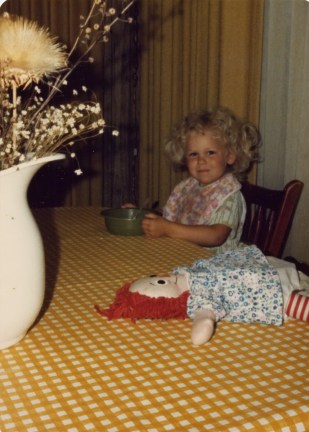
I was going to show a photo of the big bowl of finished granola, but my camera battery is spent. So here is a picture of someone enjoying an early version of GJ’s Granola, circa 1977 (notice the gold draperies and tablecloth).

Time for bed now, and thank God, I can end the day having accomplished reading, writing, and homemaking, even if I wasn’t very organized in my concentrating. I want to do better tomorrow.