Monthly Archives: December 2013

It cheers my heart like spirit’l wine.

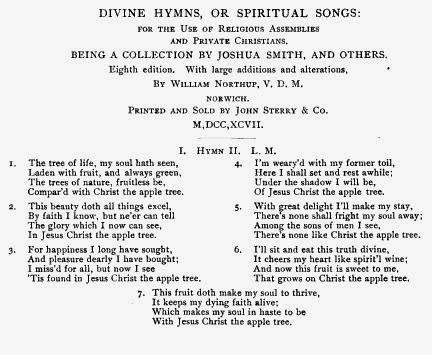
I have just discovered the 18th-century hymn “Jesus Christ the Apple Tree,” on this G.K. Chesterton site., where you can read good meditations on its meaning. It is thought to have been written by a New Englander, and has been set to various tunes. The most common seems to be the one by Elizabeth Poston, of which this video records a nice rendition.

The hymn has become associated with Christmas, and I’d like to add it to our own family’s collection of carols, at least by next Christmas. “Under the shadow I will be, Of Jesus Christ the apple tree. ”


Not a single place dark or unhappy.

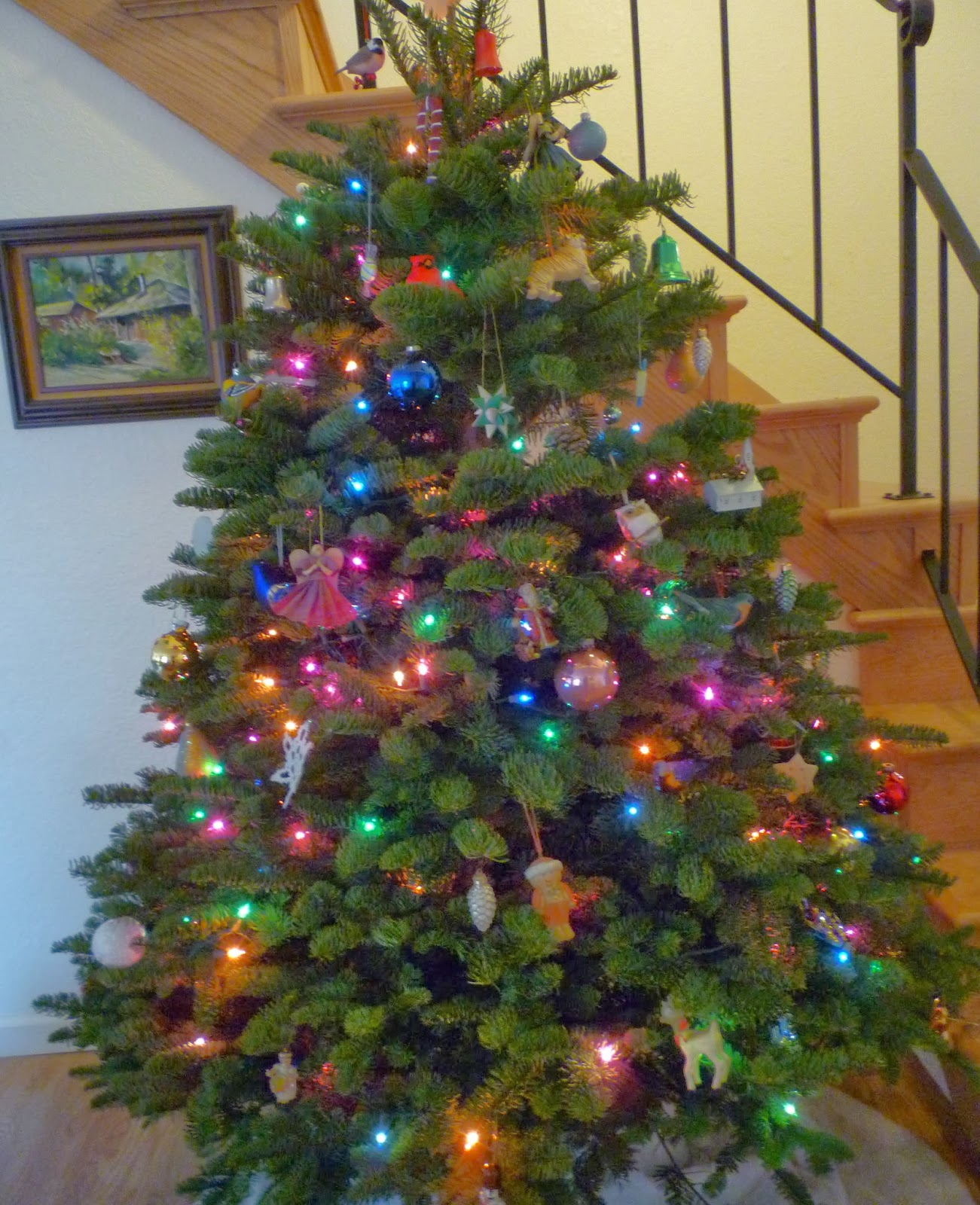
We have been ill around our house, and could not get going on the Christmas tree project until this week. Now we managed to get it up and decorated.

I cut off our homemade wood-shaving angel in the picture so I’m showing a close-up in the next. Mr. Glad did nearly all the tree-trimming this time, after he went all by himself to get the tree, a Noble Fir grown in Oregon.


Anna wrote last week about various Advent and Christmas trees she has known, and it made me want to remember some trees of the past. Her post includes a photograph of a large and dramatic Christmas tree in Norway.


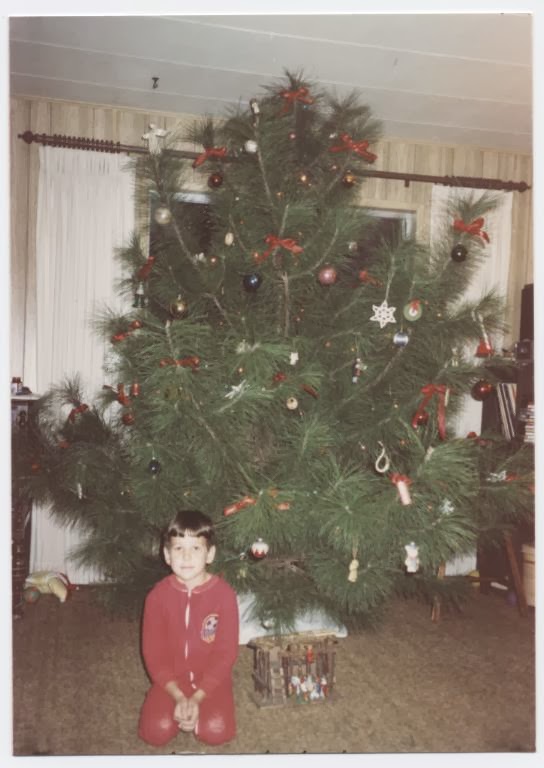
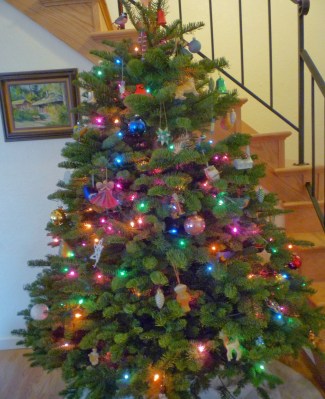
I don’t have anything that old, but at right is a picture of me in a red sweater in front of a 1950’s tree. And at the bottom of the page, a little tree that the sister in the photograph gave me more recently. I like best to have birds and fruit and pine cones on my tree, and I never did like tinsel.

The boy at left (now our Soldier) is posing by a tree from a minimalist era, when a friend let us cut from his property a wild and untamed specimen, on which we don’t appear to have strung lights. But how strange and exciting for young children to have a tree in the house for a while, even undecorated.

Below, this year’s tree before trimming, to go with a sweet poem e.e. cummings wrote.

little tree
little silent Christmas tree
you are so little
you are more like a flower

who found you in the green forest
and were you very sorry to come away?
see i will comfort you
because you smell so sweetly

i will kiss your cool bark
and hug you safe and tight
just as your mother would,
only don’t be afraid

look the spangles
that sleep all the year in a dark box
dreaming of being taken out and allowed to shine,
the balls the chains red and gold the fluffy threads,

put up your little arms
and i’ll give them all to you to hold
every finger shall have its ring
and there won’t be a single place dark or unhappy

then when you’re quite dressed
you’ll stand in the window for everyone to see
and how they’ll stare!
oh but you’ll be very proud

and my little sister and i will take hands
and looking up at our beautiful tree
we’ll dance and sing
“Noel Noel”

–e.e. cummings
Switch on a star.

This poem from Joseph Brodsky’s Nativity Poems makes me feel the personhood of God as He has shown Himself in history and nature. I love the part about miracles gravitating toward the people who are waiting.

25. XII. 1993

For a miracle, take one shepherd’s sheepskin, throw
in a pinch of now, a grain of long ago,
and a handful of tomorrow. Add by eye
a little chunk of space, a piece of sky,

and it will happen. For miracles, gravitating
to earth, know just where people will be waiting,
and eagerly will find the right address
and tenant, even in a wilderness.

Or if you’re leaving home, switch on a new
four-pointed star, then, as you say adieu,
to light a vacant world with steady blaze
and follow you forever with its gaze.

-Joseph Brodsky (1940-1996), Russian-born poet,
winner of the Nobel Prize in Literature in 1987

Nativity Cake

When our first two children were very little, I wanted to establish some God-honoring traditions for Christmastime. I didn’t think that the traditions of our parents were focused enough on the Nativity of Christ.
As an example, no one in our Protestant circles, even we who believed in the reality of the Christmas story, went to church on Christmas Day, and we missed a big opportunity to teach our children, and to know God, by praxis. It’s too bad, however it happened, that the tradition of not worshiping and communing on Christmas got started.

In any case, lacking a Christmas Day church tradition, we were on our own. I wanted the children to have more than a Christmas tree and presents, and one thing I contrived was a birthday cake for Jesus. It should be some special kind of cake that we would never eat any other time of year.

I found a recipe in Sunset Magazine for Dried Fruit Loaves, and as I scanned the ingredients list I reasoned, from my young-marrieds-on-a-shoestring perspective, that only Christmas extravagance would make me willing to invest in that amount of dried fruit and nuts.

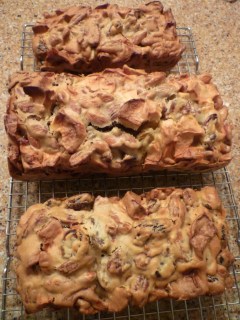
So I’ve been adapting it and baking it without fail for about 38 years. Most years I made four times the original recipe and gave away various sizes of loaves. There is very little to it besides the fruit and nuts, and everyone still loves to slice a thin piece or two for a wholesome snack, all through the Twelve Days of Christmas or however long the bread lasts.

this week’s loaves

We don’t usually sing “Happy Birthday” to Jesus anymore. All those children grew up and are teaching their own children about Christ’s Incarnation, and I’m not often with them to light a candle on the cake. But some of us now have the joyous tradition of going to church on Christmas Day.

I was just remarking to my husband that I could even stop including the bread in my baking projects…but it’s not difficult to make, so I don’t know why I even consider that. I guess because it’s more fun to try new things.

When I searched online for this recipe, I found something a bit different from Sunset under the name Western Dried Fruits Cake. It contains raisins, which I think too common for the occasion, and judging from the only picture I saw, and the recipe ingredients, mine is much better all around.

One of my friends makes this bread; she has eaten mine and told me hers is the same, and she calls it California Fruitcake. When I search with that term I come up with something much more like our favorite, also with credit given to Sunset: California Fruitcake.

The last two years I have decreased the amount of my recipe, for some reason to one-third of the quadruple-batch, but for your convenience I will post here something close to the original version. And how about a Christmasy name as well:

California Nativity Cake

2 cups flour (I’ve used part whole-wheat)
1 cup sugar
2 teaspoons baking powder
1/2 teaspoon salt
4 cups lightly packed dried fruit. I like to use half dried apples, and the remainder dried apricots and dates, sometimes with some pears or figs in the mix. Cut the larger pieces of fruit into 1″ pieces.
3 cups whole nuts. Usually our cake is heavy on the almonds, lately with some pecans as well.
5 eggs, lightly beaten
1 1/2 teaspoons vanilla
1/4 cup water

Prepare six mini loaf pans or fewer larger pans by greasing and lining with waxed paper or parchment paper. Stir the dry ingredients together and mix about 1/2 cup of this mixture with the fruit and nuts. While mixing I make sure to stuff an almond into each date. Stir the eggs, vanilla, and water together and blend with the flour mixture, then add the fruit and nuts.

Spoon into the prepared pans, and if you want to minimize the rockiness of the terrain of the finished loaves’ tops, use your spoon to push pointy edges of apple down into the sticky dough. Bake at 325 degrees for 50 to 75 minutes depending on the size of pan, or until well browned. I usually have to put some foil over the top of large loaves after an hour.

Let cool on a rack for about 10 minutes before turning out on to racks. Pull off the paper and let cool thoroughly. Wrap loaves airtight and refrigerate or freeze for at least a few days before serving. Aged loaves can be cut in thin slices.

our youngest celebrating at Grandma’s house 20 years ago