This map  shows how severe our current drought is, affecting half the nation. The darker areas are the worst, named “Exceptional Drought,” and my part of California is down a notch from that, at “Extreme Drought.” You can see this and four other instructive maps more clearly here: Five Maps of America’s Massive Drought.
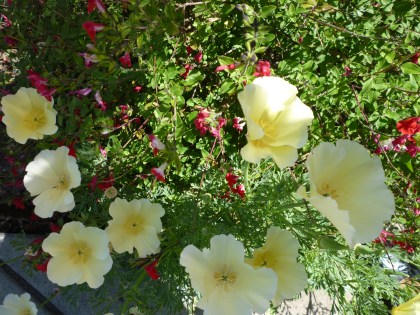
We began several months ago in our household to collect water in buckets in the shower, to use for flushing the toilets. We are also letting our lawn die. I didn’t want a lawn anyway; I’d rather have flowers like these below, which I snapped at the library this morning.


They are Matilija Poppies (Romneya), and if you have a big space they can be a good fit – so dramatic and graceful. I tried them once but didn’t really have room. They prefer dry soil.

I don’t remember what these fun blue flowers are, but they were also decorating the parking lot at the library, obviously part of a planned xeriscape. [Thanks to Jeannette for enlightening me in a comment below.]
Over the years we Glads have emphasized drought-tolerant ornamentals in our landscaping and have collected quite a few. Sweet alyssum and Lamb’s Ears are always ready to sprout up and fill spots where thirstier plants languish, so much so that we are constantly cutting them back so that other less invasive plants like this salvia and California poppies can also thrive. California poppies grow all over the bare golden-brown hills in the summer, where where not a drop of rain falls.
As I went looking through my pictures for examples of plants that are good choices for the arid West, I discovered more than I remembered, like aloes, rosemary and lavender.
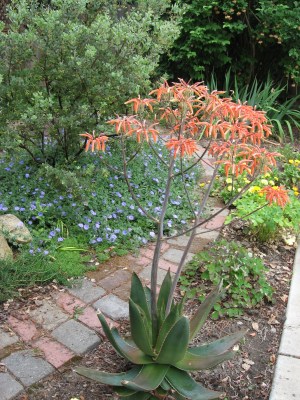
Even the ground morning glory that grew beneath the manzanita for years required little water. The orange-topped succulent is an Aloe Saponaria.
In the front yard my favorite of these plants that thrive in drought is the pink Mexican Evening Primrose. In the middle of summer it doesn’t need water more than once a month, and it never stops blooming from spring through fall.
And in the back, the prize goes to the Mexican Bush Sage (do you notice a theme here?). It likewise has its long spikes of purple for half the year, and makes me happy by the hummingbirds that love to visit it and that I can watch through the window.
I don’t know what lesson to take from all this beauty. So I guess I’ll just take the beauty. And pray for that sake of all the plants that next winter will bring lots of rain.


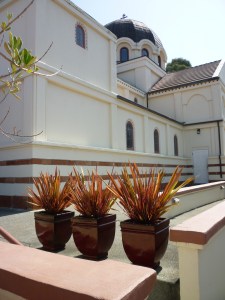 r New Zealand Flax. I didn’t plant these, but on my watch, maybe five years ago, the plant in one pot died. I combed the nurseries in vain to find a replacement, and then I had a brilliant idea. Since these perennials grow constantly larger, I could “thin” and divide the two healthy plants and use what I cut off to start a new one in the third container.


 them of the sort I’m used to. They don’t tell you how many days to maturity, or how deep to plant the seeds, or how many days they might take to sprout. Maybe they have that info online? If so, that’s too new-fangled for me; I don’t have a smart phone that I consult when I’m in the rows.
 was coming up, except weeds and volunteer nasturtiums. One morning I decided it was time to face the failure and start in on the weeds – but wait! Those tiny two-pronged spikes I see when I put my face down by the dirt…. they just might be the beginnings of feathery fennel leaves! So I will wait a few more days. But the hyssop – I don’t think so.

 Gladsome Lights