Blessed are the poor in spirit: for theirs is the kingdom of heaven. Matt. 5:3
I liked the first poem I read by R.S. Thomas so well that I borrowed a collection of his poems from the library. It had some water damage already so I don’t worry about leaving it in the bathroom or reading it at the breakfast table, and I’ve been perusing it for a few weeks.
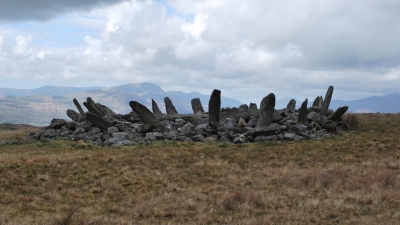
One doesn’t have to explore this book for very long to find that Thomas’s poetry is full of the feeling of coldness between us and God. Themes of harsh landscape and winter reappear, with lots of stone, stone, stone. My husband has been watching a TV detective series set in Wales and he commented that he would not want to live there, it looks so bleak. Maybe Thomas’s perspective is touched by the geography of his homeland.
This poem below is an example of this tone, though it’s not as painful as some of his verse that describes the alienation that is so common to the human experience. The last line relieves me with its hopeful turn and reminds me of what I’ve heard elsewhere: It’s only when we are truly empty of anything to offer God, and present ourselves humbly before Him, that He can speak to us, with His fullness that is silence, His presence that is His Word.
THE ABSENCE
It is this great absence
that is like a presence, that compels
me to address it without hope
of a reply. It is a room I enter
from which someone has just
gone, the vestibule for the arrival
of one who has not yet come.
I modernise the anachronism
of my language, but he is no more here
than before. Genes and molecules
have no more power to call
him up than the incense of the Hebrews
at their altars. My equations fail
as my words do. What resource have I
other than the emptiness without him of my whole
being, a vacuum he may not abhor?
— R.S. Thomas
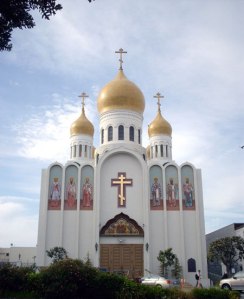 Our friends Mr. and Mrs. C drove Mr. Glad and me to San Francisco this morning for a visit to Holy Virgin Cathedral, the “Joy of All Who Sorrow.” We were going there for the same reason many people come from all over the world, to pray at the relics of St. John (Maximovitch) of Shanghai and San Francisco.
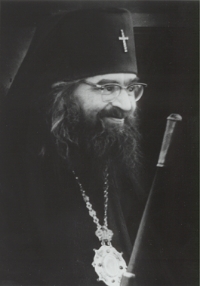 were coming to power there he helped 5,000 of these expatriates to emigrate, eventually to the United States. Later still he established the cathedral in San Francisco where his incorrupt relics remain.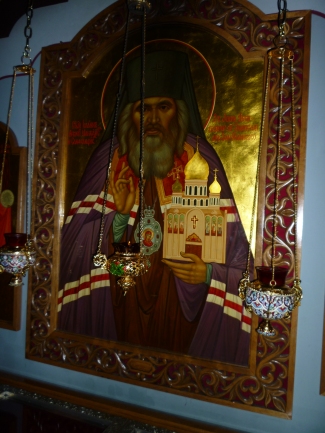
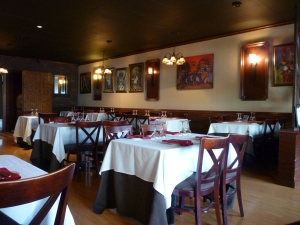 Afterward we needed some lunch, so we followed the advice of the candle desk attendant at the cathedral and ate at a Russian restaurant called The Red Tavern that was also in that Richmond District neighborhood. We were the only people there, too, though from the name we half expected when we went through the door to see a group of Bolsheviks plotting in the back corner.
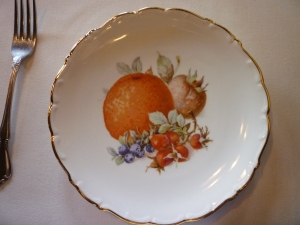
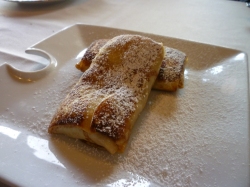 man only recently from Ukraine was our waitress and we enjoyed talking to her and eating the wonderful food. I didn’t think that I liked Russian food much, but everything I tasted was superb: dark brown bread scented with caraway, fresh cabbage salad with golden raisins and tomatoes; thinly sliced fried potatoes; and barley-mushroom soup with a complex and rich flavor. We all shared some Polish poppy seed dessert that we could tell had marzipan in the filling. We cut the two pieces into two more and ate them off these pretty dishes that the waitress said were their “dessert plates.”
 The forecast had been for cold and foggy weather in San Francisco today, but the sun was shining on our day and we didn’t even need our sweaters. Also, in our souls, we felt the warmth of Christ and of our friendship.
 Gladsome Lights