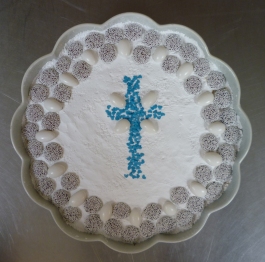
 It is traditional in Orthodox churches to have a short memorial forty days after a death, and though my husband was not Orthodox, I am, and I am the one remembering and praying for him. Last week my priest generously held this service, called a panikhida, and I prepared the dish of boiled wheat called koliva for us all to eat together at the end of the service.
I’m sure that in homogeneous cultures women learn from other women how to make this ceremonial food, as they work in the kitchen together. I learned from other women via the Internet, and it worked out fine.
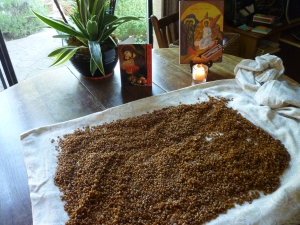 The essential ingredient is boiled wheat – but actually, even that is not essential, because sometimes it is rice, or lacking wheat, barley or another grain can be substituted. But the image of a kernel of grain being buried endures, as in the Gospel of John Christ speaks of His own coming death, “Verily, verily, I say unto you, Except a corn of wheat fall into the ground and die, it abideth alone: but if it die, it bringeth forth much fruit.”
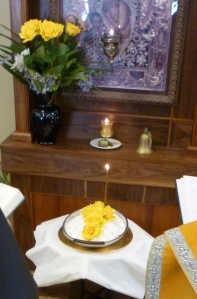
Below is a picture of the koliva at a one-year panikhida for someone else, which had been held the week before at my church. That one was decorated with gorgeous yellow roses.
I boiled the wheat, which was said to be enough for 40 small servings, and then laid it out on towels to dry for a couple of hours, as the Greeks in particular like to do. One Greek woman made a strong point about what she considered the superiority of this dry quality, contrasting it with the Romanian koliva which was said to be like pudding.
Most koliva that I had eaten was also more loose and dry, so that appealed to me. But I also read that the Romanians often decorate their wheat with chocolate, which custom I planned to imitate.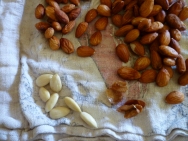
I included a small amount of cumin, cardamom, and cinnamon — less of the cinnamon than most people do — golden raisins, almonds and walnuts, and orange zest. It was the first time I had tried blanching almonds, which was easy and fun. When after blanching I squeezed the skins off the nuts, one of the nuts shot across the room and into my open pots-and-pans drawer. I haven’t gone looking for it yet.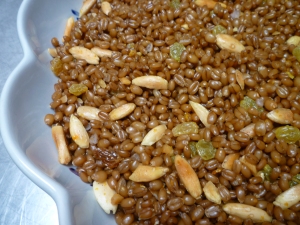
Some of these ingredients were mixed into the wheat as soon as it was dry, but the walnuts I chopped and spread on top, under a layer of graham cracker crumbs which is put there to keep the last layer of powdered sugar from dissolving and disappearing into the wheat. You want it to stay on top and be gleaming white. The usual technique for the top is to lay waxed paper on the powdered sugar to flatten it and make it smooth, bu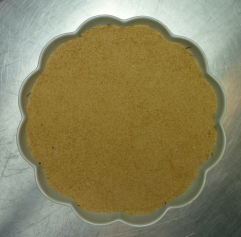 t I put the final layers of my dish together in the church kitchen where I could not find any waxed paper. My alternative method didn’t work so well, which is why the surface of my finished product has some flat areas, some imprints of my fingers, and some sugar untouched.
I decorated the top with Jordan almonds and chocolate pastilles, and with some little blue baking decorations that I separated out of a color mixture.
The panikhida was held in the evening. Several people from my husband’s church came and stood with us near the Crucifixion icon and we all held candles for prayers and hymns and “Memory Eternal.” Then I scooped out portions of the koliva into little Dixie cups for people to eat together in honor of my dear husband. As it is spooned up everything gets mixed together and sweetened by the powdered sugar, and one tries to give everyone a bit o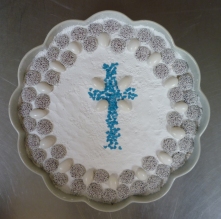 f chocolate or a candy. The koliva recipe was judged to be excellent.
That morning of the 40th day I drove to the cemetery to see the grave marker that had been put in place, and to bring some flowers. There were barely enough nice blooms left on our snowball bush to make a cross on my husband’s grave, so I added some calla lilies and roses, and I sat for a while on the grass there. On the way over in the car I had listened to jazz on the radio, to feel him close to me, but at his grave I sang, “Christ is risen from the dead, trampling down death by death, and upon those in the tombs bestowing life.”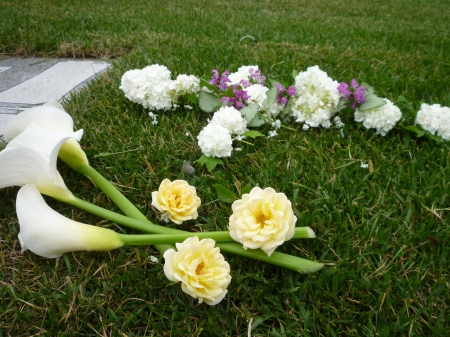
 Gladsome Lights