Monthly Archives: December 2015

mythology of floating logic

It’s been a while since I picked up David Bentley Hart’s The Experience of God, and I was pleased to see that I’m a third of the way through the book, nearing the end of the first part, on Being. I wasn’t pleased to find myself struggling to follow his train of thought as he picked apart what is known as Anselm’s argument, and was relieved when he moved on after a few pages, saying that he didn’t want to get “entangled in needless complications on this matter.”

Though I am philosophical by nature, I’m woefully unschooled in the discipline and its fundamentals. How many times have I looked up words like phenomenology, ontology,  and epistemology? Whatever I read on the subject is an attempt to correct that lack, and I appreciate Hart’s clarity and organization; he does seem to be writing for someone like me.

When we say that God is Being or “the source and ground of all reality,” following in the tradition of centuries of philosophers and theologians, many contemporary thinkers say it is because we are “mired in sheer nonsense.” Hart tells what he considers an important source of this lack of agreement:

…The analytic tradition is pervaded by the mythology of “pure” philosophical discourse, a propositional logic that somehow floats above the historical and cultural contingency of ideas and words, and that somehow can be applied to every epoch of philosophy without any proper attention to what the language and conceptual schemes of earlier thinkers meant in their own times and places. This is a pernicious error under the best of conditions, but it has worked arguably its greatest mischief in the realm of ontology, often as a result of principles that, truth be told, are almost entirely arbitrary.

I enjoy learning about particular people of the past and of their contributions to the wealth of humanity’s philosophical legacy. Hart mentions Meister Eckhart and his idea of “Is-ness,” and that takes me back to when I was a college freshman and privileged to be in a tutorial course that was an introduction to Meister Eckhart. I certainly had no intellectual grid prepared to fit him into then! How nice to have him come around again when I can appreciate his place in history.

Hart’s book was on the table with my bowl of stew this morning, but now the breakfast philosophy session has come to an end and other tasks are calling; I will go forward with the prayer that the presence of Him Who Is will sustain me. Given my ignorance of that floating kind of logic, I shouldn’t have any trouble keeping my feet on the ground and my self in the flow of history, soon to close out the year twenty-fifteen.

Enjoy it while it lasts! Let’s be here, now.
December and my watered gardens.

It is a little strange IMG_1228to finish the installation of my garden at the beginning of winter. Some of the plants and trees are going into their dormant stage soon after being planted, and are not likely to be very showy until next summer. I’m thinking of the coneflowers. So I ran out and bought three six-packs of Iceland poppies to plant in that area to break up the expanse of wood product that will be staring at me. And some Dutch iris bulbs.
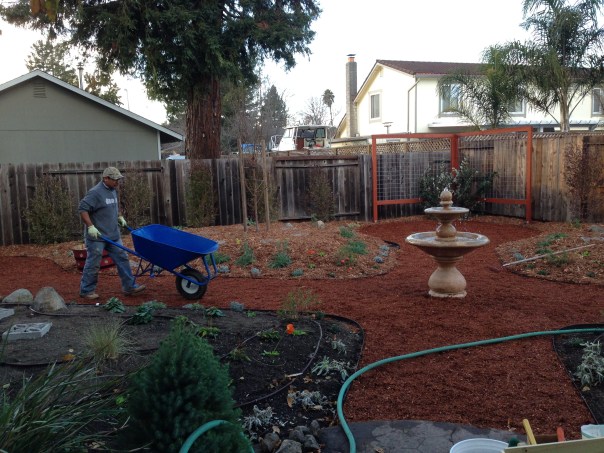


Much mulch, that’s what you see now. The bare branches of fig and plum don’t show up against the brownness. The paths are one kind of mulch, called Playground Mulch. It’s soft and laid on thickly so the grandchildren won’t scrape their knees on flagstones or whatever I might have used instead. Neither will they get muddy, because there will be no dirt to be seen! The other kind of mulch, coarser but a similar color at this point, covers all the planting beds and hides the drip irrigation lines; it is tucked in around every flower or shrub. This is how you do it if you want to conserve water, and I do….

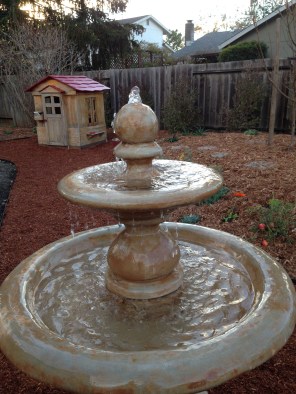
The children might get wet, though, if they stick their fingers into the fountain. It’s finally all put together and hooked up to its new electrical conduit deep under the pathway, and I can turn it on very easily whenever I want. Then its lovely water sounds provide a needed auditory focus and delight during this period when the plants are small and mostly not flowering.

Even when it’s not turned on it makes me happy, sitting there in the middle of everything and marking the intersection of the four directions, not quite the points of the compass, but pointing to the corners of the space. I don’t like to call it a yard now that I’ve invested so much in the beautification of my property. It was a yard, when it was all a big slab of dirt, waiting to be turned into something, with heavy machinery and other non-living stuff all over the place. But now, now it is a watered garden.

IMG_1225

The unfinished tasks are likely to be completed before Christmas. In the meantime I am giving my attention to the holiday, and rain is watering the garden, too, so even the poppies are droopy and not photogenic. What I do find photogenic is my Christmas tree, which Pearl helped me set up and decorate last week. Christmas tree 2015

I realized last month that I could not manage a cut tree of the size I wanted, so I bought an artificial tree, and I’m happy with it. Even the thought of getting an artificial tree caused me to panic at first, because I had no idea where to start looking, never having given a thought to that sort of tree before. But my goddaughter Sophia is an interior decorator and she immediately helped me. It’s been easier than I expected.

I couldn’t resist buying a darling live tree in a pot as well, but I’ll show it later. It’s still outdoors in the dark at the moment. Oh – but I see that it is showing in the photo above, with the hose caught on its branches. I don’t know where it will go when I bring it in, but I will decorate it with birds and pine cones.

Today was the feast of St. Nicholas. Everything was lovely at church. We have been having Matins before Divine Liturgy Sunday mornings, and I’ve helped with that service most Sundays, which means that I arrive at about 8:30. Matins is all about the Resurrection of Christ, so the significance of his rising from the dead is what we sing about for an hour straight, and that’s before we even get to the Divine Liturgy.

When both of us are in church, I hold my goddaughter Mary, whom I wrote about here and who is now nine months old already! I carry her up for Communion, and like to keep her with me as long as possibl3be58-nicholasilluminatede afterward just because she’s so sweet. Today as we stood in line we looked up at the chandelier that was still swinging gently from when it was earlier set in motion to accompany a hymn to the Theotokos. We stood next to a candle stand for a couple of minutes and watched a score of candles shining. I sang along with the choir, to her, “Receive the Body of Christ; taste the Fountain of Immortality.” Then we did, and our hearts were refreshed.
This glorious Lord’s Day —  It all fills up the soul and tires the body!  Today after the service I worked in the church bookstore that is open during the agape meal, so I didn’t get home until 2:00, exhausted.

This evening we listened to some Christmas music, and Kit built a fire to cozy us up. It feels like December!

pressed into the earth

When in 1930 Jill Ker Conway’s father began homesteading a “block” of 18,000 acres in New South Wales, Australia, the change in lifestyle was jarring for his wife.

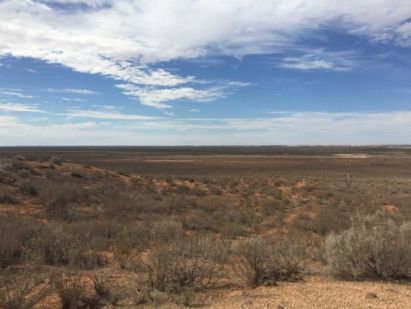
When my father left in the morning to work on the fences, or on one of the three bores [wells] that watered the sheep and cattle, my mother heard no human voice save the two children. There was no contact with another human being and the silence was so profound it pressed upon the eardrums. My father, being a westerner, born into that profound peace and silence, felt the need for it like an addiction to a powerful drug. Here, pressed into the earth by the weight of that enormous sky, there is real peace. To those who know it, the annihilation of the self, subsumed into the vast emptiness of nature, is akin to a religious experience. We children grew up to know it and seek it as our father before us. What was social and sensory deprivation for the stranger was the earth and sky that made us what we were. For my mother, the emptiness was disorienting, and the loneliness and silence a daily torment of existential dread.

from The Road to Coorain

western new south wales

The Road from Coorain

I have just begun reading a book of memoirs that Pearl gave me last week. I share this snippet not because of any metaphorical application but just for its worthiness.

On the plains, the horizon is always with us and there is no retreating from it. Its blankness travels with our every step and waits for us at every point of the compass. Because we have very few reference points on the spare earth, we seem to creep over it, one tiny point of consciousness between the empty earth and the overarching sky.

–Jill Ker Conway in The Road from Coorain