Monthly Archives: May 2016

Again I attempt Ukrainian art.

gl P1040397 pysanky in house 16Under the Soviet regime the making of pysanky was forbidden as a religious practice, but as this art form had pre-Christian beginnings and had spread well beyond Ukraine by the 20th century, it by no means was repressed for long.

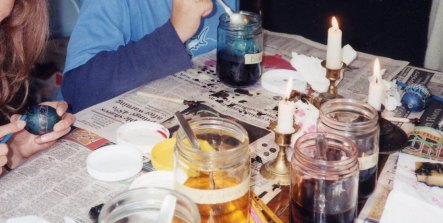
In my world there is no connection of Ukrainian pysanky eggs to the realities of Christian faith and practice, though over the centuries people have come to use eggs as symbols of many truths or events. Many artists in my parish have through the years given informal instruction in this wax-resist method of dyeing eggshells, and this spring between Holy Week services I was able to take advantage of a class in which I was the only student.
gl pysanky crp
About 15 years ago…

Twice before, about 30 years ago and again 15 years ago, I took part in homeschool group efforts to try this art — the more recent occasion I actually organized the class! — and both times I’d enjoyed the process much more than the quality of my own results. A few of the pysanky in the top picture are from those attempts, but the only one I am certain I created myself is the one I did last week; the bowl of eggs is a combination of my collection and housemate Kit’s.

Pysanky2011
From the Internet

P1040312

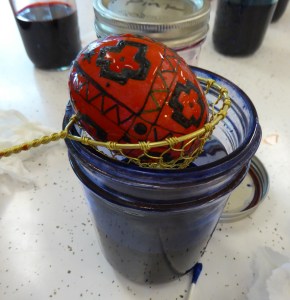
You use the same method that is called batik: you dye the egg and then apply a design in beeswax over that color in the places you want it to appear in the final product. As someone said, you have to think in reverse.

I’m not good at remembering a strategy with a sequence of steps to be taken in the future, or in reverse either, so without a lot of planning and notes to myself, which I didn’t want to take the time for, the results I get are pretty random and surprising.

P1040315

At least, following my teacher’s example, I did draw a design with pencil on my eggshell. Several hours stretched ahead of me, but I knew I could easily get bogged down in the design phase — my weak area — and never get an egg made, so I sketched something like I often doodle when talking on the phone, and even that wasn’t quick. Then I dipped my egg in the lightest color, yellow.

Because I had drawn those crosses and dots on the plain white egg, using the hot wax pen called a kistka, the wax would keep the successive layers of dye from infusing the egg shell and those areas would remain white in the finished design.P1040314

As I continued applying wax, whatever lines went on the now-yellow egg would remain yellow. And so on through whatever dippings I made.

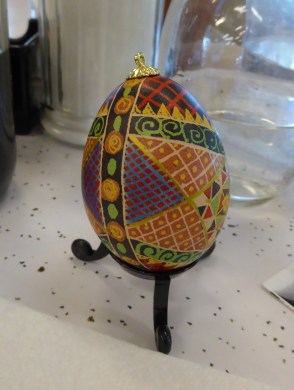
My teacher Tatiana had told me at the outset, “It takes about two hours to make a pysanka.” I think hers each took less time than that. It seemed that by the time I had dipped my egg in two colors, she had finished hers. It had been a light brown egg to begin with, so the undyed triangles are creamy.

P1040316crp

She applied some metallic color with a pen to make her design even more brilliant.
P1040323crp

P1040326

I dipped my egg in the red dye, and she began her second design:

P1040325

Meanwhile, when she learned that I would like a purple color, Tatiana suggested a series of immersions in colors that she thought might bring about that result, as she lacked a straight purple dye in her collection of jars. I tried it and we were both very pleased with this deep and glowing shade which, when I took the picture below, I was in process of covering with wax as much as possible in hopes of retaining a good amount of it in my finished design.

P1040329

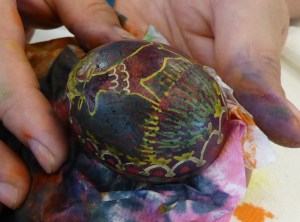
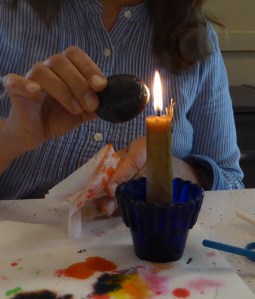
My teacher was removing the wax from her second egg, and soon I had done my final dip of black and held my egg to the candle as well.
P1040327crp

P1040336crp


At this point it’s back and forth between melting patches of wax with the candle heat and rubbing it off with a paper towel, until you have worked your way all around the egg and only the dyed eggshell remains. I was warned not to hold the egg too long near the candle, because I might burn it.

Here is Tatiana’s second egg, with some silver metallic embellishments…
 

P1040328

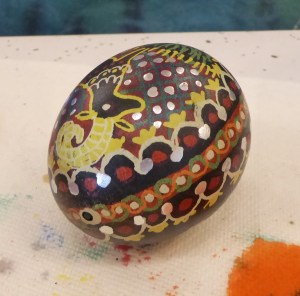
And here is mine… It had taken me nearly four hours!

P1040339

I don’t like it very much, I’m sorry to say. I would not use that green color again in such a prominent part of the design. And I know, I should try some curved lines next time. I hope my next time is sooner than another 15 years from now — I’m sure my hand will be even less steady by then. And once again, even though I am not thrilled with the end product, the whole process is like magic to me, the design hidden more deeply step by step until finally the waxy black cloak is taken away and the final picture is revealed in its uniqueness. Let’s do this some more!

We thirst for time’s transformation.

I continue my alphabetical posts, from which I took a Holy Week hiatus after “S for squash.” That brings me to “T” for — what else? — time.

In my recent musings on the meaning of kairos vs. chronos, I found this passage from Fr. Alexander Schmemann’s journals:

This morning during Matins I had a jolt of happiness, of fullness of life, and at the same time the thought: I will have to die! But in such a fleeting breath of happiness, time usually schmemann close 16‘gathers itself.’ In an instant, not only are all such breaths of happiness remembered but they are present and alive — that Holy Saturday in Paris when I was a young man — and many such ‘breaks.’ It seems to me that eternity might not be the stopping of time, but precisely its resurrection and gathering. The fragmentation of time, its division, is the fall of eternity. Maybe the words of Christ are about time when He said, ‘…not to destroy anything but I will raise it all on the last day.’ The thirst for solitude, thirst for the transformation of time into what it should be — the receptacle, the chalice of eternity.

Death was strangled…

…and other images of atonement are the subject of Fr. Stephen Freeman’s post Knocking Down the Gates of Hell, in which he shares the findings of a research paper he once wrote on Martin Luther’s hymns. Luther’s own atonement theology highly favored the imagery that also dominates that of the early church fathers, in which Christ smashes the gates of Hell and frees all those in chains.

Fr. Stephen shares several verses from various exuberant Orthodox Paschal hymns we are singing this month, such as these I excerpted from his post:

Hell, who had filled all men with fear,
Trembled at the sight of Thee,
And in haste he yielded up his prisoners,
O Immortal Sun of Glory.

Thou hast destroyed the palaces of hell by Thy Burial, O Christ.
Thou hast trampled death down by Thy death, O Lord,
And redeemed earth’s children from corruption.

Though Thou art buried in a grave, O Christ,
Though Thou goest down to hell, O Savior,
Thou hast stripped hell naked, emptying its graves.

Death seized Thee, O Jesus,
And was strangled in Thy trap.
Hell’s gates were smashed, the fallen were set free,
And carried from beneath the earth on high.

Thou didst will, O Savior,
To go beneath the earth.
Thou didst free death’s fallen captives from their chains,
Leading them from earth to heaven.

In the earth’s dark bosom
The Grain of Wheat is laid.
By its death, it shall bring forth abundant fruit:
Adam’s sons, freed from the chains of death.

Wishing to save Adam,
Thou didst come down to earth.
Not finding him on earth, O Master,
Thou didst descend to Hades seeking him.

The Paschal icon shows the resurrected Christ pulling Adam and others out of Hades.

db271-resurrectionstvladorthchurch

It’s Bright Monday as I write. This morning’s Divine Liturgy was splendid and full of love and light. We are all giddy with joy and fatigue, and can’t stop greeting one another with kisses and proclamations of “Christ is risen!” In the Paschal Canon where we sing, “Let us embrace each other joyously!” I always hope I will be standing next to someone I can hug at that moment. Today two women I didn’t know were the closest, and I made so bold as to hug them both at once, which they didn’t seem to mind. gl - EB

I realized just in time for the midnight service of Pascha Saturday/Sunday, something I have had to call to mind again and again over the last months, that wherever my late husband is, he lives in the present. The part of me that grieves for his presence the way it used to be, as my earthly lover and companion, can never be satisfied; it is a longing for the past, and God is giving me instead Himself and all His gifts in this present moment. My dear Mr. Glad does not live “back there” in the past, either!

It’s because the various parts of me are not all united that my heart’s faith and love must keep instructing my mind — and other tangled and erratic parts? — that to be here right now with God is the way to stay close to my husband. In the reality of the Resurrection and our Blessed Hope, in the gathering of time and times that is kairos, he and I are more together than we have ever been, and in Love.

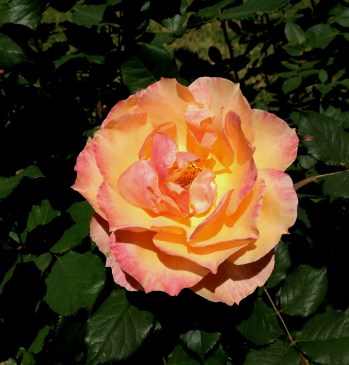
gl rose pascha 16


One sweet thing about Pascha coming so late this year is that roses are blooming all over. We have dozens of rosebushes at church that are loaded with flowers (not to mention the white roses that filled bouquets decorating inside the church.) This morning I took a picture of one favorite, to decorate this blog post. Happy Spring! Christ is risen! If you have read this far, I send you my Easter love!