Monthly Archives: September 2016

Little corner of my world.

9-13-img_3252Along these lower creekside paths in my neighborhood, maintenance vehicles may drive when they are taking care of things. Recently I had seen one down there that didn’t look very official, an unmarked white SUV, just parked, with no crew around, and I wondered… who? Yesterday I saw it again, driving slowly along, then stopping, then creeping forward, and then at one pause a man got out, and I backtracked so I could talk to him across the channel, as he was lifting away a dead branch.

He said he worked for the water agency, and that as they clean out out the creek beds in preparation for winter, they want to preserve bird nests. He was marking any he found, so they would be spared.

That explains the desecration I saw a couple of weeks ago, seemingly random messes where it looked like elephants had trampled across the streams in places. Now I’m guessing it was humans with some heavy equipment for cutting trees and carrying them off.

9-13-img_3062-creek

9-13-gl-img_2765
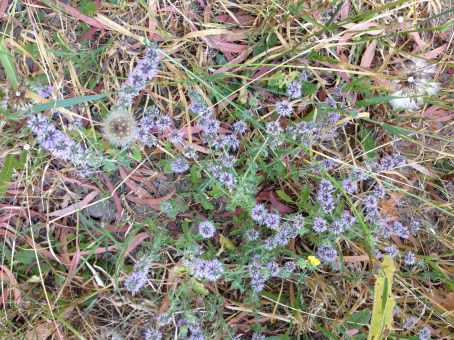
Looks like pennyroyal.
9-13-gl-img_3261
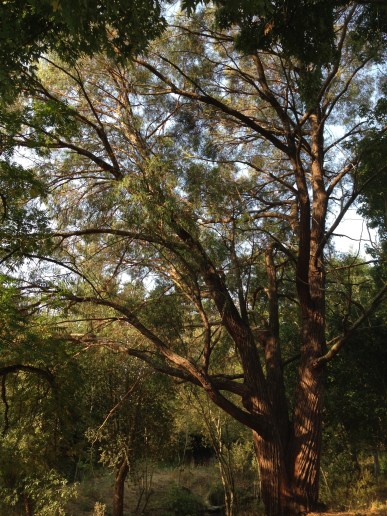
This old willow tree is a familiar friend.

These watercourses that flow from the hills are natural parts of the geography, but they also carry groundwater from the neighborhoods on either side, so it is a constant labor to preserve the ecology of the stream and keep it open, while not turning it into a mere drainage ditch. Occasionally they have to dredge out silt, and the stream looks momentarily ravaged, but quickly the willows and horsetail grass and myriad shrubs and vines start to fill in again. The egrets and mallards and frogs don’t get lost.

Darkness hangs on later these days, so I start my walks later in the morning. Today men with chain saws were already down in the dry areas of the creek bed as I walked by. One man was carefully grooming the lower parts of a small tree, getting it prepared for such time as fast waters will flow past. Let there not be any branches on which to hang debris and start the clogging-up again.

9-13-gl-img_2739
Looking down from a bridge.

It’s been such a gift this summer to walk almost daily on these paths so close to my house. Each morning or evening the views are slightly changed, the birds and flowers presenting new events to witness. As the days shorten and the weather becomes a little less friendly, I hope I can still get myself down there often, and keep learning about this small corner of my world.
9-13-img_3258

The fullness of spending and leisure.

A pair of blue jays were playing in my manzanita and pine when I came back from my walk this foggy morning. I hadn’t seen any here in many months. Oh, down by the creek I do, not far away; I don’t wonder that they prefer to hang out where there’s even more going on, more things to eat. True, there are no manzanita bushes or Canary Island Pines by the creek; maybe they came here for the the dried manzanita berries under the bush.

gl-9-p1050484

gl-9-poppy-p1050478

Anyone who has been following the Iceland poppy contest in my garden will want to see what I think is the winner of the endurance trial. It is probably an indication of how cool our summer has been, that one plant stayed alive all through August and accomplished a lonely bloom on September 7th. Surely it is the last! — and the plant does appear to be shriveling, as its companions did a few weeks ago.

gl-9-tomatoes-p1050481-crp


In the vegetable boxes, mice, as I suppose, are eating tomatoes. I don’t seem to have energy to find a deterrent to these nightly raids; I do know that the mice probably need the fruit more than I do… but it’s an ugly mess they are making, and the solution is probably to pull out the Early Girls that are the favored item on the mouse menu. With the weather we’ve been getting, it’s not likely that the tomatoes will get as ripe as I require, anyway, and I have seen some appealing recipes for fried green tomatoes lately.

gl-9-p1050346

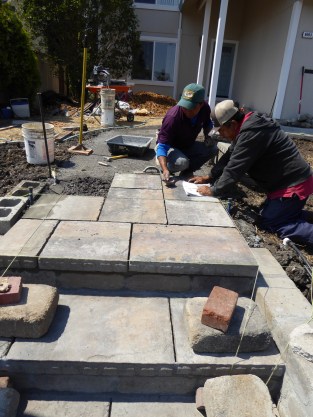
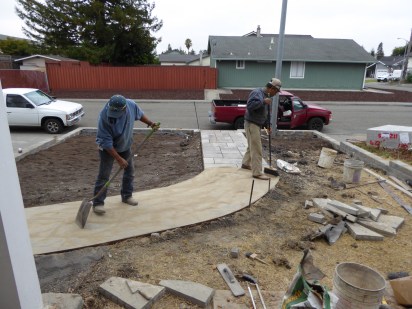
My front yard re-landscaping might be completed this month. Right now we are waiting … the hardscape is finished, these pictures showing the work of two weeks ago.

gl-9-p1050386

And back in the back yard, I finally bought a bench for the corner by the birdhouse, and Soldier happened to be here soon after to assemble it for me. Look how tall the native currants have grown up in that corner! As soon as the rains begin (God willing, they shall) the calla lilies will start sprouting enthusiastically and I’ll have to pull them out, eternally.

gl-9-p1050488

Soldier’s whole family was here for part of a day, and Liam worked in the playhouse, making a pie (so he said) out of flowers and herbs I told him he might pick for the purpose.

gl-9-p1050405

gl-9-p1050489


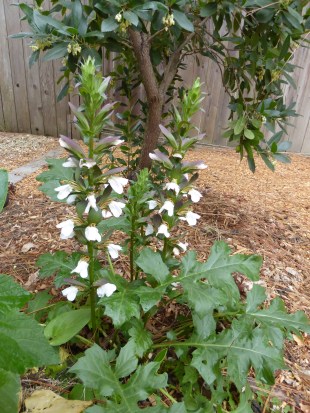
Autumn Joy sedum is still looking beautiful, as it has for at least nine months now, and the acanthus is sending out new flower stalks.


gl-9-p1050487

As I’ve been writing, and drinking my tea, the sun came out. Now it seems possible that I might get myself out to do some cleanup in the garden. Today I am going to soak my pea seeds, and hope to plant them tomorrow.

I have a feeling that it will always be a challenge, keeping up with all the things I want to do and need to do in the garden, not letting the housework go too neglected, reading and writing and praying, loving my friends and family, communing and working at church…. Life is very full. Today is very full. I looked for a closing quote to express something of what I’m feeling, but could find nothing more suitable than these lighthearted admonitions.

All happiness depends on a leisurely breakfast. ~John Gunther

That one I’ve already taken care of.

Spend the afternoon. You can’t take it with you. ~Annie Dillard

And this one is next!


Only to a degree expressible.

I’ve shared four poems by W.S. Merwin on my blog over the years. He is a poet who doesn’t use punctuation in his poems. I recently read an interview with him, given five years ago. Here I’m posting a short excerpt in which he talks about his eschewing punctuation, and about the uses and challenges of poetry generally.W.S. Merwin_NewBioImage

If you stop using punctuation, that’s a kind of formality. I mean you have to be very conscious of the grammar and the syntax and how the sentence is put together; otherwise it’ll be just so ambiguous and confusing you just won’t be able to read it. The other thing I think it does is to make the separation between poetry and prose. I thought, punctuation is very convenient, but it was really invented in the seventeenth century for prose. Not for poetry at all. The punctuation of Shakespeare texts is whatever seemed convenient. There weren’t any particular rules that he was following that I can see. I mean it changed in the course of the plays. But above all, I thought that having no punctuation made you listen to the poem. That’s the important thing.
….
Poetry, like the imagination itself, must be limitless. And there must be other ways of expressing the inexpressible, which is what—poetry is just that. Prose is about what can be said and what is known and so on. Poetry is about what cannot be expressed. I mean, terrible grief, or intense erotic feeling, or even unspeakable anger are all inexpressible. You can’t put them in words and that’s why you try to put them in words. Because that’s all you’ve got. That’s another reason why I think that poetry is as ancient as language itself, because I think language must come out of an urge for which there was no expression, no way of doing it. I mean grief or fear or rage or whatever it was. It goes from one roar or one scream or one terrible sound of pain to starting to articulate it. It’s the articulating that becomes poetry. But it doesn’t become information at that point. It’s closer to translation. It’s translating something that’s there, that is only to a degree expressible.

-W.S. Merwin in Guernica magazine interview

Sassoon’s Angels

This morning I read the day’s selection in poem-a-dayVolume 3 of Poem A Day, and it was by a poet I hadn’t read before, Siegfried Sassoon. I’m very glad to have discovered him. He is famous for his war poetry, and anti-war poetry, during and after The Great War.

Having read about him on various sites online today, I can only say that the tone of his life reminds me of the novel Brideshead Revisited, and like the narrator of that story, Charles Ryder, Sassoon converted to Roman Catholicism later in life.

When he wrote today’s anthology selection, I haven’t discovered – whether it was earlier, as part of his war poems, or later, with the “religious” poetry. Critics saw his later work as inferior and weak, an unfortunate change in perspective, but his response to this was to say that “almost all of them have ignored the fact that I am a religious poet.” He claimed that “my development has been entirely consistent and in character.”

You can hear Sassoon reading hsassoon-youngis own poem, “The Power and the Glory,”  on the First World War Poetry Digital Archive site. I also found this thorough bibliography of his works by a history and book lover, and would like to explore there some more.

The second poem by him (at the bottom of the page) that I am sharing here, written in his own hand, I found on The University of St. Andrew’s site Echoes from the Vault. It is clearly dated twenty years before Sassoon finally entered the church, but his developing vision of spiritual realities is evident. I notice that both poems feature the presence of angels.

The Power and the Glory

Let there be life, said God. And what He wrought
Went past in myriad marching lives, and brought
This hour, this quiet room, and my small thought
Holding invisible vastness in its hands.

Let there be God, say I. And what I’ve done
Goes onward like the splendour of the sun
And rises up in rapture and is one
With the white power of conscience that commands.

Let life be God…What wail of fiend or wraith
Dare mock my glorious angel where he stands
To fill my dark with fire, my heart with faith?

-Siegfried Sassoon

sassoon-mspr-6037-a9-a17-sassoon-poems-heaven-and-earth_1