On my way up the mountain earlier in the week I came across several plants whose common names include the word weed: Two tarweeds and two vinegarweeds. They all got my attention by the way they added color to the drying-out landscape of late summer.

When I was still only approaching the foothills, I saw bluish plants dotting the yellow-brown expanse stretching out away from the road, and it didn’t look like anything I had ever noticed before.

It may be that in the past they were not as tall and visible from the road, and that this year’s extra rainfall helped Trichostema lanceolatum to thrive. It was hard to get a picture of it without my socks attracting various stickers waiting in ambush, but this closeup on Wikipedia shows what a graceful flower form is hidden in the overall unimpressive bush:

“The plant is an important pollen source for native bees and other insects. When a pollinating insect alights on the lower lobes of the corolla, and inserts its mouth parts into the nectar-containing lower section of the same tube, the narrow corolla portion above is straightened and snaps rapidly downward brushing pollen onto the insect’s back.
“The volatile oils make it unpalatable to grazing and foraging animals.
“The indigenous peoples of California used this as a traditional medicinal plant, as a cold and fever remedy, a pain reliever, and a flea insect repellent.”
The two species of tarweeds caught my eye a little further on. I think it was mostly Fitch’s Tarweed, Centromadia fitchii, that had turned the slopes and flatlands gold in large swaths on either side of the highway.

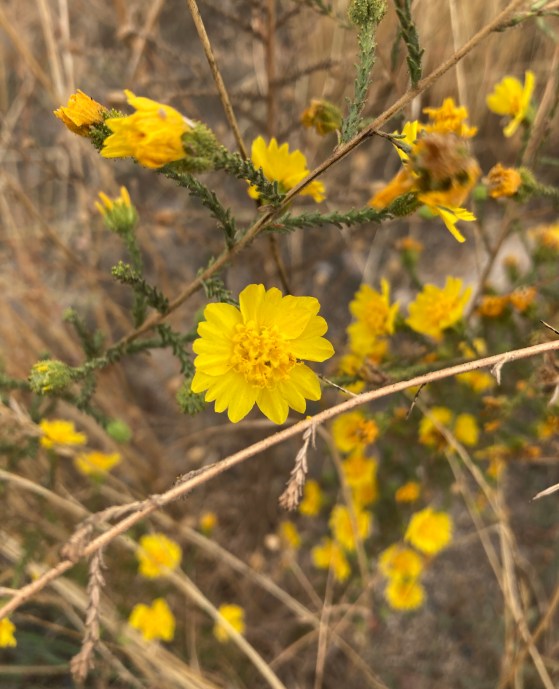
But the more photogenic plant I managed to get close to was Heermann’s Tarweed (according to my Seek app), Holocarpha heermannii. Both of these plants are in the Aster Family, but different genera. A lot of tarweeds are in the Madia Family, but it seems that Heermann’s is irregular.
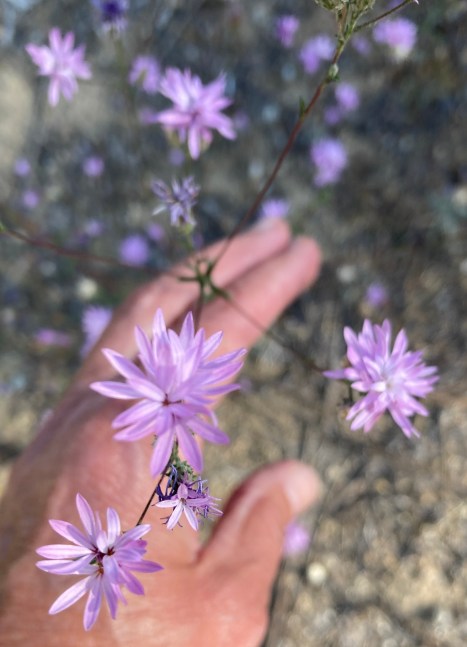
The second plant called vinegarweed grows along the roads in the High-er Sierra. When I first met it in 2009, it didn’t occur to me to taste it; maybe if I had, the idea of vinegar would have been uppermost? But my mind immediately wanted to call it Purple Haze, or Lavender Mist.
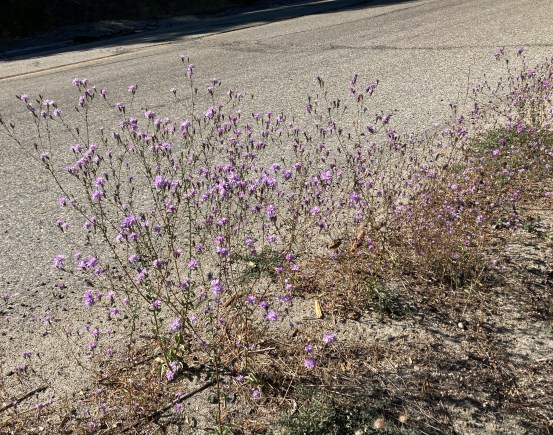
It typically gets my attention as I come around a curve in the road, floating as a long pastel smudge on the shoulder. That first sighting was long before I had any kind of nature identification app, and when I eventually found someone who could tell me what it was (Sierra Vinegarweed or Lessingia leptoclada), that amateur botanist told me that if it had been up to her, she’d have named it Lavender Groundsmoke. The hope of encountering these flowers again would alone be enough to bring me up to the mountains every summer.
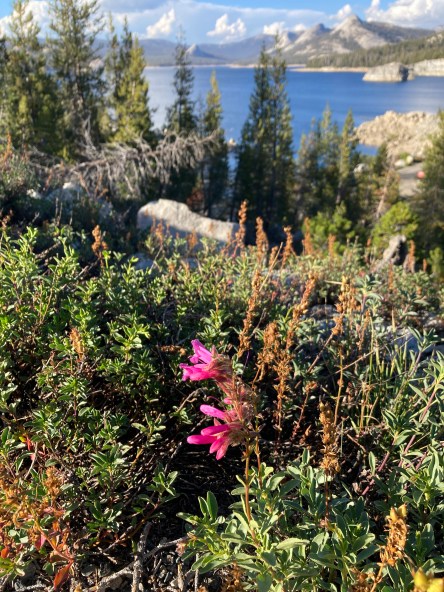
The last plant I will share has no connections to vinegar or tar; it is the favorite Mountain Pride, or Newberry’s Penstemon. In an average year, its flowers would have faded to brown by now, and in fact most of them have. But the snow hung on so late here this summer, till the end of July, that the earliest wildflowers had to wait at least a couple of weeks longer to emerge. I was happy to find one bloom of Mountain Pride still fresh and bright. These plants that sit overlooking the lake are a landmark for me, announcing at the end of my journey to the cabin, You have arrived!
 Gladsome Lights
I think the identification app that you have is such a wonderful tool for anyone interested in knowing more about wild (and not-so-wild) plants. Tarweed and Vinegar weed are not plants I’m likely to see but they’re interesting to know about.
LikeLiked by 1 person
Your “weeds” have such wonderful shape and texture. I love your last picture.
LikeLiked by 1 person
I love being introduced to your native plants!
LikeLiked by 1 person
“The only difference between a flower and a weed is judgement.”
Wayne Dyer
🙂
LikeLiked by 1 person
These are so beautiful. I especially like the cheery Heeerman’s!
LikeLiked by 1 person
I hadn’t really thought bees being native or non-native until recently. It’s funny how we’ve become so dependent on foreign honey bees to pollinate our crops. Maybe they just weren’t meant to live here
LikeLiked by 1 person
As I understand, whatever bees were used for pollination fared very well for generations… so, something has changed for them. It’s a multi-faceted problem.
One aspect I read about several years ago was how the commercial beekeepers would transport their hives great distances to provide pollination for different growers. There was concern about how unnatural that was for an insect population, and whether constant moving to a new environment would affect the bees adversely.
It is likely that the native pollinators have also been harmed by our use of various pesticides. But I haven’t kept up with the research on this situation. I appreciate your drawing attention to the pollinator aspect of the wilder natural world, and prompting me to think about it more.
LikeLike
Yes, modern pesticides are doing their damage. 😦 We used to keep bees, but it was too heartbreaking. Funny how we like some invasive species but not others. Read a great book once about even in the natural world (excluding humans lol) species invade and move all the time.
LikeLiked by 1 person
That sounds like an interesting book… Do you remember the title ?
LikeLike
Invasive Plant Medicine by Timothy Lee Scott 🙂
LikeLiked by 1 person
Thank you!!
LikeLike
Oh how lovely especially the last picture but others too. How wonderful to be at your cabin!!!
LikeLiked by 1 person
Yes! The last one is like a picture perfect postcard!
LikeLiked by 1 person
I love your weed portraits. So many have their own kind of beauty (especially if they stay in the wild). The Lessingia is like a tiny dahlia along that delicate stem.
When I used to travel with my boss, she took her GPS’ “You have arrived” to be an affirmation of her career status 🙂
LikeLiked by 1 person
I recognized your vinegar weed because we have a ‘cousin’ of it here: Trichostema dichotomum. Ours goes by the common name ‘forked blue curls,’ which suits it nicely.
LikeLiked by 1 person
That’s very pretty! And yes, what a lovely name.
LikeLike