
It was from watching a movie about Sophie Scholl (I think it must have been “Sophie 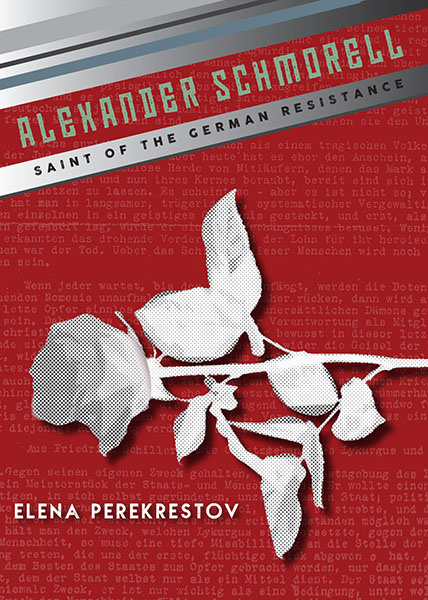 Scholl: The Final Days”) that I first heard of The White Rose, a non-violent youth resistance group formed in Munich in 1942. Britannica says of its members:
Coupling youthful idealism with an impressive knowledge of German literature and Christian religious teachings, the students published their beliefs in a series of leaflets under the name “the White Rose” (and later as “Leaflets of the Resistance”).
In the movie we meet not only Sophie and her brother Hans, but also friends and other members of The White Rose, one of whom is named “Alex.” A couple of years ago I learned that this was Alexander Schmorell, an Orthodox Christian and co-founder of the group.

There is a very memorable scene — one of only two that I can bring to mind from that film — in which Hans and Sophie are throwing leaflets from the upper story of a university building. They were seen by a Nazi Party member and arrested, on February 18, 1943.
The leaflets were like nothing the Gestapo had ever seen—not rigid ideological tracts aimed at the working classes, but passionate, erudite manifestos that quoted Friedrich Schiller, Plato and Laozi. “The guilt of Hitler and his accomplices goes beyond all measure,” read the group’s fifth leaflet. “Tear up the cloak of indifference you have wrapped around your hearts. Make your decision before it is too late!” –Smithsonian
Hans and Sophie were beheaded four days later, along with medical student Christoph Probst. In succeeding months, many other people were arrested in relation to The White Rose, and among them was Alexander Schmorell, who was executed on July 13, 1943. In 2012 he was glorified in the Orthodox Church as a saint and passion-bearer.

Memory eternal!
 Gladsome Lights
Thanks for reminding me it is St. Alexander’s day tomorrow. I have had the book about Sophie Scholl and the White Rose Society’s story for years as well as St. Alexander’s icon. It was such an inspiring story from the minute I saw it, that the best and brightest of Germany’s young people, who had so much to lose, had the courage to set it aside and speak up for what is right. May we have the courage if we were ever to find ourselves in such a situation.
LikeLiked by 2 people
How very interesting.
LikeLiked by 1 person
I had never heard of Alexander, nor Hans or Sophie. What a tale. What courage they had to stand for what is right.
LikeLiked by 1 person
One of the things that consumed a lot of my time over the last few weeks is a presentation I did at the one church this past Friday – I was absolutely terrified to get up in front of people, so I was glad that there ended up being more of a discussion aspect to this, especially considering that the crowd was so small, but there might be some interesting bits nonetheless. This is the link: https://www.youtube.com/watch?v=j-ICBCfff90
It’s weird, because I’ve never seen that icon quite like that before. That is definitely the first Dcn. Paul Drozdowski icon of St. Alexander, but the text has been changed. http://www.acrod.org/readingroom/saints/martyr-alexander He originally created the icon in 2002 or 2003 – well before St. Alexander’s glorification in 2012. I commissioned a copy of this icon in 2006, I think, and so I have this but the text reads simply “Holy Passion Bearer Alexander”. I think some of this stems from the confusion over what “Passion Bearer” actually means, as there seem to be at least four definitions (I’ve asked priests, and come to no further clarity), but I’ve never seen “St. Passion Bearer” used ever, which kind of makes me wonder if this image has been photoshopped to “update” it, especially considering that Deacon Paul did a new icon of Alexander Schmorell after he was glorified. http://damascenegallery.com/shop/icon/classic-icons/st-alexander-schmorell/
(I’m not saying that the icon isn’t “legit”, but there are several things that make me wonder about the icon above. First the title “St. Passion Bearer”. Secondly, he’s “St. Alexander of Munich”. Third, last names are sometimes added to icons, but apart from St. John Kassian, I don’t think I’ve ever seen an icon where the last name was a) the same size as the rest of the text and b) not offset by parentheses. Fourth, the text size, style, and placement look do not look like regular iconography, and finally, I don’t think I’ve ever seen an icon that calls a saint a saint of some thing or event – I think it’s always of a place.)
I’ve probably gone way beyond what anyone is interested in, but I’ve been “involved” with St. Alexander for more than twenty years now, and he’s a huge part of my story into Orthodoxy and in my years in Orthodoxy. (And if you have that book by Matushka Elena, she was kind enough to put my name in the list of acknowledgements in the back.)
LikeLike
Thank you so much for all this good information, and interesting questions. The icon I used, I got from the Uncut Mountain store page. I see that I also have in my files the earlier one, as I suppose, which only has the title Passion Bearer, nothing about Munich or resistance. If you find out anything more about why these oddities, I’d be interested to know.
The acrod link you shared is broken.
LikeLiked by 1 person
Maybe this link will work? https://pravoslavie.ru/51512.html
LikeLike
Ah, yes, that is the other one I have in my files.
LikeLiked by 1 person
The “official” one, possibly unveiled for the glorification in 2012
LikeLike
LikeLike
It’s also quite interesting how much the “official” icon resembles Dcn Paul’s and how there’s one aspect of it which some people seem to take issue with, that being the visible military collar under the medic’s cloak.
LikeLike