
St. John (Maximovitch) of Shanghai and San Francisco reposed in 1966. Twenty-five years later Hieromonk Peter Loukianoff, who had been close to St. John in the last few years of his life, and whose family had known the saint since the time they lived in Shanghai, wrote down his recollections: “Remembering Vladika [Bishop] John.”
Partly this was to correct falsehoods that had begun to circulate in the years since Archbishop John had reposed. In addition to conversations Acolyte Peter had with his bishop about various matters that might be of interest mainly in the altar, he relates many stories from everyday life that illustrate what kind of man St. John was, and the profound effect of his life on those who knew him.

He conveys how fatherly St. John was with the youth, including alar servers such as Peter — kind and gentle even when he was strict. Peter Loukianoff himself was consecrated a bishop in 2003, and was eventually elevated to the rank of Archbishop of the Diocese of Chicago and Mid-America. He reposed in 2024.
One of the stories is about St. John’s feet:
From the day of his-monastic tonsure, Vladika slept in a sitting position. As a result he had swollen legs and it was painful for him to wear proper shoes, so he wore sandals. At home, in his cell, or when he served at St. Tikhon’s he often went barefoot–not for the sake of foolishness-for-Christ, but because it was easier on his feet.
Abbess Theodora, the late superior of Lesna Convent in France, told how once when Vladika was visiting the convent one of his legs gave him great pain, and she called a doctor, who prescribed rest in bed. Vladika thanked her for her solicitude but refused to lie in bed; nothing could persuade him. “Then,” related Matushka, “I myself don’t know how I was so bold, but I said to him bluntly, ‘Vladika, as the abbess of this convent, by the power given me by God, I order you to lie down.'” Vladika looked with surprise at the abbess, and went and lay down. The next morning, however, he was in church for Matins, and that was the end of the “course of treatment.”
And another story is about his letter-writing:
Vladika’s daily schedule was as follows: In the morning he served Matins, followed by the Hours and Divine Liturgy. After services, if he served in the cathedral, he would stop on the way home in some hospital where he would visit all the Orthodox patients. Arriving home, he would tend to business. In addition to his official duties, he received scores of personal letters to which he would reply himself. (In his three and a half years in San Francisco he received more than ten thousand letters.)
At the top of each letter Vladika always neatly placed a large cross. In folding the letter to place it in an envelope I had to make sure that the cross was not creased or put in sideways or upside down. Vladika did not allow us to lick envelopes shut, and insisted they be opened with a knife. He used to remark with a smile that only Stalin ripped envelopes.
St. John was canonized in San Francisco on July 2 1994.
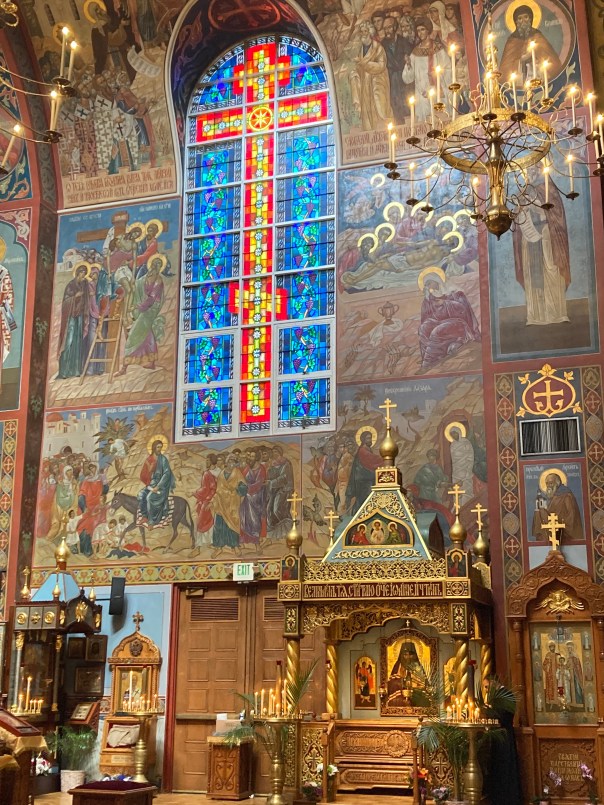
 Gladsome Lights
Thanks so much for finally informing me on why St. John wore sandals. It was always presented to me as a “Fool for Christ” thing instead of a health matter in his feet due to his sleeping sitting up. I have known about him for over 30 years and never knew that or the story about the abbess whose monastery he visited who ordered him to sleep lying down, and for one night he obeyed her due to the grace of her office, but then went back to his usual custom. As we near the end of his day, I will just say “Blessed St. John Maximovitch please pray to God for us”.
LikeLiked by 1 person
The idea of him being somewhat of a fool for Christ was one tale the acolyte grown up wanted to refute. Maybe you read elsewhere in the account of how St John would never have let himself be that type of saint because it’s not in keeping with the truth dignity and duties of the clerical office, which he took very seriously.
LikeLike