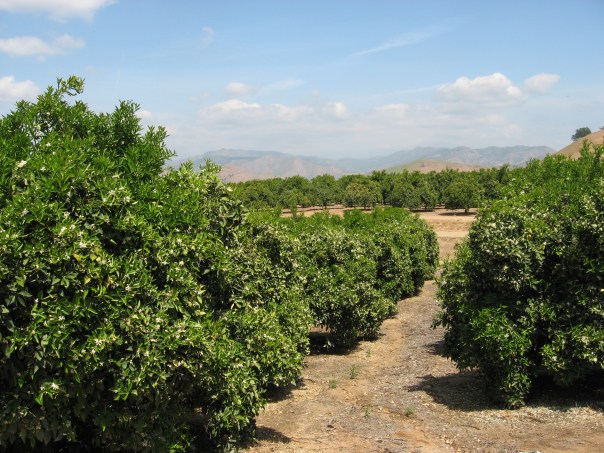
Back in the day when I lived with my family in farm country, in the midst of miles and miles of citrus orchards, my siblings and I would ramble through the groves, ours and our neighbors’, and along the private dirt roads dividing the properties from each another. All the kids did this, and no one ever suggested we were trespassing.
Once we came upon a small and shabby house with its doors and windows open, and obviously abandoned. We dared to go in, and walked through the rooms, which still contained furniture such as a kitchen table with dried up food on plates, other unwashed dishes in the sink, and personal belongings lying about. We didn’t stay long, it was too creepy, but my imagination was stirred from then until now, wondering what story lay behind the disorder. What would prompt the residents to leave without finishing dinner, and never come back? Why had no one bothered to come and clean up the mess, and make the place livable again?
That house didn’t show signs of having been beautiful at any time, but under different circumstances, it might have been. It remains for me a disturbing memory, for all the sad stories it might have been hinting at, but also because of the physical ugliness that stood as a witness to chaos. In all likelihood it has been leveled to the ground long since, and orange trees planted in its spot. I wonder if anyone else remembers it.
The poem below tells of a much richer and more nuanced experience and story. The poet Frederick Goddard Tuckerman was stricken when his wife died after the birth of their third child, and felt that as the father of the child he was somewhat guilty. Most of his poems after her death express these feelings of loss, loss of home and of the woman as the center of family life. One commentator suggests that the description of the mother, twice using the word “sat,” indicates her being frozen in time as a memory.
SONNET XVI (“Under the mountain”)
Under the mountain, as when first I knew
Its low black roof, and chimney creeper-twined,
The red house stands; and yet my footsteps find
Vague in the walks, waste balm and feverfew.
But they are gone; no soft-eyed sisters trip
Across the porch or lintels; where, behind,
The mother sat, — sat knitting with pursed lip.
The house stands vacant in its green recess,
Absent of beauty as a broken heart;
The wild rain enters; and the sunset wind
Sighs in the chambers of their loveliness,
Or shakes the pane; and in the silent noons,
The glass falls from the window, part by part,
And ringeth in the grassy stones.
-Frederick Goddard Tuckerman
Thanks to Sally Thomas for sharing this poem on her Substack page last month.
 Gladsome Lights
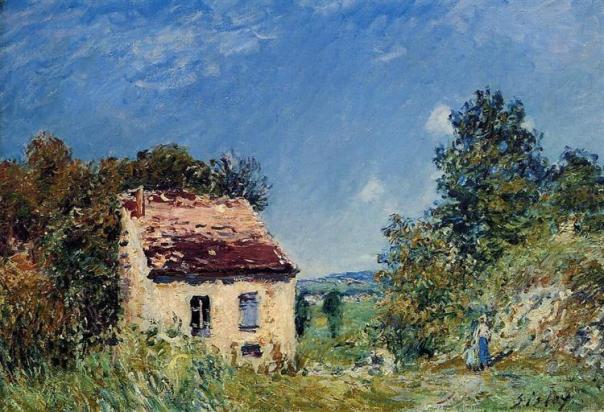
That Sisley is the perfect illustration for your story and poem. Our lives were like that too — wander about, across yards or beaches. No one cared. Now you rarely see someone walk down the beach, just for a walk. That is a sad story and you can’t help wonder what happened.
LikeLiked by 1 person
I feel drawn to old, abandoned buildings and often wonder about – and then make up – stories about them. Finding one in the state you did though is most peculiar! Your choice of poem and the painting are perfect additions to your memory 🙂
LikeLiked by 1 person
Where my uncle farmed in Canada there were many similar dwellings–unpainted wooden houses first built on the newly settled land till the more civilized house was built. My uncle’s father built a Dutch-style place (many Dutch people had settled there after they were brought over to drain the swampy land). It had a large open room with a small alcove for the parents reached by stairs from the stable where the horses were housed. Later his family rented a small retirement farm on the property of the larger farm where the parents of the current farmers lived in their retirement. When I visited in 1996 it had been empty for a time but the barn belonging to the big farm appeared to be inhabited, I suspected by a homeless person whose dog was tied to an abandoned piece of farm equipment. The area with its small family farms had been gutted economically by Kraft Cheese who bought up all the small cheese factories who bought these farmers’ milk and siphoned that industry to gigantic factory farms further west. So many abandoned houses with their own stories to tell, sad ones to me who remembered the vibrant neighborly community that existed before corporate incursion.
LikeLiked by 1 person
An interesting memory from your childhood. One wonders what the reason could have been for leaving so suddenly with food still on their plates.
I haven’t come across Tuckerman before but now I will look up more of his poems.
LikeLiked by 1 person
Your phrase “physical ugliness that stood as a witness to chaos” is evocative. It brought to mind a country phrase common in rural Texas: “Don’t be ugly.” It means don’t misbehave; get your act together; be respectful. In short, live a life well-ordered: not chaotic.
LikeLiked by 1 person
Your mention of that phrase, which I have heard, but not in person, makes me think of a compelling story I read about the vision of a certain saint, in which he heard the voice of God telling him essentially, “Don’t be ugly.” Maybe I will write a blog post about it sometime. Thank you, Linda.
LikeLiked by 1 person