Orthodox Christian, widowed in 2015; mother, grandmother. Love to read, garden, cook, write letters and a hundred other home-making activities.
View all posts by GretchenJoanna →
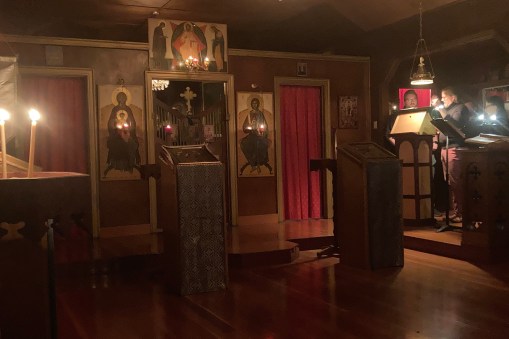
Vespers was in our little old church this evening, and very beautiful in every way. Beforehand a few of us read an akathist prayer to Mother Olga of Alaska by candlelight. I think the wood paneled walls of this church are infused with 80 years’ worth of incense; something makes it smell good even when no services have been held recently. But tonight we had fresh incense, as well as warm singing and earnest supplications.
I believe the earth exists, and in each minim mote of its dust the holy glow of thy candle. Thou unknown I know, thou spirit, giver, lover of making, of the wrought letter, wrought flower, iron, deed, dream. Dust of the earth, help thou my unbelief. Drift gray become gold, in the beam of vision. I believe with doubt. I doubt and interrupt my doubt with belief. Be, beloved, threatened world. Each minim mote. Not the poisonous luminescence forced out of its privacy, The sacred lock of its cell broken. No, the ordinary glow of common dust in ancient sunlight. Be, that I may believe. Amen.
Tessa Carman was having a conversation with Paul Kingsnorth last year, on “Following Christ in the Machine Age.” This is an overarching theme of Kingsnorth’s thinking and writing. Their conversation was leisurely and ranged over many topics, everything from books they have been reading, to Kingsnorth’s conversion, to Hollywood, to being “cancelled.” Kingsnorth lives on a “smallholding” in Ireland, so naturally the conversation turned to how we humans treat the land. I liked the point that Carman brings up, about how farmers traditionally have not been sentimental about nature, but because they “have to do” the work of caring for the land day in and day out, they develop an intimate relationship with it:
“Christians were not untouched by modernity. Especially when there’s more uprootedness — I suspect it’s easier to treat things like machines if you are used to living amongst machines. And if you’re used to taking care of a piece of land, where you have to treat it as a living thing in some sense, even if you don’t think of it as a living thing, that’s just what you have to do, because there’s a living relationship amongst the animals and the land and the people. You see that and live that, and you see the reality of it— the cycle of life and death, how manure brings life.
“If you’re in the city, you can have your image of how the natural world is instead of the reality. And there’s the danger of sentimentality, when we have disconnected ourselves from the land such that we think we can decide what’s good for the land without even knowing it, without knowing the people, let alone this specific piece of land, these animals and these plants.”
On Remembrance Day in Britain, many people join in two minutes of silence to memorialize the dead. When Malcolm Guite did that, it prompted this response:
“There was something extraordinarily powerful about that deep silence from a ‘live’ radio, a sense that, alone in my kitchen, I was sharing the silence with millions. I stood for the two minutes, and then, suddenly, swiftly, almost involuntarily, wrote this sonnet.”
SILENCE
November pierces with its bleak remembrance Of all the bitterness and waste of war. Our silence tries but fails to make a semblance Of that lost peace they thought worth fighting for. Our silence seethes instead with wraiths and whispers, And all the restless rumour of new wars, The shells are falling all around our vespers, No moment is unscarred, there is no pause, In every instant bloodied innocence Falls to the weary earth, and whilst we stand Quiescence ends again in acquiescence, And Abel’s blood still cries in every land. One silence only might redeem that blood — Only the silence of a dying God.
-Malcolm Guite
Please hear Fr. Guite read his sonnet here: “Silence”



 Gladsome Lights