Orthodox Christian, widowed in 2015; mother, grandmother. Love to read, garden, cook, write letters and a hundred other home-making activities.
View all posts by GretchenJoanna →
Though he, that ever kind and true, Kept stoutly step by step with you, Your whole long, gusty lifetime through, Be gone a while before, Be now a moment gone before, Yet, doubt not, soon the seasons shall restore Your friend to you.
He has but turned the corner—still He pushes on with right good will, Through mire and marsh, by heugh and hill, That self-same arduous way— That self-same upland, hopeful way, That you and he through many a doubtful day Attempted still.
He is not dead, this friend—not dead, But in the path we mortals tread Got some few, trifling steps ahead And nearer to the end; So that you too, once past the bend, Shall meet again, as face to face, this friend You fancy dead.
Push gaily on, strong heart! The while You travel forward mile by mile, He loiters with a backward smile Till you can overtake, And strains his eyes to search his wake, Or whistling, as he sees you through the brake, Waits on a stile.
-Robert Louis Stevenson
“Heugh” is a steep crag or cliff with overhanging sides.
“Why We No Longer But Still Could Have Beautiful Things” is something Anthony Esolen discusses in an article titled “The Ugly and the Good,” which was first published in Touchstone in 2020. This month he republished it in his Substack newsletter.
Wells Cathedral, England
Esolen begins by talking about beautiful cathedrals built in the Middle Ages:
“I’ve come to see the medieval cathedrals of Europe as the most glorious works of folk art the world has ever known…. They rose up as a lofty expression of the piety of ordinary people, the work of hundreds of men’s hands, digging the deep cavity for the foundation, hewing and setting delicate half-ton stones without mortar, mixing colors for paint or the glazing of windows, searching the forests for the tallest oaks to fell and to carve into beams to span a roof; far more kinds of work than I know and can name.
“They did it because they loved doing it. They were free.”
He contrasts freedom with license, using the example of Ebenezer Scrooge for the latter:
“To be free is not, O modern man, to be rid of all claims upon your love, your duty, your person, and your substance. If that were true, then Charles Dickens crafted a truly blithe and free spirit in the unregenerate Ebenezer Scrooge, crouching alone in his dismal flat and eating gruel gone sour. If you are talking about freedom and you are not talking about love and devotion, then you are not talking about freedom at all; you are talking about moral license, or a permission guaranteed by statutory law, that you may in some regard do exactly as you like, which may include gazing endlessly at evil pictures on your computer screen, and thus transforming yourself, cell by cell and pulse by pulse, into a thing, an automaton.”
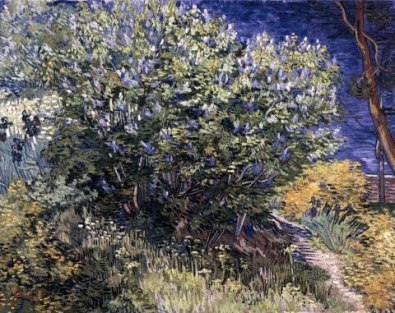
Van Gogh, The Good Samaritan
His college students ask him for a definition of freedom, because, unfortunately, many of them are puzzled by his statements about what it is not. This is his answer:
“Freedom is the unimpeded capacity to attain to the perfection proper to the kind of creature you are. But since man is made in the image of the God who is a three-personed communion of love, his perfection, the enlargement of his soul, can only come by means of a gift, by the gift of grace from God, which enables him to make of himself a gift to others. There is no truly human freedom without grace, and the love that is its proper response.”
As to modern man’s failure to develop a love, or even a desire for beautiful things, Esolen proposes three reasons. If you’re interested enough that you’ve read this far, you can read them in the article: “The Ugly and the Good”
He also exhorts us to work on the restoration of the culture we have lost:
“We must take back the heart, the chest, the seat of proper passions, which is to take back from Satan those commanding heights of the imagination, which is to reject the errors I have mentioned and to repair the harm they have done. We must not value the useful over the beautiful. We must not reduce beauty to a commodity. We must not forget that our experience of beauty should lead us back to the source of beauty, who is God.”
Esolen suggests that we spend more time cultivating an appreciation for art of every sort; and that we start with the beautiful things that are most accessible:
“Song and poetry are the most immediately available of all the arts, requiring only a human mind and a human voice. If you want a Rembrandt, you have to go see it, or carry a copy with you under your arm while you avert your eyes from the glare of the policeman. Grand pianos, with Van Cliburn sitting at them, are not to be found on every street corner. You cannot from your porch in New Hampshire gaze upon the great arms that Bernini conceived for St. Peter’s piazza, extending in the shape of a key to embrace the thousands who would come to worship there.
“But anyone can possess a song or a poem. If you have a voice, you can sing, and if you have a mind, you can remember what you sing. If you have a voice, you can utter a poem, and remember what you have uttered. In a way, you can best possess a song only by singing it, and a poem only by giving it the performance of your mind and heart and voice and body. Song and poetry should be the most democratic of the arts, more truly by the people, of the people, and for the people than anything else in our experience.”
That brings me to — Poetry Month! I have a little experience of what he’s talking about here, knowing by heart several poems from A Child’s Garden of Verses, which give me joy when I have occasion to recite them, usually to a grandchild, these days. How many songs do I know? Oh my, countless! After reading Esolen, I am extra grateful for all the songs and singing I have loved throughout my life. I am singing these days more than ever.
This short and beloved poem below, which I think I’ve shared here more than once — maybe I should compose a tune for it. Because of its simplicity and rhythm it embedded itself in my mind very easily, long ago, and years later it was right at hand to speak aloud, one night when my late husband and I were peering over a bridge into the dark, where with the help of a street light we could see ripples in the stream down below.
The tide in the river, The tide in the river, The tide in the river runs deep. I saw a shiver Pass over the river As the tide turned in its sleep.
–Eleanor Farejon
May we nurture ever more beauty, music and poetry in our lives,
and offer the joy with thankfulness up to God.
“No frail human morality can ever hope to contain the overflowing fullness of life with which Christ desires to rejuvenate the faithful.
“The world will not be saved by optimistic humanism that believes human progress and morality will eventually save the world. For Dostoevsky and the church fathers, man’s deepest problems are not moral, nor even psychological, but ultimately existential and ontological. It’s not about following the rules or feeling balanced. It is a matter of choice and it is a matter of human nature being touched by the hand of God Himself.
“Only by daring to leap towards God in spite of the good and evil that exist in the heart can the believer hope to get beyond the contradiction of the human condition. In order to avoid descending into nihilism, Dostoevsky offers his readers another path: the acceptance of suffering and affliction in the context of a relationship with God. It is only in this context that man is able to recognize a path out of his fallen condition. It is only this Love that is able to transform suffering into salvific joy.”
-Father Alexis Trader (Now Bishop Alexis of the Diocese of Sitka)
Every experience of Pascha in the Orthodox Church is going to be unique, and I suppose a person might remember past celebrations and compare one to another, but there is no question that this year was the best. Last year was the best, too. Because right now, whatever year it is, is the Pascha that has come to us now, and Pascha is a gift from Christ, from His Church, to us, His Church. We receive the Kingdom of God into our souls, just as the mercies of God are new every morning — especially Pascha morning.
“Death is over,” our rector preached this afternoon at Vespers, and the choir was even more robust than last week, with fourteen mostly big men (and several women) singing the triumphant resurrectional hymns, and many of the rest of us singing along with our favorites.
But let me backtrack to earlier in Holy Week. I spent all day Wednesday working on my red egg project. I’ll write more about that later, because to my surprise, the “experiments” continued all the way to Friday, involving about 365 eggs in all. I was still learning things this afternoon, so I will write a thorough report for the benefit of future red egg-dyers.
Our Holy Friday services, of which there are three, begin with Matins of Holy Friday on Thursday evening; it is to me one of the most beloved of all the week’s services. It is long, because 12 Gospel passages telling of Christ’s last days are read, solemnly in the middle of the church, while we hold candles and let our hearts be taken into that moment in God’s time. This year I made it to the other two services, too, on Holy Friday proper. Then I crashed.
The morning of Holy Saturday I took my turn and read the last two hours of the Psalms, by the icon “corpse” of Christ. Probably I should have been content to sign up for just one hour; I guess I was greedy! My voice was getting hoarse by the last half hour…
Then it was time for the baptisms; it was an especially meaningful day for me,
because I am the sponsor for the young woman who became “newly illumined.”
After that long service, taking most of Saturday afternoon, and the Eucharist, we had wine and freshly baked sourdough bread, to break our fast and to keep us going a little longer.
I went home and managed to take a nap before our midnight service. Orthodox Christians can’t wait until nine or ten o’clock, as we would on a typical Sunday morning, to meet and worship. Not at all. We want to be already gathered in the church by 10:00 or 11:00 o’clock, so that we can have time to process around the whole church property, and then be back at the doors to sing “Christ is risen!” as soon as the clock has changed to Sunday.
From 2010.
There came that glorious breaking forth of jubilation, with the chandeliers laden with flowers and set to swinging; ladies and children in their long white skirts, or frilly Easter dresses; deacons repeatedly walking up and down censing the whole temple; and the Paschal Homily of St. John Chrysostom, and the first chapter of John’s Gospel, starting with:
1 In the beginning was the Word, and the Word was with God, and the Word was God. 2 The same was in the beginning with God. 3 All things were made by him; and without him was not any thing made that was made. 4 In him was life; and the life was the light of men. 5 And the light shineth in darkness; and the darkness comprehended it not.
So much joy, in the risen Christ, our life and our light. What can I say? We feasted on Pascha, and then we gathered in the church hall and broke our Lenten fast together with earthly food: chocolate cake, mascarpone cheese, our red eggs, salami, chicken wings, and wine. Those were just a few items I saw at our table. I got home just after 4:00, and remarkably was able to be asleep before 5:00.
Today was the Paschal Vespers, which was richer and more elated than I ever remember. But maybe I myself was just not as tired as some years! Then the Pascha picnic, and a chance to spread ourselves on our blankets over the grass or at the picnic tables, and catch up for hours in a very relaxed way, watching the babies crawl around, and the tug-o-war competitions.
I’m going to reset my body clock tonight, I hope, and attend Bright Monday’s Divine Liturgy in the morning. For this Bright Week we will have frequent reminders of how Christ’s death ended death, and that his resurrectional life sustains us every hour of every day; Pascha continues. Christ is risen! Indeed He is risen!